Friday, December 5, 2025

Artists' Residency: Monson Arts' Residency

Monson Arts’ residency program supports emerging and established artists and writers by providing them time and space to devote to their creative practices. During each of our 2-week and 4-week programs throughout the year, a cohort of 5 artists and 5 writers are invited to immerse themselves in small town life at the edge of Maine’s North Woods and focus intensely on their work within a creative and inspiring environment. They receive a private studio, private bedroom in shared housing, all meals, and $500 stipend ($250 for 2-week programs). The Abbott Watts Residency for Photography offers access to the photography studio and darkroom of Todd Watts in nearby Blanchard, adjacent to the former home of Berenice Abbott. Click here to read more about this unique opportunity specifically for photographers.

Applications for a residency at Monson Arts are open to anyone at any stage of their career, working in visual arts, writing, and related fields (i.e. audio, video, photography, woodworking, movement, screen and playwrights). Open calls for residency applications currently take place 3 times throughout the year with deadlines on January 15, May 15, and September 15. Each application period corresponds to specific residency offerings 3-6 months out.

Residents’ studios are located in newly renovated Main Street buildings that have been designed specifically for visual artists and writers. All of our studio spaces are outfitted to be as flexible as possible so that we can accommodate a variety of creative practices. Our visual arts studios are spacious and light-filled with large work tables and sinks. Shelving and portable storage carts are available as needed. Access is available to woodshop and metal shop facilities in nearby buildings for any fabrication needs. Our writing studios are comfortably furnished with work tables, office chairs, bookshelves, and reading chairs. For those working in time and sound based media: apply to the Writing category if quiet contemplation would be best for your project or the Visual Arts category if you need room and the opportunity to make and play sounds out loud.

Residents live in newly renovated historic homes throughout town, within walking distance to studios and everything that downtown Monson has to offer. These are mostly 3 bedroom structures that are fully furnished and comfortable all four seasons of the year. Houses all have shared kitchens, bathrooms, and common areas with laundry machines, telephone, and other amenities as well. Wifi is available in all of our buildings through high speed fiberoptic service.

Application Requirements include: 

  • Up to 5 images / 5 minutes of media OR 5 pages of writing examples
  • A letter of intent for your time at the residency
  • C.V. or Resume (limited to 6000 characters)
  • Two reference names
Spring

3/30 – 4/23 – Residency – (With Abbott Watts Resident)

4/27 – 5/21 – Residency

*5/26 – 6/5 – Residency – (With Abbott Watts Resident) 2 week residency (Tuesday start for memorial day)

Our next application period will be open December 1st – Jan 15th for residency sessions taking place in the Spring of 2026. 

More information and application portal here.

Call for Submissions: The Writing Disorder

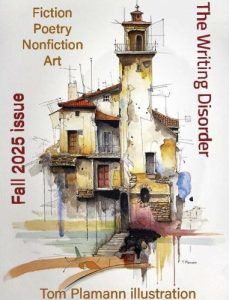
The Writing Disorder Fall 2025 cover image 


The Writing Disorder 

CURRENT NEEDS:
Fiction, Poetry, Nonfiction, Art, Reviews, Interviews, Comic Art and Experimental work.
We would like to see more poetry, long fiction, nonfiction, artwork, reviews and interviews.

FICTION & NONFICTION:
“Welcome all. We are open to content and subject matter. Please send us your best work. We seek traditional as well as experimental submissions. Our staff enjoys reading all kinds of work. As always, there is no limit on word count.” — C.E. Lukather, Editor

POETRY:
“A new season, a new issue, a new crop of poetry. As your poetry editor it is my pleasure to offer this harvest. This harvest which is impossible without you. Impossible without your careful crafting, grafting, sowing of words. Without your words nestled like seeds on the paper, peas on a page. So send us your free verse, your experimental, your form. Send us the flowers, the fruit, and the hay.” — Juliana Woodhead, Poetry Editor

ARTWORK:
We showcase artists and photographers as well. Features typically include 10-15 images (minimum 1200 pixels wide, 100 ppi, RGB, jpeg files) Include artist statement, bio, links to work, list of shows, and titles of art. We can also include video or audio clips.

MANUSCRIPTS:
We are currently accepting manuscripts of nonfiction work for publication: biographies, autobiographies and unusual life stories. For more information, please contact us at: 

info@thewritingdisorder.com 

FORMAT:
The Writing Disorder accepts Microsoft Word document (storytitle.doc or .docx) submissions by email. However, we can’t promise that it’s going to look exactly the way you had it (we are Mac users). Please attach it to your email.

NOTE: Please include your last name in the title of your Word document.
Send your fiction, nonfiction and artwork to:

submit@thewritingdisorder.com 

Send your poetry to:

poetry@thewritingdisorder.com 

Our Submission Policy
The Writing Disorder is published four times a year: new issues are posted at the beginning of Spring, Summer, Fall and Winter.

Needs:
We seek work of the highest quality, but do not have specific guidelines for style or subject matter. Check our website before submitting for any announcements. Although we look for short stories and poetry, we also publish personal essays and memoirs. Novel excerpts are acceptable, if self-contained. Reviews, nonfiction pieces, humor, comic art, and criticism are also welcome. And we love experimental work. For poetry, please submit THREE to EIGHT poems. Also, let us know what type of work you are submitting. Sometimes it’s difficult to tell whether a piece is fiction or nonfiction.

Format:
Submit one prose piece or three to eight poems. A notation of publications and awards, if any, is helpful. Poems should be individually typed either single- or double-spaced on one side of the page. Prose should be typed double-spaced on one side and can be as many pages as you need.

Deadline:
Our reading period is all year long. Submit your work at any time during this period; if a manuscript is not timely for one issue, it may be considered for another.

Submitting Your Work:
Send only one manuscript at a time online. Do not send duplicate or multiple submissions. There is a limit of four total submissions per writer per reading period (season), regardless of genre, whether it is by mail or online. Do not send a second submission until you’ve heard about the first. We cross-reference our database periodically, and if we find more than one active submission, or a fifth submission (or more) during the reading period, all submissions will be immediately rejected unread. Simultaneous submissions to other journals are amenable as long as they are indicated as such and we are notified immediately upon acceptance elsewhere.

NOTE: We accept previously published work—as long as it is not currently available online.

Submissions by Email:

Email one file to:

submit@thewritingdisorder.com

— containing one prose piece or three to eight poems. If you have a legitimate association with a staff editor you may address that editor by name in your email. You should also include a brief citation of publications and awards (less than 50 words), if any. A longer citation of credits or a cover letter may be included as the first page of your submission document. Submissions must be sent as a Word (.doc or .docx) file. Any files that don’t adhere to our guidelines will be withdrawn from consideration. In general, you will receive a faster response by email versus by regular mail.

Call for Submissions: Prism Review

Recent cover image or website screenshot for Prism Review 

We are open--send great work!

Generally, all accepted authors are paid, and all non-contest submissions are considered for our $200 Staff Choice Award: an accepted submission chosen by our staff as best embodying two things we love and respect about writing: stylistic ambition and social engagement. One author each issue will receive this award, announced with the issue's release (usually in May).

As always: we hope to read your very best, we're excited to read it, and we want more, we hope for more, we quietly plead for/demand more. Simply: we love great literature, especially literature that is urgent and/or strange, and we love all voices, be they new, emerging, or established - certainly those from underrepresented groups. We always put samples from past issues on our homepage if you'd like to get a sense of our sensibilities.

Note: Submissions are being read for our spring 2026 issue. They must be previously unpublished, and simultaneous submissions are totally fine (but please withdraw accepted pieces immediately; the lack of this practice has increased far too much for us lately). Only one submission (in any genre) at a time.

Note 2.0: We generally charge a two dollar fee so that we can do something we hope all agree is a good thing: pay all our authors, at least $40 per writer; usually we have free submission windows in early Dec and May ... and during most of June and July, we're happy to provide free submissions to any authors who self-identify as being from underrepresented or minoritized communities or simply can't afford the $2 fee. Just email our editor at:

sbernard (at) laverne (dot) edu (Change (at) to @ and (dot) to . )

for more information.

-->Excepting the student contest, current students and employees of the University of La Verne are not eligible to submit. Sorry!

Note 3.0: We are not Prism International, a fantastic journal in Canada.

Submit your work here

Call for Submissions: Ninth Letter

Ninth Letter accepts submissions to our print issues between Sept. 1 – Feb. 28.

Genre Guidelines:

For poetry, please submit 3-5 poems (max. 8 pages) at a time.

For fiction and creative nonfiction, submit one story or essay up to 8,000 words at a time. For flash, you may submit up to 3 pieces with a total word count totaling no more than 4,000 words.

If you classify your work as “hybrid,” please submit to the genre category you feel your submission most closely applies. You are welcome to leave a note in the cover letter field with any details you think our reading team would find helpful. We will make sure your submission gets to the right team and receives the attention and consideration it deserves.

Submission Fee:

We charge a $3 reading fee. Fees are waived from December 1-31 or until we hit our cap of 300 submissions per genre.

Fee Waivers:

A limited number of fee waivers are available for writers for whom the submission fee would present undue financial hardship. Please send a short email to:

ninthletter9@gmail.com 

to request a fee waiver. No proof of income or other sensitive information is required.

Publication Terms & Payment:

Ninth Letter pays $25 per poem and $100 for prose upon publication and two complimentary copies of the issue in which the work appears. Contributors also receive an exclusive subscription discount offer at the time of acceptance. Ninth Letter acquires First North American Serial Rights (FNASR). We ask that you acknowledge Ninth Letter upon reprint of your work.

Response Time:

We strive to respond to your submission within six months. Please wait until that time has elapsed before querying about the status of your submission.

Submit your work here.

Call for Submissions: The Lemonwood Quarterly

The Lemonwood Quarterly latest issue 

What to Submit

The Lemonwood Quarterly seeks the best English language short stories and plays we can find. We do not publish poetry, flash fiction, nonfiction prose, book reviews, or interviews. We are looking for superbly written stories and play pieces between 2,000 and 10,000 words. Please submit a double-spaced Word document.

We especially seek out stories with female protagonists who are well into adulthood. There’s no minimum age requirement, but if your protagonist is not at least over thirty years old or so, it could be difficult for them to carry forward the type of stories we aim to publish. We definitely are not looking for coming-of-age stories. We are excited to showcase stories with protagonists who have already passed through those earlier milestones or hurdles and are at a different point in their life.

Who Should Submit

We welcome and encourage submissions from writers of every gender, age, race, ethnicity, sexuality, and nationality —including writers without fancy degrees or previously published work, and whose perspectives might be underrepresented in the literary world. Please do not send us work that includes machine-generated or AI text.

How to Submit

We accept only online submissions through the link below. Please do not send us emails or hard copies of your manuscripts. An online submission fee of $4 to help cover administrative costs is required to complete your submission.

Submissions are read anonymously, so please do not include your name anywhere on the word document itself. You will provide your identifying information in the submission form.

When to Submit

Our magazine is quarterly, so we are frequently considering new submissions. Our submission period may close if we reach our submissions capacity, so submit early. Please submit only one story or play at a time and wait to hear back from us before submitting again. We aim to respond within one to six months. If your story is selected for publication, please wait until the issue with your piece has been published before submitting another story. If your story is rejected, please send us new work; do not resubmit previously rejected stories.

Simultaneous Submissions to other Publications are fine, but please indicate in your submissions form that the work has been submitted to another journal. If work that you have submitted to us is accepted elsewhere, please notify us immediately via our contact form to withdraw your submission.

All work should be previously unpublished in any form, including online, in blogs, or in print.

Translations are accepted. Translators should acquire translation rights from the copyright holder before submitting. In the submission form, in addition to your translation and your own information, you will be asked for a copy of the original work, the author’s name, the work’s original title, a note stating the original language in which it was written, as well as a short bio about the author.

Revisions

Please send us your work in its final fully edited form. We do not have the staff available to consider individual revisions. If you feel you must revise, please contact us via the contact form to withdraw your submission, and resubmit the newly edited piece. It may take several days for your withdraw request to be processed.

Refunds of the submission fee cannot be made after the piece has been submitted, even if you need to withdraw the work. If you withdraw a submission and you want to submit a different piece, you cannot swap them out; you must make a new submission.

Compensation to Authors for their Work 

  • The Lemonwood Quarterly pays all of our contributors a flat rate. The current rate is $200 for every story or play published in our magazine.  
  • We will nominate as many pieces as we can to annual literary prizes such as The Pushcart Prize, The O. Henry Award and The Best American Short Stories.  
  • Contributing authors will be featured on our website and will have the opportunity to submit an updated bio, a photo, and any links to their social media.  
  • Authors will receive a contract upon acceptance and payment upon publication. The Lemonwood Quarterly’s publishing agreement includes the following rights: First worldwide electronic publication rights; non-exclusive online rights on our website, and other limited rights. Copyright is retained by the author. Authors are free to resell the work, although we do ask for a 90-day exclusive from our first publication of the work. We ask that whenever an author reprints a piece that first appeared in our magazine, The Lemonwood Quarterly is given acknowledgement as the work’s original publisher. 

Submit your work here

Call for Submissions on Theme of "The Great Unknown": Wild Greens

Wild Greens is looking to publish art, commentary, essays, poetry, short fiction, handmade items, and music for our January issue.

The theme is "The Great Unknown."

Grab your hat and your scarf and embark on a journey toward the inviting horizon. Does a better tomorrow await? Take the plunge into the endless possibilities of what could be.

Submissions open through December 15. 

Submit your work here

Writing Competition: The Richard Mathews Prize for Poetry

The Richard Mathews Prize for Poetry

Book Publication • $2,000 Award
Selected Poems published in Tampa Review


1. Manuscripts must be previously unpublished. Some or all of the poems in the collection may have appeared in periodicals, chapbooks, or anthologies, but these must be identified.

2. Manuscripts must be at least 48 typed pages; we prefer a length of 60-100 pages but will also consider submissions falling outside this range. Manuscript pages should be consecutively numbered.

3. Entries should include a separate title page with author’s name, address, phone number, and e-mail address (if available).

4. Entries must include a table of contents and a separate acknowledgments page (or pages) identifying prior publication credits.

5. Submissions are due December 31. Simultaneous submissions are permitted, but the University of Tampa Press must be notified immediately if the manuscript is accepted elsewhere.

6. A nonrefundable handling fee of $25 is required for each manuscript submitted. Submissions are not complete until this fee has been sent using any major credit card via our secure online service. (There is an additional small electronic payment processing fee.)

7. The winning entry will be announced in the subsequent fall. Online submissions will be acknowledged by email.

8. All entries receive one free issue of Tampa Review. (Mailed to any U.S. address; international subscribers will receive a digital issue.)

9. Judging is conducted in accord with the Council of Literary Magazines and Presses Contest Code of Ethics by the editors of Tampa Review. Submissions are not accepted from current faculty or students at the University of Tampa. Editors will recuse themselves from judging entries from close friends and associates to avoid conflicts of interest.

Submit your entry here

Writing Competition: The C. Michael Curtis Short Story Book Prize

The C. Michael Curtis Short Story Book Prize is open to emerging writers in thirteen Southern states. Submitters must currently reside in Alabama, Arkansas, Florida, Georgia, Kentucky, Louisiana, Mississippi, North Carolina, South Carolina, Tennessee, Texas, Virginia or West Virginia, and must have no more than one previously published book.

The C. Michael Curtis Short Story Book Prize includes $5,000 and book publication for a debut book of short fiction. C. Michael Curtis served as an editor of The Atlantic since 1963 and as fiction editor since 1982 and discovered or edited some of the finest short story writers of the modern era, including Tobias Wolff, Joyce Carol Oates, John Updike, and Anne Beattie. He edited several acclaimed anthologies, including Contemporary New England Stories, God: Stories, and Faith: Stories. Curtis moved to Spartanburg, S.C. in 2006 and taught at both Wofford and Converse Colleges, in addition to serving on the editorial board of Hub City Press. This prize is made possible by a generous contribution from Michel and Eliot Stone of Spartanburg.

A $25 submission fee will accompany each submission. Manuscripts will be taken through online submission only. All manuscripts will be read anonymously by paid screeners. This contest is guided by the CLMP Code of Ethics.

Deadline: Dec. 31, 2025

Submit your entry here.  

Sunday, November 30, 2025

Call for Submissions: Guernica

 Guernica latest issue

Guernica is Open for Submissions!

We are excited to consider your work for publication. Please carefully review our submission guidelines before submitting.
 
General Guidelines
  • Submission Platform: All submissions must be sent via Submittable. We do not accept submissions via email or postal mail.
  • Familiarize Yourself: The best way to understand our editorial approach is by reading recent issues of Guernica. We encourage you to explore the magazine before submitting.
Accepted Genres: We welcome submissions in the following genres:
  • Fiction
  • Nonfiction (personal essays, reportage, etc.)
  • Poetry
  • Visual art (illustrations, photography, etc.)
  • Interviews
Please note: we do not accept pitches. Only completed pieces will be considered.
 
Original Work: We consider only previously unpublished work. (Note: We do consider previously unpublished translations of work that has been published in another language.)
 
Length: While we have no strict word limit, most pieces we publish fall within the 2,000–7,000-word range, with the majority around 4,000–5,000 words.
 
Cover Letter: Please include a brief cover letter with your submission that contains:
  • Your name
  • A short bio
  • Contact information
  • The title of your submission
Simultaneous Submissions: Simultaneous submissions are accepted. However, please notify us immediately if your work is accepted elsewhere.
 
Response Time: We aim to respond to submissions within 6 or so months.

Thank you for considering Guernica for your work. We look forward to reading your submissions!
Submit your work here.
 
Payment: $100 

Call for Submissions on Theme of "Thresholds": Multiplicity

Recent cover image or website screenshot for Multiplicity 

We invite submissions for our Spring/Summer 2026 issue:

THRESHOLDS

We halt at thresholds; we step over them. We edge back from thresholds; we move past them. We can reach our thresholds; pain and hurt can exceed them. Thresholds become a marker—in space, time, and metaphor—sometimes a pause point, sometimes a pressure point, sometimes a passing point. Some thresholds are doors. Others are platforms. Some are arched gates, strung with colorful beads or lights, promising magic on the other side. Others are darkened hallows that fill us with dread.

For this issue of Multiplicity, we want to hear about all manner of thresholds. We want to learn about the moments of standing in-between or on the verge, the moments of choosing not to enter or turning back, and the moments of pressing forward to reveal what's on the other side. Take us to the threshold. We accept essays, profiles, and narrative nonfiction up to 2,999 words, poetry (up to three poems per submitter), and original photography (up to five photographs) inspired or connected to our theme.

For accepted work, we pay $45 for prose, $15 per poem, and $15 per photograph. 

Submission Dates: November 20, 2025–January 31, 2026
Acceptances Sent: March-April 2026
Anticipated publication: June 2026


Our $3 submission fee is our way of protecting human writers and editors. It is waived without question for any writer experiencing financial difficulty. Please contact us through our website if you require a waiver.

SUBMISSION GUIDELINES:

Our literary magazine first-round review process is blind. Please do not include your name or other personally identifying information on any of the pages of your submission or in the file name of the document you submit. Your cover letter and bio will be reviewed if your work enters our final round of review.

Be aware that curation of the magazine happens inside Multiplicity Studio, where Bay Path MFA faculty and students work together during the spring semester to review submissions. Notification of accepted work typically occurs in late March or early April. For this reason, we don't expect exclusive submissions, but do let us know if your work is accepted elsewhere, so we can remove it from our cue. (And congratulations!) 

  • Prose submissions should be double-spaced, formatted in Times New Roman or a similar serif font, 12 pt., with one-inch margins all around. Please paginate and include the title of the work on each page. All work should be carefully proofread before it is submitted. 
  • Poetry submissions may include up to three poems per issue; stanzas should be single spaced and there should be no more than one poem per page. 
  • Photographs (up to five) should be original, royalty-free, and thematically relevant. Please submit in a format that can be displayed on a Web page and opened in Photoshop. JPG and PNG are preferred. Submitted images should not include vectors or layers. You may include captions, or a brief narrative to illuminate the thematic content. 
  • We will not knowingly publish submissions that are slanderous, libelous, racist, sexist, ageist, or otherwise intentionally discriminatory or offensive.
  • All works must be original and must not be subject to copyright restrictions. For each issue, the journal publishes one submission per selected author/artist. Once our final review is complete, our Editorial Board will notify each submitter of the status of their work. Please see our Usage Rights page for information about the rights we request upon publication.
Submit your work here

Thank you for submitting.

Call for Submissions: The Ranger's Almanac

Submission Guidelines

Share your stories, poems, artwork, photographs, or music inspired by any national or state forest or park. No limit on genre, so long as the location serves a prominent role.

Selected works will appear in our annual Forest & Park Service literary journal.

Compensation 

$10 — stories (1,000+ words), artwork, or music 

$5 — stories under 1,000 words, poems, reprints, or photographs

Requirements 

  • Short stories: 500–10,000 words
  • PG-13 or below
  • Text: Times New Roman, 12pt, double-spaced
  • Work must relate to a forest or park

Additional Notes

  • Multiple & simultaneous submissions welcome
  • Priority given to current/former park & forest staff
  • Music shared via QR code in final journal

Submissions may also be emailed:

rangers.almanac@gmail.com

Deadline: **February 28, 2026**

Publication: Memorial Day, 2026

Submit your work here. 

Writing Competition: The Amity Literary Prize

The Amity Literary Prize is an award honoring authors of unpublished non-fiction, fiction including novels, YA, collections of short fiction, and poetry collections. Authors writing in English—regardless of nationality, residence, or publication history—may enter the competition.

The Award winner is offered publication and a $1000 cash prize. Though only one winner will be chosen, we may offer to publish other manuscripts submitted to the competition in addition to the prize winner.

Entry Fee: $25.00 

 AMITY: Friendship. 15th Century; Middle English amyte, amiste, borrowed from Anglo-French amité, amisté (earlier and continental Old French amistet, amistiet), going back to Vulgar Latin *amīcitāt-, *amīcitās, … of Latin amīcitia, from amīcus “friendly, well-disposed” — more at AMIABLE merriam-webster.com

SCHEDULE

Accepting Submissions: October 1 through December 31, 2025.
Winner will be announced April 2026.

ELIGIBILITY REQUIREMENTS

  • Authors writing in English, regardless of nationality, residence, or publication history may submit to the competition.
  • Only previously unpublished novels, YA novels, collections of short fiction, and poetry collections are eligible. Poetry manuscripts may be a collection or a single long poem but must include at minimum 60 – 120 pages of poetry.
  • Fiction manuscripts, including collections of novellas, must be 70,000 words minimum.
  • YA must be 50,000 words minimum.

All submissions must be submitted online through the Anamcara Press website. Manuscripts should be formatted 12-point type, double-spaced, and with a decent margin all around (1” is nice).

If your manuscript is accepted by another publisher while under consideration for the Amity Literary Prize , please withdraw it from the competition by notifying Anamcara Press. Entry fees cannot be refunded.

Our books are produced as print-on-demand trade paperbacks and distributed to the trade by Ingram Book Group and its distribution partners at the standard discount. For more information, click here. They are made available to bookstores, libraries, and online retailers everywhere. Additionally, Anamcara Press distributes directly to Amazon, and has wide distribution of both eBooks and Audio books through Draft2Digital, and Dreamscape Distribution.

Fees are used as prize money for the winners, to pay for publication of the winning manuscripts and any other manuscripts chosen for publication, and to pay for promotion. No one establishes a literary press to make money. It’s a labor of love.

We practice Good Karma and look forward to receiving your submissions. Thank you for your contribution to Anamcara Press!

Submit your entry here

Writing Competition: Longleaf Press Poetry Book Prize

The prize will be administered by the editors of Longleaf Press. The winning manuscript is to be selected by Roger Weingarten, and will be published by Longleaf Press in January of 2027.

Along with publication, the winning author will receive a $1000 prize, 25 author copies, and a virtual reading.

The submission deadline is Jan. 15, 2026 through Submittable. A decision will be announced by March 15, 2026.

Submission Guidelines

  • Please submit an original manuscript in English of at least 50 pages.
  • Intimate friends, relatives, or current and former students of judges are not eligible to submit.
  • Multiple submissions are acceptable as long as they are submitted separately with separate entry fees.
  • Simultaneous submissions are fine, but please be sure to withdraw your submission via Submittable if your work is accepted elsewhere.
  • Please update any changes in contact information via your profile on Submittable.
  • No revisions to submitted manuscripts will be considered. The author of the winning manuscript will have the opportunity to edit mistakes and suggest revisions prior to publication.
  • Be sure that your document is complete and formatted correctly before uploading.
  • Individual poems in a manuscript may have been previously published in magazines, journals, anthologies, or chapbooks, but the work as a whole must be unpublished. If applicable, include with your manuscript an acknowledgments page for prior publications.
  • There is a non-refundable submission fee of $27 payable through Submittable.

Process and Ethics

Longleaf Press endorses and abides by the Ethical Guidelines of the Council of Literary Magazines and Presses (CLMP): “CLMP’s community of independent literary publishers believes that ethical contests serve our shared goal: to connect writers and readers by publishing exceptional writing. We believe that intent to act ethically, clarity of guidelines, and transparency of process form the foundation of an ethical contest. To that end, we agree to 1) conduct our contests as ethically as possible and to address any unethical behavior on the part of our readers, judges, or editors; 2) to provide clear and specific contest guidelines–defining conflict of interest for all parties involved; and 3) to make the mechanics of our selection process available to the public. This Code recognizes that different contest models produce different results, but that each model can be run ethically. We have adopted this Code to reinforce our integrity and dedication as a publishing community and to ensure that our contests contribute to a vibrant literary heritage.”

After the submission deadline, manuscripts will be divided among the Longleaf Press editors, who will select approximately 20 semi-finalist manuscripts. Roger Weingarten will then select the winning manuscript. We will announce the winner by March 15, 2026. The winner will be notified by e-mail or telephone.

Submit your entry here

Call for Submissions: The Orange Rose

The Orange Rose 

SUBMISSIONS OPEN UNTIL December 15, 2025

Send all work to:
 
theorangeroselitmag@gmail.com

We are currently accepting Fiction, CNF, Flash Fiction, Micro Fiction, Poetry, Art, and Photography.

We ask that you submit to only ONE of the listed genres at a time, and that you wait for a response before submitting again.

You may submit from one of the following:
  • One fiction or CNF piece (1,001 to 3,000 words)
  • One flash fiction piece (401-1,000 words)
  • Up to three micro fiction pieces (maximum 400 words)
  • Up to three poems (each poem should start on its own page)
  • Up to three pieces of art and/or photography All work must be previously unpublished
We are open to any genres, but will automatically reject any work that includes graphic imagery or hateful content.
 
We ask that any photography submitted not include people due to our inability to verify their consent.
 
Simultaneous submissions are allowed, but please notify us immediately if your work is accepted elsewhere. We want to congratulate you!
 
Please attach submissions as a .doc or .docx file only
 
Include a short third-person bio in the cover letter of your submission, along with any social media handles or personal website links.
 
Please refrain from telling us about your story in the cover letter – let your stories speak for themselves. The cover letter is for us to learn about you.
 
In the email subject line, use the format “SUBMISSION: [Genre]”
 
We ask for First North American Serial Rights. All rights revert back to the author after publication. If your work is reprinted elsewhere, we ask that The Orange Rose be acknowledged as the site of first publication

Call for Submissions: Blanket Gravity Magazine

What We're Looking For

Deadline: Jan. 10, 2026 

Blanket Gravity Magazine is a journal for fiction, creative nonfiction, and visual art. We are interested in moments of emotional intensity, and how their effects ring out in the bigger picture of our identities. We are looking for writing and art that explore mental health or emotional life. By "mental health," we mean art that tries to make sense of emotional struggle or uncertainty, as well as our thoughts about who we are, what other people mean to us, and the nature of the world.

For nonfiction, we hope to receive personal essays by people with lived experience of mental illness or emotional struggle.

We curate submissions for writing and art that will offer readers experiences outside their emotional pain, or a moment of interest or connection. We're not trying to erase or replace negative moods—we’re trying to show an expression of care.

How to Submit

You can read our first issue to get a sense of writing and art we are interested in.

Complete the form below for fiction and nonfiction works. We are open to simultaneous submissions, but please let us know immediately if your work has been accepted elsewhere. We accept previously unpublished writing only. Writers retain copyright after granting non-exclusive First World Electronic Rights to Blanket Gravity Magazine. The maximum length we consider is 5,000 words. Writers may indicate if they want to publish under a pseudonym or anonymously.

Payment upon publication is $40 USD per accepted submission. Unfortunately, we are not considering poetry. Works must be developed and written without use of AI.

For visual art, please email 3-7 high-quality attachments to:

blanketgravitymag@gmail.com

as well as a link in the body of the email to the artist's portfolio if available. Blanket Gravity Magazine asks for non-exclusive license to reproduce the artwork in the online and digital magazines and social media. Artists may indicate if they want to publish their artwork under a pseudonym or anonymously. Payment upon publication is $40 USD per accepted piece. Works must be developed and created without use of AI.

Optional Theme

For the second issue, we welcome fiction and nonfiction works that explore the optional theme of "Technology and Love." Selected pieces will be featured in a special collection within the issue.

Prompt: A snippet of old text history kicks off memories of an extinguished friendship. The nightly video call between a long-distance parent and their kids. A college student confides details about romancing their crush into ChatGPT. Technology has become the site of intense shared moments, in some cases fully an additional participant in a relationship. We are looking for fiction and creative nonfiction pieces that explore the role of technology in intimate relationships today, whether by facilitating connection or misunderstanding, capturing a moment in time, or other imaginative forms of engagement. How are we molded by the people we choose, and how has technology shaped the ways we love them?

Complete the submission form for fiction and nonfiction here. For visual art submissions, please email directly to:

blanketgravitymag@gmail.com

Call for Submissions on Theme of "SMUT": ELA Literary Magazine

 ELA Literary Magazine

A “new” way to look at old relationships.

We’re tired of reading the old tropes, and we’re tired of seeing the same tropes saturate the market. If we’re honest, we’re just a little tired of romance.

We want to see what happens if the one night stand doesn’t go to plan, if the second chance romance goes just as badly the second time, if the fake relationship is a little too convincing. What happens when the forbidden love is actually something horrifying, if your crush never finds out you exist, if you actually decide to date a werewolf… and we’re sure there are more!

We are looking for stories that fuel the fire, that bring passion back into the romance genre in new ways, that, true to our brand, subvert and surprise. So take those tired tropes, old and new, and reinvent them. Take the romance genre, take the concept of relationships, and turn it upside down. This is a collection of Stories Made Uncomfortably Tender!

For this issue, we are accepting smut. We are encouraging a little spice here and there; for this reason, submissions for this magazine are strictly for those over the age of 18. However, we ask as always that you include trigger warnings when submitting and we will not accept any stories that actively abuse characters, sexually or otherwise, or go to extremes when it comes to explicit content.

If you want to get a feel for what we’ve previously accepted, feel free to check out our Spotlight Series or read through our previous publications here!

Deadline: Dec. 31, 2025 

WHAT WE’RE LOOKING FOR

The joy of language is that every word has 101 different meanings. Some are obvious, as clear as written on the page. For others, you have to look a little bit deeper. Then, there are those meanings which lurk in the shadows, just out of the corner of your eye, waiting to reveal themselves only once you give them your full attention.

No matter what kind of writer you identify as, we want to read the stories that have been gathering dust in drawers and hard-drives from all over the world. So if you have a story that subverts expectations, plays on the idea of tired tropes, is a little bit twisted, or a representation of something you’d like to see appear in your genre, we want to read it!

Each of our issues will be centred around a particular theme. These are broad and will be announced when our submissions open. We encourage you to get creative with it - we want to be surprised with what we read!

SUBMISSION PROCESS

Before submitting your work for the latest issue, please check if our submission window is open.
We are a UK-based magazine and so the date is written: DD / MM / YYYY.
We will not be taking submissions for the magazine outside of this window.

To submit to our latest issue, send it as an attached Word file to:

elaliterarymagazine@gmail.com

with the subject line: Submission: NAME OF THEME.

In the main body of the email tell us a little bit about yourself, your writing process, what the story is about, and why you think it would be a good fit for the magazine! If you think your work might require trigger warnings, can you also let us know in the email. It won’t effect your chances of featuring if you have them or not, but we want to make our readers aware of any potentially sensitive material.

We aim to get back to you as soon as possible to let you know we’ve received your submission, and aim to have chosen our featured pieces two-three weeks after the closing date. We’ll then notify all of the successful authors, and give an honourable mention to our runner-ups on our social media.

After this, we begin the editing process and will keep you updated with the progress and the eventual publication date for the magazine.

Our magazine will then go live on the website and will be free to download!

PAYMENT

Unfortunately, we cannot offer payment for successful contributions; however, it is free to submit to the magazine.

Saturday, November 22, 2025

Call for Submissions: RCC MUSE Literary Journal

 Colorful abstract landscape painting with the word 'MUSE' vertically aligned in white letters.

RCC MUSE - General Submissions - SUBMISSIONS OPEN SEPTEMBER 15 THROUGH JANUARY 31

Genres (PLEASE NOTE THE LIMITS):

  • Fiction – Submit one short story (up to 1500 words max)
  • Creative Nonfiction – One piece (up to 1500 words max)
  • Poetry – Submit up to three poems
  • Art – All kinds of art accepted for print. Preferred format: JPG, 300 DPI resolution, 8 inches on the long side

Email submissions to:

muse@rcc.edu 

  • Submit poems as an email attachment in .doc, .docx, or .rtf formats only
  • Include contact information in your submission file
  • Use this subject line format: Last Name – Genre – Title of Submission (e.g., Smith – Poetry – “In Summer”)
  • No handwritten submissions accepted
  • Simultaneous submissions are allowed. Please notify us if accepted elsewhere
  • No creative work created with the assistance of AI will be accepted

In the body of your email, include: Your full name (as you would like it to appear in the journal)
Email
Phone number
Mailing address
Short third-person bio (approx. 50 words)

Authors and artists receive one complimentary copy of the issue; additional copies may be purchased. MUSE acquires First North American Serial Rights and non-exclusive reprint rights (for promotional use only).

If published elsewhere in the future, please acknowledge MUSE as the original publisher

We appreciate your patience; we try to respond to all submissions within six months.
Mail submissions to:

RCC MUSE Literary Journal
James Ducat, Editorial Advisor
Riverside City College
4800 Magnolia Avenue
Riverside, CA 92506

Call for Submissions: Neon and Smoke


Neon and Smoke latest issue

What We’re Looking For

Neon & Smoke is a home for bold fiction. We’re especially drawn to: 

  • Stories that move. Not just emotionally, but narratively. Give us stakes. Give us story.
  • Stories that mean. The kind where a sentence lands and you need to sit with it for a second.
  • Stories that sound. Bold voices. Quiet voices with teeth. Characters who command attention.
  • Stories that blend. They might wear the clothes of genre—revenge, horror, speculative—but underneath, they’re about something deeper: grief, identity, morality, transformation.
  • Fresh perspectives. We elevate marginalized voices, including BIPOC, LGBTQ+, and incarcerated writers—but we welcome all voices.
  • Unforgettable characters. Give us flawed humans (or monsters) navigating strange, beautiful, or broken worlds.
  • Emotional resonance. We love stories that linger—whether from laughter, heartbreak, terror, or awe.
  • Emotional range. Give us sorrow and joy. Stillness and chaos. Anger, love, weirdness, release. We want fiction that reflects the full spectrum of being alive.
  • Clarity with depth. We value accessibility. You don’t need to write for a panel of editors. Write for the reader who feels it in their chest.

What We’re Not Looking For

  • Fiction that relies on harmful stereotypes or gratuitous violence without narrative or emotional purpose
  • Work so abstract or insular that it leaves readers adrift—if the meaning is buried under a dozen metaphors and only visible to the writer or a lit journal editor, it’s probably not for us.
  • Stories that dwell in a single emotional register without transformation. We've read enough grief without movement, rage without reflection, or sorrow without spark.

Submission Categories & Guidelines

Flash Fiction

  • Submit 1 story up to 1,000 words (1,100 if it earns every word).
  • Standard manuscript format (.doc, .docx, or .pdf).
  • We do not accept reprints.
  • Simultaneous submissions are allowed—just notify us immediately if your piece is accepted elsewhere.

Payment: $20 flat rate for accepted original stories.

Poetry Submissions

  • Submit 1–2 poems totaling no more than 60 lines or 600 words.
  • We prefer work that fits on 1–2 printed pages.
  • The theme is a guide, not a rule—surprise us.
  • Submit as a single .doc, .docx, or .pdf file with no identifying information.
  • No previously published poems (online or in print).
  • Simultaneous submissions allowed with prompt notification upon acceptance elsewhere.​

​Visual Art

  • Submit up to 3 original, unpublished pieces.
  • Include only high-resolution files.
  • Do not include any identifying information in the files or file names.
  • We accept photography, illustration, digital art, collage, and mixed media that fits the Neon & Smoke aesthetic.​

Rights

For accepted work, we request First North American Serial Rights and First Online Rights

All rights revert to the author or artist upon publication. We ask for credit as the original publisher if the work appears elsewhere in the future.

Submit your work here

Deadline: Dec. 31, 2025 

Call for Submissions on Theme of "Para/Social": Exposition Review

Recent cover image or website screenshot for Exposition Review 

Exposition Review is an independent, multi-genre literary journal that publishes narratives by new, emerging, and established writers in the genres of fiction, flash fiction, nonfiction, poetry, scripts for stage & screen, experimental narratives, visual art, film, and comics (see guidelines below).

Wondering what to submit to us? We like to be surprised; we like writing that is razor-sharp, immediately transporting us with a strong voice and sense of place. We like work that’s thoughtful and cathartic, work that embraces conflict and isn’t afraid to take risks. We love pieces that blur the boundaries of genre. To get a better idea of what we look for in submissions, please read our previous issues. You can also follow the Expo blog to get news about latest submission and contest openings.

ANNUAL ISSUE SUBMISSIONS:

Every issue has a theme from which writers and artists can draw inspiration. We encourage those who submit to think outside the box; we look for stories that fit the theme yet make us think about it in different ways; we want work that satisfies and challenges traditional forms of storytelling.

The theme for our eleventh annual issue is "PARA/SOCIAL."

Read more about how to submit below!

PARA/SOCIAL:

Issue XI begins with an infinite tension.

Para – altered, beside, beyond, against.
Social – the networks of intimacy, recognition, and belonging we carry with us.

Joined together, these words suggest closeness without reciprocity; connection without contact. We hear it most often in the context of celebrity, cashiers, counselors, and colleagues – unreturned attachments we form out of unmet needs.

But what if PARA/SOCIAL is more than a warning label? What if PARA/SOCIAL signals possibility?

To write into PARA/SOCIAL is to explore:The tenderness of feeling known by someone who does not know you.
The estrangement of being “with” people while remaining apart.
The creative sparks that fly in parallel play — lives brushing close, never fully merging.
The edges where community becomes illusion, and illusion shapes community.

For this issue we invite work that traces the edges of intimacy and illusion. We seek longing projected across distance, the distortions of connection, and the gifts of being alongside – with or without perception and recognition.

This theme is not a verdict, but an invitation: to consider how we live beside each other, how we build connections through shadow, screen, and story, and how we might reimagine the boundaries of the social altogether.

Let PARA/SOCIAL pull you, softly or wrenchingly, in opposite directions. Let the word unravel and remake itself through your work.

Submissions for Vol. XI will be open September 15–December 15.

All work is read and given fair consideration by our editorial staff. Guidelines for individual genres are as follows:

  • Fiction. Short stories and stand-alone novel excerpts up to 5,000 words.
  • Flash Fiction. Up to three pieces of flash or microfiction. Each piece should be no more than 1,000 words; there is no minimum word count. The shorter, the better!
  • Nonfiction. Memoir, personal essays, and creative nonfiction up to 5,000 words.
  • Poetry. Up to three poems of any form and in traditional or experimental styles. Translations are accepted as well.
  • Stage & Screen. One-act plays, scenes, or short film and screenplay excerpts up to 15 pages. Please format according to the standard unpublished playwriting or screenwriting format.
  • Experimental Narratives. We love narratives in all forms. Whether it’s digital poetics, a video, or a genre-bending transmedia piece, if it tells a good story, creates compelling characters, and/or tickles our literary senses, we want it. Consider the limits of other categories and our online platform for length guidelines.
  • Visual Art. Up to five pieces of art and/or photography per submission. If submitting more than one piece of art, please compile into one file (PDF or otherwise). Please include a brief artist’s statement or statement about the work (1–3 paragraphs), and include appropriate credit lines for all pieces (Artist Name, Title of Work, Year. Medium, Dimensions.)
  • Comics. Comics should be self-contained, up to three pages per piece, with no more than three pieces per submission.
  • Film. Short films in live-action narrative, documentary, or animation up to 15 minutes in length. Please include a brief summary and credits list in the cover letter of your submission.

Author receives $50.00 USD for accepted work.

Submit your work here. 

Call for Submissions: Allium: A Journal of Poetry and Prose

Recent cover image or website screenshot for Allium 

Fiction, Nonfiction, Poetry, and Multimedia submissions are now open through February 15, 2026.

Fiction, Nonfiction, and Poetry Submission Guidelines

Allium, A Journal of Poetry & Prose publishes three issues each year: two online issues (Fall and Summer) and one print issue (Spring).

Allium uses Submittable to manage our submissions. There is a $3.00 reading fee

Allium’s submission window opens November 14. We read work February through May. Accepted work will appear in one of three future issues: Fall Online 2026, Spring Print 2027, or Summer Online 2027. Placement will be at the editor’s discretion.

Allium accepts simultaneous submissions. If your work is accepted elsewhere, we ask that you notify us immediately. Previously published work (social media, blogs, personal websites) and AI-generated work will not be considered.

For POETRY, Allium requests a maximum five poems (up to seven total pages) with no more than one poem per page.

For PROSE (fiction, creative nonfiction, craft essay, hybrid), Allium requests a maximum of fifteen pages (3,750 words, double-spaced, 12-point Times New Roman font). Extra poems or pages will not be read.

Please do not submit more than once in each genre for each reading cycle.

Submit your work here.

Call for Submissions: Rat Bag Lit

To answer your first question and save you some scrolling: we are a semi-pro paying market with a rate of 1c USD per word, up to a maximum of $20 per short story.

We are open for submissions for Print Issue #2!

We will be accepting submissions for creative non-fiction flash, poetry, fiction flash and short stories up to 5k (varies by call). We accept reprints for Flash and Short Story. We will also have optional paid submissions for short stories up to 5k when free subs fill and our new “unhinged rat-jection feedback” option.

We publish a new microfiction or drabble piece Monday through Friday on the Rat Bag Lit substack. Stories are available for free for 4 weeks, before switching to a subscriber-only archive.

Our first print issue is currently in the works and is expected to be released on March 15, 2026 in both print and digital formats.

We will OPEN for unthemed micros (up to 300 words) and our monthly drabble themed call “Anti-Resolutions” on December 1st.

Keep an eye on our socials or joining our mailing list for exclusive surprise, unscheduled calls. Follow the submission manager link immediately below for our most up-to-date calls and payment information:

Fiction that crosses genres and blurs the lines between literary and genre. Work that keeps us up at night, stories that make us laugh, and the strangest dreams that pop out of your odd little noggin. Bold ideas, tight prose, snappy dialogue, speculative elements. Something we haven’t seen and, hell, maybe something we’ll wish we hadn’t. Mysterious, haunted mansions, crackling campfires, electric space stations, lonely abandoned farmhouses. That story that you hold close to your heart but has been rejected a billion times, but you keep sending it out because you believe in it, damnit? Yeah. Send us that one.

Yes to aliens, alternate worlds, apocalyptic game shows, bigfoot, blue collar, cats, cemeteries, coming-of-age, cosmic, cryptids, cults, cursed objects, dark, dating fails, dystopian, elder millennials, embarrassing moments, female narrators, food service, gen x, ghosts, girl power, gothic, grim reapers, grumpy unicorns, fairytale revamps, found family, haunted mansions, hidden worlds, horror, humor, liminal spaces, mermaids, modern-day wizards, mythology revamps, occult, ordinary people finding portals, paranormal, post-apocalyptic, sad robots, secret societies, squishy soft science fiction, shitty roommates, snark, social commentary, silly, steampunk, stoners, swapped gender roles, supernatural, talking animals with bad attitudes, teenagers, time travel, tongue-in-cheek, underdogs, unreliable narrators, urban fantasy, weirdos, witchcraft

Probably no to action / adventure, all vibes no story, boring stories, children’s stories, celebrities, cliches, cozy, dead wife/husband/parent/partner, emotional manipulation, espionage, excessively purple prose, hate of any kind, historical fiction, humor that denigrates, kids with cancer, military fiction, modern politics, mystery, political satire, rage bait, religious fanaticism, sappy romance, sword & sorcery, thriller, tired tropes, tragedy, werewolves, vampires, zombies (Have a story that you think we’ll like despite it being listed as a no? Try it anyway. We love being surprised and have accepted at least one story including one of these.)

We don’t want:

No AI-generated stories. If it didn’t come from the depths of your own weird brain, we don’t want to read it. We will not consider stories written, co-written, created, or assisted by AI and machine-learning languages such as ChatGPT. We do not use AI-generated images.

No hate speech. We aren’t interested in your bigotry, homophobia, racism, sexism, or transphobia, or anything along those lines. We are an inclusive publisher.

No fan fiction. We won’t publish anything that violates someone else’s copyright. We’d prefer you come up with your own characters and worlds. The exception to this being mythological fiction, in which case, make it modern and interesting as you breathe new life into old (public domain) tales.

No song lyrics. Song titles are usually fair game in fiction, but song lyrics require permissions that we rats aren’t able to obtain. We’d prefer not to have to reject a great story because of song lyrics.

No hard-core erotica. I mean, if you send us something hot, we’ll read it, but if you make Ratty blush, we probably can’t publish it. That being said, we are not prudes. If you can walk the line without crossing it, by all means, send it in if you think it fits our vibe. (To save you a rejection: we are very unlikely to publish your penis poetry, which we see far too much of in our queue.)

No hard-core violence and gore. We don’t want to read it, even with a trigger warning. Keep it off-page please. This includes violence directed at animals.
A NOTE ON CONTENT WARNINGS

Our first readers don’t necessarily need content warnings, but we would appreciate you including them if you feel like one might apply for a general reader. If you worry that a content warning might be a spoiler, you can include it either at the bottom of your manuscript or in your cover letter. This helps us as we decide which pieces should have a content warning for publication and has no impact on our submissions process. We plan to use the list in this article as a starting point.
don’t self reject

If you love your story and think it fits our vibes, why not take a shot and send it our way? Worst case, you’ll get another rejection to add to your pile, and maybe we’ll love it. We are an inclusive publisher and welcome submissions from writers of all demographics. We especially want to hear from underrepresented voices

PUBLICATION SCHEDULE

We publish a new drabble or microfiction piece every weekday (Monday – Friday) on the Rat Bag Lit substack. (We know this platform is a bit problematic, but we hope you’ll forgive us until we find a better option that suits our needs and technical abilities.)

Our first print publication has a scheduled release date of March 15, 2026. Issue #2 is scheduled for October 15, 2026. We will post any updates to our publication schedule here and on our social media.

We accept unsolicited submissions written in English. Most submission categories are free, but we do have a paid option for longer short stories and/or when free short story submissions are full for the month. We also have a paid “rat-jection” feedback option. We appreciate your tip jar submissions.

We do not charge our authors any fees for publication beyond the optional fees listed above. If free submissions are closed and paying a submission fee presents a financial hardship to you, email us for assistance.

We accept fiction, creative non-fiction, and poetry in the following categories:

Drabbles – monthly themes, exactly 100 words, no more, no less, with a maximum 15 word title. For digital publication – Pays $1. You can submit up to two at once. No reprints.

Micros – maximum 300 words. For digital publication – pays a penny a word up to $3. No reprints.

Flash – 1000 words maximum. Pays a penny a word for print/digital publication, up to a maximum of $10, Reprints half-rate, up to a maximum of $5.

Creative Non-Fiction – 1000 words maximum. Pays a penny a word for print/digital publication, up to a maximum of $10. No reprints.

Short Story – 1001 words up to a maximum of 5000* words. Print/digital publication, Pays a penny a word, up to a max of $20, Reprints half-rate, up to a maximum of $10. (*3.5k-5k stories are limited to the paid submissions category for originals and the reprints category for reprints).

Poetry – We’ll be honest, we aren’t super familiar with poetry, but we’re willing to take a look at what you’ve got. Experimental, speculative, non-rhyming, non-traditional… Sure, why not? We won’t know any better. Make it weird, keep it short, maximum 300 words. Pays a penny a word up to $3 for print/digital publication. You can submit up to 3 at once. No reprints.

More information and submission link here. 

Writing Competition: Robert H. Winner Memorial Award

Robert H. Winner Memorial Award: $2,500

For a manuscript of 10 pages by a mid-career poet who has not had substantial recognition. Open to poets 40 and over who have published no more than one full-length collection of poetry. Poets who have not published a poetry collection are eligible.

Previously published poems are acceptable; include acknowledgment of publications on your cover sheet. Poems entered as part of a Winner manuscript may be entered individually in other PSA awards, if they haven’t been previously published.

Judged by Michael Dickman

Established by the family and friends of Robert H. Winner, whose first book of poems appeared when he was almost fifty years old.

Submission Details & Instructions 

  • Awards are free for Poetry Society of America members.
  • The fees for non-members are: single poem awards are $10, and multiple poem awards are $15.
  • Personal identification cannot appear anywhere in the submission document, including in the file name.
  • Only one entry per award.
  • You cannot submit the same poem to more than one award.
  • The exception: Individual poems submitted to the Alice Fay Di Castagnola Award or Robert H. Winner Award may be submitted to another PSA award.
  • The submission must not have been previously published or accepted for publication.
  • The exception: Individual poems submitted to the Alice Fay Di Castagnola Award and the Robert Winner Award may have been published.
  • Simultaneous submissions are fine; if the poem is accepted elsewhere for publication, please withdraw the submission.
  • Submissions written by more than one author are not eligible.
  • Translations are not eligible. All poems must be original and primarily in English.
  • A poem that has previously won a Poetry Society of America award cannot be resubmitted to any of the awards.
  • We cannot accept corrections after submission.
  • Submissions from Poetry Society employees, officers, advisory board committee members, or their immediate families are ineligible.
  • All submissions are judged anonymously.

Notification 

  • We cannot confirm receipt over the phone or email.
  • We cannot accept any corrections or revisions to submissions.
  • The winners will be announced in late spring.
More information and submission portal here

Writing Competition: 7th Annual Story Foudation Prize

We are proud to announce our seventh annual Story Foundation Prize is now open! The winner will receive $1500 and publication in our summer 2026 issue for a single short story.

This year’s judge is Deesha Philyaw, whose most recent book is the award-winning story collection The Secret Lives of Church Ladies. Submissions for the Story Foundation Prize opened on August 15, 2025 and will close at midnight PST on December 15, 2025.

Submit one short story of up to 10,000 words via our Submission Manager.

Our entry fee is $25. Each entrant receives a one-year subscription (three issues) to Story.

Please double-space your manuscript.

Multiple submissions and simultaneous submissions are welcome, but you must pay a separate fee for each entry and withdraw the piece immediately if accepted elsewhere.

Entries must be previously unpublished. All entries will be considered for publication at our regular rate. Previous winners of the Story Foundation Prize are not eligible.

Winners will be announced in March 2026.

Questions? Please contact us via email at:

contact@storymagazine.org

We look forward to reading your work!

Call for Submissions: Shift: A Journal of Literary Oddities

The reading period for Issue #8 (2026) runs from October 15, 2025, to January 15, 2026.

We will respond to contributors by May 31, 2026.

Please send us your best work! We accept simultaneous submissions—but NOT previously published work. During our reading period, please notify us by email if you wish to withdraw a piece for any reason, including acceptance by another journal.

We value human creativity and effort. We do not accept work generated by AI or assisted by AI beyond basic spellcheck and grammar check.

Please read these directions carefully. You may submit a total of five (5) pieces to Shift across all categories.

Each one requires a separate submission.

We do NOT consider groups of poems.

Please fill out a form for each submission.

We read blindly during our initial review. Please remove your name and contact info EVERYWHERE in your Word document. This means no name in the document header or in the document title. We will be able to track your submission through the Google form. Include only the word count, page numbers, and title.

Name the file with the initials of your first and last name and keywords from the title (all in one word). For example: SWLiteraryTale

Submission Forms (will reopen on October 15, 2025)

Fiction form (under 4,000 words)
Nonfiction form (under 4,000 words)
Poetry form (under 75 lines)
Art/Photo/Image form (in a JPEG with a resolution of at least 300 dpi)

Answers to additional FAQs

  • We do not charge a reading fee.
  • Each contributor to the journal will receive one complimentary print copy of the issue.
  • Published work may be nominated for Best of the Net, Pushcart, and other awards.
  • Authors whose work particularly dazzles us might be invited to participate in Ringling’s Visiting Writers Forum, a conversation series with authors and other literary professionals:

www.visitingwritersforum.com

  • Please direct any journal-related questions to our email.
  • Again, we do NOT accept AI-generated or AI-assisted work.
Visit their website here

Monday, November 17, 2025

Pushcart Prize Nomination

 Many thanks to Mathieu Callier for nominating my micro-fiction, "Red," for a Pushcart Prize! You can read it here.


Fellowship: Martha's Vineyard Institute of Creative Writing

The MVICW Emerging Writer Fellowships are open to all writers who have yet to publish a full-length book or chapbook. These fellowships continue MVICW's mission of supporting new writers from all backgrounds, genres, and ages (16+) in their creative endeavors at our Summer Writers' Conference.

Deadline: Jan. 19, 2026 

FELLOWSHIP PRIZES:

One Full Fellowship Winner will receive the Full Attendance Package to the MVICW Summer Writers' Conference which includes registration, lodging, and a manuscript session.

One Second-Place Fellowship Winner will receive 50% toward registration for the MVICW Summer Writers’ Conference

Please note: We only announce the names of our first place winners on social media and in our public announcements. Finalists will not be announced.

SUBMISSION GUIDELINES:

DO NOT INCLUDE YOUR NAME IN THE TITLE, FILE NAME, SUBMISSION, OR LETTER OF INTEREST. Submissions will be judged anonymously.

For Poetry Submissions Letter of Interest (approx. 750 words): Please tell us about who you are as a person and an artist. We'd like to hear about your life, your artistic career, and your creative work. If you have specific needs (financial or creative) which would be met by this award please outline them in your letter.
Submit your single best poem (1-3 pages max)

For Prose Submissions Letter of Interest (approx. 750 words): Please tell us about who you are as a person and an artist. We'd like to hear about your life, your artistic career, and your creative work. If you have specific needs (financial or creative) which would be met by this award please outline them in your letter.
Submit one short story OR one flash fiction piece OR novel excerpt OR creative nonfiction entry. (The submission should not exceed 3,000 words).

Please Note: If your submission exceeds our guidelines, we will submit either the first 3,000 words of your prose submission or the first poem of your poetry submission.

ADDITIONAL GUIDELINES: 

  • Payment is $20 per submission. You are welcome to submit more than one piece by submitting them separately and paying the submission fee for each entry.
  • The entry must be submitted in English and must be your own original work.
  • You may submit new or previously published material. As the manuscripts will not be published/reprinted, the author retains all rights to the work.
  • There is no restriction to style, content, or genre.
  • You must not have published a full-length book or chapbook
  • You must be 16 years old or older on the day the retreat begins to enter.
  • The submission must not include your real or pen name or any information that identifies you in any way.
  • You must submit before midnight on the deadline date.
  • Previous First Prize Fellowship & Contest Winners (who attended the in-person conference) are not eligible to apply. However, second-place winners and all virtual conference winners are eligible.

DETAILS ON AWARDS AND RULES:

One fellowship recipient will receive registration, lodging, and a manuscript session at the MVICW Summer Writers’ Conference. The lodging for full fellowship recipients is a triple room with two other attendees at MVICW lodging. If a private room is preferred, the winning writer may choose to pay the difference. The prize does not include lodging outside of MVICW shared-lodging, but the winner may choose to forfeit the lodging stipend and arrange for their own accommodations on the island. The awards do not cover air/travel to the island or food/personal expenses. One runner-up recipient will receive 50% toward registration for the MVICW Summer Writers’ Conference.

You are not eligible to enter the competition if you are (a) our employee or independent contractor of MVICW; (b) a family member (spouses, domestic partners, parents, grandparents, siblings, children, and grandchildren) of our employees; (c) a judge involved in the competition, including any reviewer who participates in selecting the nominees and finalists; (d) a close friend of the judge so that the judge can identify your work; (e) a previous MVICW full fellowship/first place contest winner. However, first place winners of our Virtual Conference Fellowships are eligible to apply in hopes of winning attendance to our in-person conference.

We will notify potential winners via email or telephone. If potential winners decline the prize or fail to respond within seven (7) days after the first contact, the winners will be deemed to forfeit the prize and MVICW has the right to select alternate potential winner(s) in their place.

Send your entry here

Call for Submissions: The Shared Drafts Project

The Shared Drafts Project celebrates the vulnerable, the flawed, and the too-much. We don’t want polish — we want pulse.

This issue invites the kind of writing meant for you, not others — the notes, reminders, and quiet reflections that catch who you are in the moment. The pages that help you think, process, or simply make sense of a day or yourself or something else.

We are not accepting poetry, prose, fiction, or short stories. We’re only reading journal-style entries — reflections, notes, and fragments written for yourself, not for an audience.

They can come from but are not limited to:

Notebooks
Notes apps
Audio Recordings
To-do lists
Creative logs
Sketchbooks
Planners

Rules
Just send one thing.

Must follow a journal format in the form of self reflection or something written for yourself.
For writing, maximum 5 pages in length.

Submission Window: November 15, 2025 - January 15, 2026
If your piece is selected, you will hear from us by February 20th, 2026.

Honorarium: $5.00 for selected works. 

Submit your work here.

Sunday, November 16, 2025

Call for Submissions on Theme of "Sabotage": Muleskinner Journal


Black-and-white illustration of a mule standing in profile on a light gray background. The drawing is detailed, showing the mule’s head, ears, body, and legs with fine shading and line work. 

Submissions for Journal Sixteen open!

Our theme: Sabotage

So fun to say.
It thumps like a shoe dropped into the gears. It smolders like a slow fuse lit under the floorboards.

For Journal Sixteen, we are looking for sabotage.Sweet or bitter. Large or small. It might be a quiet refusal, a deliberate misstep, or a coded message. It might be a love letter thrown away by a jealous friend. It might be the body rebelling against itself, a system collapsing from within, a character who undermines their own desires. It might be the artist’s hand trembling on purpose, the poem that undoes its own logic, the narrative that eats its tail.

As always, we invite you to interpret this theme liberally—bend it, twist it, betray it. Sabotage it, if you must.

Send us your beautiful wreckage, your quiet detonations, your elaborate ruses, and your betrayals of self. We’ll be listening for the sound of gears grinding, the machinery silenced.

Muleskinner Journal Sixteen will close on December 15.

Our submission guidelines are here. Do your worst. It’s Sabotage!

What we look for…

Muleskinner Journal accepts previously unpublished work only. Please use the following guidelines for your submission. Submit in only one category. Send no more than one submission per issue.

Poetry: Any length or form. (1-3 pieces)

Flash or Micro Fiction: max. 1000 words each (1-3 pieces)

Short Story/excerpts from longer (previously unpublished) work: (max. 6000 words) Please include word count on first page

Creative Nonfiction: (max. 3000 words) Please include word count on first page

Manuscript Guidelines…

We accept unsolicited general submissions for free, through Submittable.
We have a Tip Jar. It’s voluntary. But’s it’s there to help us offset costs and build toward paying our writers. Someday. Soon.

Submissions should be in .doc or .docx format and the file should be titled: Last Name_Title or Last Name_Poems.

Prose submissions should be sent in Times New Roman or similar, 12pt font, double-spaced, always, with numbered pages.

For prose, include the word count at the top of the first page.

Simultaneous submissions are fine — we’re writers too, after all — but let us know if your piece is accepted elsewhere.

Include a short, third-person bio - we want to know who you are, and include any social media handles you would like us to share.

No more than one submission per issue.

Feel free to inquire about the status of your submission if you haven’t heard back after a month. We try to be quick.

No re-submissions of the same work unless a revision was specifically requested.

And finally, when you send us a submission, we will add you to our mailing list. This will never be shared with anyone. You can unsubscribe at any time. We ask that you stay on our mailing list as a way of staying with the community we are building. We won’t send you too much, and we won’t send you advertising. If you do unsubscribe, you may always resubscribe yourself, but we will not auto-subscribe you again, no matter how many times you send us your work to consider. In short, we respect your Inbox.

We look for writing of all kinds that uses skill, wit, and determination to deliver the goods. We accept and publish poetry, short fiction, flash fiction, micro-fiction, short scripts, excerpts from longer works, memoir, criticism, craft essays, artwork, journalism, and shopping lists.

We don’t care who you are, as long as you are the author of what you submit.

And, we hate to have to say this, but please respect yourself, your readers, and other writers, and do not do that silly and shameful AI thing.

Submit your work here

Call for Submissions: Little Fruits Magazine

Send us the fruits of your labor.

We want your ripest writing. Tart, rotten, or dripping with sweetness. Please keep within word counts and genres.

Currently accepting:

flash fiction (max 1,000 words)
short fiction (max 2,500 words)
nonfiction (max 2,500 words)

We’re honored to consider your little fruits.
 
where to submit
 
Please submit via Google Form here.

Oxford commas required.

Follow manuscript format (see here), with author’s name and word count on the first page, double-spaced, Times New Roman (or similar), and page numbers.
 
the fine print

We don’t accept work that has been published or made with AI (ask your friend to edit instead). Simultaneous submissions are allowed, but please email us if you’re accepted elsewhere. We do not accept work that is violent, derogatory, or graphic without purpose.

By submitting to Little Fruits Magazine, authors agree to grant us first serial rights upon acceptance. This means we ask for the right to be the first to publish your work, whether online or in print. After publication, all rights revert to the author. We request acknowledgment if the work is republished elsewhere (e.g., "Originally published in Little Fruits Magazine").

Since we are still little fruits, we do not pay. We also do not charge reading fees. 
 
Deadline: Jan. 31, 2026

Call for Submissions: Mizna

Recent cover image or website screenshot for Mizna 

Submissions now open until December 1, 2025 11:59pm CT

Upcoming Issue

The upcoming issue is not responding to a theme and we will accept writing on any subject. Nonetheless, we also recognize a need to center work that is modulated to the realities of our current moment.

We seek writing which explores the realities and identities related to the SWANA (Southwest Asian and North African) sphere both in the region and in diaspora. We especially welcome writing in relationship to SWANA people and places which are currently targeted by empire and tyranny, from Armenia, to Palestine, to Sudan, and beyond.

Contributors

Contributors do not need to be SWANA- or Arab-identified and can be based anywhere in the world, but work submitted should be considerate of Mizna’s ethos and the social realities of our audiences, as well as aim to contribute to ongoing conversations in and beyond our communities. While we welcome submissions from former contributors seeking a space for their work in this urgent moment, we also especially encourage submissions from writers who have never been published by us before. We encourage submitters to become familiar with work that has been published in Mizna before submitting work.

Forms of Writing

Mizna has long been a home for literature with innovative, experimental forms and is published with high quality print production practices. We welcome visual poetry submissions or hybrid works that cross the arbitrary boundaries of genre. In general, literary works of poetry, visual poetry, fiction, flash fiction, nonfiction, creative nonfiction, comics, collage, invented forms, and any forms of mixed print or hybrid work will be accepted, with consideration to the physical parameters of our print journal, technical staff, and budget. We do not consider visual art submissions.

Submission Details

> There are no submission fees.

> Selected contributors will receive a $200 honorarium, a one-year subscription to Mizna, and five copies of the issue.

> Please include a short cover letter (max. 200 words) with the following: Titles of all submitted pieces
Indication of any simultaneous submissions
For prose over two pages, a 1–2 sentence overview of the piece
Author bio (max. 50 words)
Any additional information you would like the editorial team to know (max. 1 paragraph)

> File types must be .doc or .docx or PDF for pieces with more complex layouts. We do not accept other file types (e.g. Pages, Notepad, JPEG).

> Prose submissions should be double spaced and limited to 3000 words.

> Pitches for essays will not be accepted, please submit only complete and finalized drafts.

> Poetry submissions should be limited to four poems of any length (verses exceeding our page width will be treated with a runover indent).

> Please only submit once per submission period.

> Please do not send visual art submissions.

> Submissions that do not adhere to these guidelines are subject to being discarded unread. Submissions outside the open call window will likely not be considered or receive response.

> Pieces are chosen by Mizna editorial staff and a regularly changing selection committee. Accepted pieces will be contracted to be published in print after an editorial process involving authors. Mizna will hold rights to publish online or in future publications, but authors will hold copyright. Emails will be sent out for rejected pieces but regrettably we do not have capacity to provide feedback or editorial support.

About Mizna

For over 25 years, Mizna has promoted experimental approaches to art, literature, and film; work that questions and expands the forms and conceptual frameworks of Arab and SWANA culture. We publish a biannual print literary and art journal, Mizna, and Mizna Online, a digital platform for literary and multidisciplinary work reflecting critically on the current realities of the SWANA region and beyond. We produce the Twin Cities Arab Film Festival, the largest and longest-running SWANA-centered film festival in the Midwest. Mizna also offers readings, film series, performances, public art commissions, and community events that have featured 1000+ local and transnational writers, filmmakers, and artists.

Submit here.