Monday, December 29, 2025

Call for Submissions: WisteriaMagZ

WisteriaMagZ is a print and digital collective working to uplift underrepresented stories through art and writing. 

We are an alternate frontier for social change, focusing on creating a platform and community for marginalized groups to share their voices.

Storytelling is central to helping us all understand each other despite our different backgrounds, ideologies, identities, and perspectives. It tugs on the threads that run through all of us, reminding us of our shared humanity. This is the mission that is central to the work we do at Wisteria Magazine.

Who can submit?

  • Emerging and independent writers.
  • Artists and visual storytellers.
  • New and unpublished voices. 

Guidelines

  • Original work only
  • No plagiarism
  • One category per submission
  • Previously unpublished preferred

Format

  • Written work: PDF/DOC (up to 1000 words)
  • Art work: JPG/PNG (high quality)
  • Films: Google Drive/YouTube Link

Include your name and title of work, along with social media handles.

Email: wisterialynemagz@gmail.com

Subject line: Submission-Category-Your name

Submissions are free. 

Sunday, December 28, 2025

Call for Submissions: Bottle Rocket Literary Magazine

Bottle Rocket is a literary magazine publishing works of prose under 1000 words. Like the magazine’s name suggests we are looking for work that soars before bursting into wild sounds and colors. Short prose that dazzles and leaves an impression long after it has been read.

There are no hard and steadfast guidelines here other than that the work should be original, previously unpublished and skew literary. We accept submissions and publish on a rolling basis. To submit, email up to 3 stories as a .doc or .docx file to:

bottlerocketlitmag@gmail.com

We aim to respond to all submissions within one week, though likely much faster.

Call for Submissions: the Thieving Magpie

the Thieving Magpie is a new digital literary magazine for new and emerging voices and visions. We are seeking good writing, inspired art and unbound imagination. Short Fiction. Poetry. Essays. Photography. Art.

We are looking for original material only, i.e. first-ever publication.

We accept submissions through our electronic submission portal or email to:

submissions@thievingmagpie.org 

We do not accept submissions through post/mail. You may submit manuscripts for the following categories: Fiction, Poetry, Essay, Interview (for interviews, please query first). Manuscripts must be in one of the following file forms: .doc, .docx, .rtf, .pdf, .txt, .odf, .mp3, .mp4, .mov, and .flv.

Please submit one complete story, essay or interview; poems in sets of three; one short film or documentary of up to 15 minutes.

the thieving Magpie is a free, non-profit organization. To make our platform as accessible to as many voices as possible, we do not charge a reading fee. We also do not pay our writers and artists if we accept their work. We do highlight the work of each writer and artist on our regularly changing dynamic front page on a rotational basis and on our social media outlets.

Be sure to indicate whether the submission is Fiction, Poetry, Essay, Art, Photography, or other format of visual art. Parameters and dimensions of visual art will be provided on request.

Call for Submissions on the American South: Callaloo Literary Journal


Callaloo is a journal devoted to creative work by and critical studies of the work of African Americans and peoples of African descent throughout the African Diaspora. We accept original submissions of scholarly articles, book reviews, interviews, nonfiction essays, short fiction, poetry, and visual art. Studies of life and culture in the Black world are also published regularly in Callaloo, as is wide-ranging cultural criticism. Callaloo is a quarterly journal. We accept submissions through Submittable during our open reading period.
 
Callaloo seeks submissions for a special issue to commemorate the journal’s 50th anniversary. In 1976, Callaloo was founded to create a space for writers from the US South whose voices had been overlooked or excluded from mainstream American literature. The issue, guest edited by our co-editor for Poetry Tyree Daye, will feature pieces by Southern writers or those living in, working in, or observing the South from another regional vantage point. We seek poetry, fiction, creative non-fiction, scholarly articles, book reviews, interviews, and artwork for a survey of the contemporary arts and letters landscape in the South. 

Deadline: Feb. 14, 2026

All manuscripts must be double spaced (except poetry) and submitted only as a Word document (.doc or .docx). We suggest that prose manuscripts not exceed 6,000 words (excluding the abstract and references in the case of scholarly articles), although we will consider submissions of up to 10,000 words if the piece truly merits the length. All manuscripts should follow the MLA Style Manual and Guide to Scholarly Publishing (3rd edition) and include a works cited and endnotes, not footnotes. Callaloo's Style Guidelines can be downloaded here.

IMPORTANT NOTE: All submissions made to the journal are considered final drafts. In order to honor our publisher's production schedule, manuscripts accepted for publication in Callaloo must be forwarded to our Production Editor immediately, allowing contributors no time to make revisions. Before submitting your work, please be sure that the manuscript being uploaded is the version you wish to ultimately see in print.

Poetry submissions are limited to no more than six poems at a time (all in a single document) with a maximum of twelve poems by an author per calendar year. Additional poems (unless requested by an editor) will automatically be declined.

Prose submissions are limited to one manuscript per submission with a maximum of three submissions by an author each calendar year. Additional prose submissions (unless requested by an editor) will automatically be declined.

Artwork must include the following information: title of piece, year created, media, dimensions (in inches), location of the piece.

We do not accept any unsolicited material that has been previously published.

Please do not send revisions during the time your manuscript is being reviewed; those revisions will not be considered during the review process.
 
Submit your work here

Call for Submissions: Colorado Review

Colorado Review Fall Winter 2025 magazine cover image 

Colorado Review pays its writers and artists: $300 for short stories and nonfiction; $100 for poetry; and $100 for cover photography.

Like most literary magazines, we ask that anyone submitting work be familiar with our publication. You may purchase sample copies from the website (see the “current issue” or “back issue” pages). We also feature recently published stories, poems, and essays on our website. Somehow, please read what we publish and see if your work and our vision are a good match before you submit.

We accept submissions for fiction and poetry between August 1 and March 31.

Colorado Review purchases First North American Serial rights and pays $300 for short stories and nonfiction pieces. We pay $100 for poetry. Payment for cover art is $100. Published writers/artists also receive two copies of the issue in which their work appears, as well as a one-year subscription.

Nonfiction manuscripts, book reviews, and cover art are considered year-round. Please do not submit fiction or poetry to the nonfiction or cover art categories during the summer.

The fee for online submissions is $3. We do not charge for book review or cover art submissions.

Please include a brief cover letter.

Simultaneous submissions are accepted; writers must notify us immediately if the work is accepted elsewhere.

We consider only previously unpublished work.

We accept translations of previously published or unpublished work. Please upload proof of permission to translate with your submission document.

We strongly encourage writers to be familiar with our magazine before submitting to it. Examples of work published in Colorado Review are posted on our website; sample print copies are also available for $10 (issues before Spring 2020) or $12 (issues from Spring 2020 on), including postage. Digital copies (as PDFs) are available for $5 each. Visit our website to order.

It is not necessary to query us first.

If Colorado Review has published your work in the last two years, please refrain from submitting so that we may continue to feature new voices.

Note: By submitting, you agree to let us occasionally e-mail you relevant announcements. But the last thing we want to do is annoy you; there will always be an easy way to opt out in every e-mail.

Submit here

Call for Submissions on Theme of "Lost Civilizations": Blink-Ink

Blink-Ink #62 literary magazine cover image 

Blink-Ink

Lost Civilizations

The Silurian Hypothesis

Extreme geological forces of nature make our Earth something like a gigantic trash compactor. Physical evidence of anything at all doesn’t last long. This and the great age of the planet might imply that civilizations as advanced or even more advanced than our own have come and gone. Civilizations that are completely lost to us today. Or are they? 

Send us your best stories of approximately 50 words to do with Lost Civilizations: The Silurian Hypothesis, in the body of an email to:

blinkinkinfo@gmail.com 

Submissions are open December 1st, 2025 through January 15th, 2026. No attachments, poetry, bios, or AI generated content please.

Call for Submissions on Theme of "Temper & Testimony": Vassar Review

Recent cover image or website screenshot for The Vassar Review 

For our eleventh edition, the Vassar Review seeks to address an era of bearing witness. We live in an economy of believability, where testimonies are not taken at face value—they must be maintained through labor. A testimony can voice experiences of injustice; testimonial narrative can, as Cuban author Miguel Barnet articulates in his theory of the testimonio, reveal the urgency to make an event or a situation of oppression public. However, the believability of one’s testimony can also reflect their power and resources; it can reflect the ability to wield affect and emotion in one’s favor. Can one’s temper strengthen their testimony, or render it obsolete? How are temper and emotions facets of writing that can distort, establish, or influence the truth? The synthesis of temper and testimony allows for robust discourse about how emotion and truth are expressed in our world—in politics, personal narratives, court and the pursuit of social change. Just as glass and steel are tempered, we want art, prose and poetry that encourages the strength of truth. And, like the process of tempering, we are curious about how emotion can strengthen one’s chosen artistic or literary medium. We are looking for your strangest truths, your unwritten testimonies, your work that bears witness to the truth. In this edition, we will celebrate the pursuit of truth, which is, after all, the closest we can get to a global recollection of what is real.

The Vassar Review is a revival of the literary arts journal published by Vassar College from 1927 to 1993. Each edition approaches its theme as a subject for a discourse of contemporary works across mediums.

The journal is released annually in the spring in print and online. We will be accepting submissions relating to the theme of “Temper & Testimony” from November 25th, 2025 until January 15th, 2026.

We accept a range of work including poetry, prose, sculpture, soundscapes, performance, scripts, digital media, and beyond that relates to this year’s theme. Bilingual texts and excerpts from longer dramatic works such as screenplays and graphic novels are also considered. We do not accept works previously published in print but will consider previously exhibited visual work. Simultaneous submissions are allowed but require that artists notify editors if the work has been accepted elsewhere. All contributors retain copyright over their individual works.

Submit your work here

Call for Submissions: Northwest Review

Recent cover image or website screenshot for Northwest Review 

Founded at the University of Oregon in 1957, the Northwest Review publishes fiction, poetry, creative nonfiction, flash fiction/nonfiction, translations, and art. Located in Eugene, Oregon, the journal will always welcome work related to the Pacific Northwest, but we are a national magazine, open to writers beyond borders and limits. We love innovation in form and style, but prize literary quality above all. Surprise us, transport us, immerse us, entertain us, move us—give us your best.

We are open to both new and established writers. We have published Pulitzer Prize and National Book Award winners, but we also love nothing more than discovering new voices, particularly those from marginalized backgrounds.

Authors receive $25 per poem and up to $75 per short story/essay. Please allow six months before querying. Due to the volume of submissions, we may not be able to respond to individual queries.

For poetry, please send one to four poems at a time (and no more than 10 pages). Short fiction and creative nonfiction should range between 1,000 and 9,000 words. We also accept flash fiction and flash nonfiction of up to 1,000 words (please submit no more than three per submission).

We accept simultaneous submissions but please let us know ASAP if your work is accepted elsewhere. We only accept writing that has not been previously published. Do not resubmit work even if it’s been revised, unless a revision is requested by the editors.

Please submit your work via Submittable. The small submission fee we charge helps keep the lights on and ensures we can publish writers at all stages of their careers.

NWR is an independent nonprofit digital magazine produced in partnership with the University of Oregon’s Editing and Publishing Program. In our 70 year history, we have introduced the world to major American writers: NWR published Ken Kesey's first short story in 1957 and George Saunders' first short story in 1986. In addition, we've published literary luminaries such as Ursula K. LeGuin, Louise Erdrich, Raymond Carver, Barry Lopez, William Stafford, James Dickey, Charles Bukowski, and Joyce Carol Oates. Shuttered in 2011, NWR was relaunched in 2020 by S. Tremain Nelson and published writers such as Major Jackson, Hilary Leichter, Matthew Dickman, Maurice Carlos Ruffin, Jay McInerney, Joe Wilkins, Destiny O. Birdsong, Faylita Hicks, and Michelle Peñaloza. Now back in Eugene as a mostly digital publication, the Northwest Review continues to build on its esteemed legacy to find a new generation of American voices.

Our professional genre editors select all NWR content but work in close collaboration with both undergraduate and graduate student editors to produce each issue. NWR provides UO students with opportunities to gain valuable experience in literary editing and production. We also employ a team of volunteer editors, who help us find the best work possible. Most of the work we publish is found through the slush pile. Although we are a digital publication, we hope to eventually expand to publishing print anthologies and books of fiction, poetry, and creative nonfiction.

Submit your work here

Call for Submissions on "Food Outside of Cities": Kitchen Work

Kitchen Work Issue #11 will be devoted to stories about FOOD OUTSIDE OF CITIES!

Please send us writing about markets, cafes, remote picnics, tiny kitchens, and big dinner tables in your favorite location. The deadline to submit for Kitchen Work Issue #11 ‘Off the Beaten Path’ will be announced soon.

We accept submissions of up to 3,000 words about…
∙ foods and wines themselves
∙ cooking
∙ markets
∙ cookbooks
∙ restaurants
∙ personal gastronomic histories
∙ lunch breaks
∙ picnics
∙ culinary educations
∙ politics of food
∙ food and physiology
∙ personal profiles
∙ hospitality
∙ family traditions
∙ the best meals ever

Submissions to kitchen work are gauged for literary quality, focus and intrigue, and not for gastronomic sophistication. We are eager to print stories about fine dining, and also about your mother’s corned beef, or a 14-year-old’s impressions of her school lunches. Of course, all submissions about the work of the kitchen are especially welcome.

Recipes and bottle notes: in addition to general submissions, kitchen work™ also seeks submissions for recipes and bottle notes—a section of the journal devoted to favorite recipes or bottles of wine. These should include the recipe itself, or the name of the wine, and 500 words or fewer about its significance or some experience with it.

How to Submit

1. Send all inquires to:

submissions@kitchenwork.com

2. Write a brief (100 words or fewer) cover letter in the email body, including word count, and characterization of the submission as non-fiction, fiction or poetry, or of the illustration.
3. Please submit writing as attachments formatted in Microsoft Word or with Google Docs. Illustrations may be submitted as PDFs.

Terms

Only previously unpublished works will be considered for publication. Accepted submissions will receive responses within 30 days of submission.
Current Rates

Authors of accepted submissions are paid $0.20 per word. Illustrators are paid $100 per accepted illustration. This payment buys first serial rights in our print and digital editions; the copyright reverts to the author immediately upon publication.

Saturday, December 20, 2025

Call for Submissions: Shared Drafts Project

Shared Drafts Project is a space for the work that has nowhere to go, for the writers who were told they don’t know how to write, for the things we wished we could say out loud.

The Shared Drafts Project celebrates the vulnerable, the flawed, and the too-much. We don’t want polish — we want pulse.

This issue invites the kind of writing meant for you, not others — the notes, reminders, and quiet reflections that catch who you are in the moment. The pages that help you think, process, or simply make sense of a day or yourself or something else.

We are not accepting poetry, prose, fiction, or short stories. We’re only reading journal-style entries — reflections, notes, and fragments written for yourself, not for an audience.

They can come from but are not limited to:

Notebooks
Notes apps
Audio Recordings
To-do lists
Creative logs
Sketchbooks
Planners

Rules
Just send one thing. 

  • Must follow a journal format in the form of self reflection or something written for yourself.
  • For writing, maximum 5 pages in length.
  • Submission Window: November 15, 2025 - January 15, 2026
  • If your piece is selected, you will hear from us by February 20th, 2026.

Honorarium: $5.00 for selected works. 

Submission link here.

Call for Submissions: The Santa Clara Review

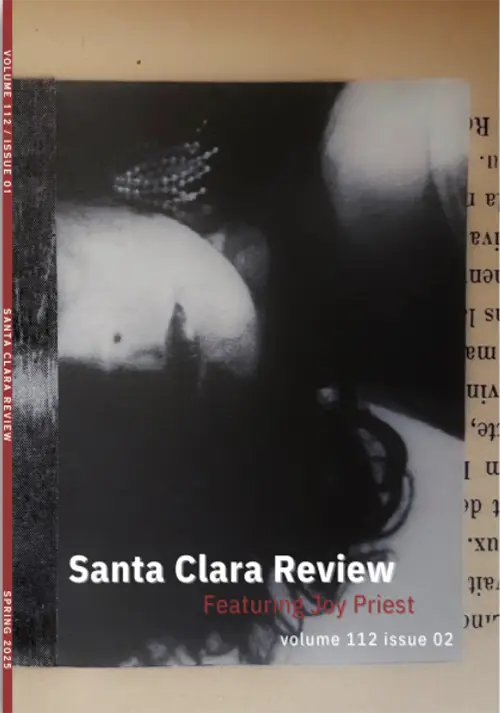
Cover of Santa Clara Review Volume 112 Issue 02 featuring Joy Priest, with a black-and-white abstract photograph and red spine text. 

The Santa Clara Review accepts submissions from September-October for our first annual issue and from December-January for our second annual issue.

Submissions are now open from December 1st through January 15, 2026!

We accept prose, poetry, and art via Submittable.

Please submit works of fiction or nonfiction prose under 6,000 words. Please submit no more than five poems or pieces of artwork at a time. Simultaneous submissions are allowed, as long as we are notified immediately if the piece is accepted for publication elsewhere.

Call for Submissions: Feels Blind Literary

Feels Blind Literary welcomes submissions of short fiction, creative nonfiction, plays, and art from new and emerging creatives who are women, nonbinary, trans, genderqueer, genderfluid, agender, etc.

 Deadline: Jan. 31, 2026

Submissions for Issue #13 should be sent to:

feelsblindliterary@gmail.com 

Please include a short bio written in the third person.

The submission fee is always waived on Mondays.

​​We are adamant about not creating a barrier in terms of who can submit and how often, which is why every Monday is a free submission day during opening reading periods. On other days, we have decided to start collecting fees. Here's why—we've noticed many literary magazines and organizations expressing solidarity with social justice movements and we've been considering how to do the same. Feels Blind Literary is committed to speaking out against social and environmental injustice, police brutality, and unconstitutional attacks on our bodies and the free press. With that being said, we didn't feel just saying we're committed to these causes was enough. Rather, we knew we needed to demonstrate that commitment in tangible ways, both by continuing to elevate marginalized voices in the work that we publish and by raising money for causes we believe will help directly combat the -isms in this country.

​As such, all non-Monday submissions must include a $3 submission fee through our donation tab.

A portion of the fees for this reading period will go directly to a nonprofit addressing these issues in a tangible way. For this cycle, submission fees for Issue #11 with go to Aid Access, one of the largest suppliers of abortion pills in the country. The site enables women to pay on a sliding scale based on need and other women can donate to help offset costs for those in need. They also ship abortion pills discreetly to all 50 states. They reported receiving 10,000 requests for the medication in the first 24 hours after the election was called, so they could use all of the help they can get. We also are launching a special issue to coincide with AWP and all submission fees will go to ECDC, an organization based in Silver Spring, Maryland and Arlington, Virginia providing crucial services for refugees.

Call for Submissions: New Letters

New Letters latest issue 

New Letters reads submissions all year long. We only accept work submitted through Submittable, our online submission manager. There is a small fee for submissions, though fees are waived for current subscribers. You may subscribe to the magazine here.Please send no more than six poems, one chapbook, one piece of nonfiction, one short story (graphic or traditional), or one novella per submission.
  • Send one submission at a time.
  • Put your name, postal address and email address at the top of the first page of the submission.
  • We generally publish short stories that are no more than 5,000 words; novellas that are no more than 30,000 words or roughly 60 pages; graphic short stories in comic spreads up to ten pages and in color or black and white; and chapbooks that are no longer than 30 pages.
  • We consider simultaneous submissions if you (a) let us know and (b) notify us immediately if the work you sent to us has been accepted for publication elsewhere.
  • Like most literary magazines, our staff is small and the volume of submissions large; please be patient. We make every effort to respond to submissions within six months.
Book Review Guidelines 
  • New Letters is primarily—but not exclusively—interested in reviewing excellent books (even movies and visual art) otherwise not receiving much attention in the national media. We also like books that have something important to say about culture, politics, aesthetics, or any kind of art; that includes scholarly, critical, or biographical books that could find a non-specialized readership.A single-book review will run 500 to 900 words, usually; essay-reviews of groups of books run longer. The review should merit its length. 
  • If you have a potential conflict of interest, you should mention that connection in the review.
  • Negative appraisals can be included as part of reviews; however, if the review is substantially negative, we prefer simply to ignore the book.
  • New Letters pays, typically, $25 for book reviews; payment is not guaranteed but made as resources allow. 
Artist Guidelines 
  • New Letters publishes photographs, drawings, paintings and even, at times, photographs of three-dimensional work. Although placement in the magazine sometimes creates a resonance with a particular piece of writing, we generally do not use art to illustrate the writing. Art in New Letters is there for its own sake.
  • We have two principal standards for selecting art: Is it fresh, interesting, high-quality work; will it effectively reproduce on the pages of this magazine?
  • Please note these criteria and suggestions:We have no preferences for subject matter or style. We evaluate each work of art on its own terms, based on how it will serve the needs of the magazine.
  • Send professional resume information and one or two (at most) sample works of art. Do not send art without professional background information.
  • Send sample low-res images by email to:
 NewLetters@umkc.edu 
 
or direct us to a website where we can view your work.
  • There is a small payment for work after publication. The amount varies, depending on grant revenue.
  • We usually respond within three or four weeks.
 Format & Style Tips
  • Our only fixed requirement is good writing, and we have no rigid preferences as to subject, style, or genre.
  • We are open to critical discourses about writing, art, or culture, as long as that writing is, in itself, lively, fresh, and vivid.
  • We do not read unsolicited email submissions, nor do we respond to such submissions by email.
  • Double space prose.
  • We suggest generous margins (consider 1.5-inch side margins for prose and at least that for poems).
Rights & Payment
 
We buy first North-American serial rights. All rights revert to the author upon publication. New Letters is among a group of literary magazines that actually pay writers & artists, albeit modestly. Payment to contributors also includes two copies of the issue and 50 percent discounts for additional copies and subscriptions.

Writing Competition: The Winter Anthology Contest


Recent cover image or website screenshot for The Winter Anthology Contest

An elegiac perspective.

A will to sustain the analog humanities as long as possible without naïveté regarding their eclipse by newer paradigms.

An argument that the finest works of contemporary art are systems balanced at the edge of chaos, at points of equilibrium between complexity and clarity.

Please send as much poetry or prose as you like. Whole manuscripts are welcome. Send writings of which you are the sole author and that were written during this millennium. Published and unpublished writings are equally welcome. To get a sense of our aesthetics, see our previous volumes. All work will be read first by the editors, then passed on this year's judge, Srikanth Reddy, who will pick the winner.

Multiple entries in multiple genres are welcome.

The deadline is January 10th, 2026. The winner will be declared in February 2026. 

Entry fee: $11.00

The winner will be published in Volume 16 of The Winter Anthology and receive a $1000 honorarium. Finalists will also be considered for publication.

To enter electronically, go to: thewinteranthology.submittable.com/submit

Call for Submissions: Chicago Story Press Literary Journal

Recent cover image or website screenshot for Chicago Story Press Literary Journal 

We publish essays and creative non-fiction stories. We love pieces that illuminate the human experience. We value narratives that delve into the emotional complexities of life, share insights, stir empathy, and provoke deeper understanding. Beyond telling us what happened, show us the impact it had on you and others.

Submission Guidelines:

  • Length: Must be 1,000-3000 words.
  • Must be based on a true event that happened to you.
  • Format: Submissions must be in a Word document. DO NOT SEND A PDF.
  • Original Content: We seek original, unpublished work.
  • Submissions are taken only through Submittable.
  • Simultaneous submissions are acceptable, but please let us know if your piece is accepted elsewhere.
  • $5.00 submission fee to help defray the many costs of running a literary journal. If you are unable to pay this fee, please contact us.
  • We will pay you $25.00 upon publication of your piece. We pay only through PayPal.
  • It's important to note that you will retain full ownership of your piece and the copyright reverts to you upon publication. If you decide to publish your piece again, please mention that it was first published by Chicago Story Press.

Note:

We may suggest light edits to your piece. Please make sure it has no misspellings or grammatical errors.

Requirements:

The author guarantees that he/she possesses sole ownership of his/her personal narrative, that it is a true story, and that he/she is the sole owner of the copyright and its content.

Moreover, the author assures that he/she did not commit plagiarism in relation to his/her story and ensures that its contents are entirely his/her creation.

The story must not contain libelous, illegal, sexist, racist, homophobic, legally obscene, defamatory and intentionally hateful contents.

Now Indexed in EBSCO

We are proud to announce that our literary journal is now included in EBSCO’s prestigious literary database, which is accessed by 90% of colleges and universities worldwide. This partnership expands the global reach of our authors' work, making it more accessible to scholars, researchers, and readers around the world.

Why the Fee?

To cover the costs of running our journal, we charge a small reading fee. This fee supports the time-intensive process of reading hundreds of submissions, selecting and editing the pieces we publish, and maintaining our digital platforms. Importantly, none of this money goes into our own pockets—we are a volunteer team committed to supporting authors.

Writing Competition: Porter House Review Editors' Prizes

Recent cover image or website screenshot for Porter House Review 

Porter House Review

2025-2026 Editors’ Prize

The Porter House Review staff is excited to announce our 2025-2026 Editors’ Prizes in Fiction and Poetry. This year’s contest will be judged by James Frankie Thomas and Carl Phillips. This contest will open on December 15, 2025 and close on January 31, 2026. Winners and finalists will be announced in late Spring 2026. 

Contest Rules & Guidelines

One winner will be selected in each genre. The winners will each receive an award of $500 and publication in our journal. First and second runners-up will receive $200 for fiction and $50 for poetry. All submitted works will be considered for publication.

The submission fee for this contest is $10.00. However, between January 5-7th, this submission fee will be waived. While we rely in part upon submission fees to pay our contributors, we are also dedicated to offering free submission periods as we recognize these fees may present a hardship to submitters. Whether a submission was received during a paid period or a waiver period will have no bearing on its consideration by our editors and judges.

Fiction

We seek to publish fiction that is emotionally affecting, haunting, bizarre, and in firm control of the machinations of storytelling (e.g. character, scene, plot, and momentum). We welcome both traditional short stories, flash fiction, and other hybrid forms.

Please limit your submissions to 5,000 words or fewer. Submissions should be typed, double-spaced, paginated.

Poetry

We seek poetic works that capture experience by reinvigorating the language of the everyday, or surprising readers with novel, rarefied text. We are particularly interested in poetry that champions inventive forms and content.

Submit a maximum of 5 poems or fewer. Please include the number of poems you are submitting in your submission title.

Other General Notes

All entries will be read blind. To that end, please remove your name and any other identifying information from your manuscript. Texas State University students, alumni, and faculty members are not eligible.

Please send work that is previously unpublished. Simultaneous submissions are accepted, but please immediately withdraw from our contest if you place your work elsewhere.

Finally, all work must be submitted through our Submittable portal. We do not accept paper or emailed submissions.

Submit your entry here.

Call for Submissions: Prose Poems Magazine

Please read our submission guidelines carefully. Anything that doesn’t follow the guidelines below will be deleted.

Prose Poems is an online-only publication, though we may branch out to broadsides or limited print editions at some point. We only publish prose poetry, but short-shorts and flash fiction are fine, as long as they are a paragraph. Each poem should be a page long, maximum. Please, do not send any other styles (free verse, formal verse), or individual poems longer than a page. Simultaneous submissions are fine. Please submit a one-paragraph author biography with your submission. No attachments please. Simply paste your poems into the body of an email (or send as a PDF). Please don’t send more than five poems, and if rejected, please don’t submit again right away unless requested to do so.

Simultaneous submissions are encouraged, but please notify us if your work is accepted. We do not accept previously published work. Also, please only submit one batch of poems at a time, and please don’t submit more than once in short success unless requested.

Translations are allowed, but only accept side-by-side translations; if you are submitting a translation, you must have the rights to reproduce the original text as well.

Important: No AI-generated or ChatGPT-produced work. Robots (and tech bros) are boring.

Issues Per Year: I am very active outside from spring through fall. (Mostly hiking and looking for Moths.) But I live in Minnesota, where SAD SEASON (no bugs!) runs from November-March. That’s where the magazine comes in: I plan to publish one issue per month in the winter months.

Issue Basics: Each issue will have four poets, with two prose poems each.

Payment: I think it’s important to pay authors, even though I don’t have a lot of money to do so. (I run this from my couch, so it’s not exactly the Paris Review and their bazillion-dollar soirees.) So here’s the deal: I’ll pay each author $10 for their two poems/pieces. At four authors per month, that’s $40/month. I can afford that.

To get paid, you must provide an email address for Paypal; if you want to forgo the payment, I’ll transfer the $10 to a slush fund to use on the magazine or to pay our authors.

Submit to:

prosepoemsmagazine AT gmail.com (Omit spaces and change AT to @ )

We will never charge for submissions because that is incredibly lame. If anyone wants to donate to help fund the magazine or its authors, you can do so here. (I will not use any of the donated money for my personal use; it will only go to funding the magazine or special projects–broadsides, perhaps–or to our authors.)

Monday, December 15, 2025

Best Microfiction Nomination!

What a lovely surprise to find in my email this morning! This little piece, "Red," was already nominated for a Pushcart Prize by Mathieu Cailler, Author, a Pushcart winner from last year.

 
And now, the editors of The Sunlight Press have nominated the same story for Best Microfiction. Many thanks to Rudi Patel and Beth Burrell at The Sunlight Press for their support!


Saturday, December 13, 2025

Call for Submissions: Fresh Words: An International Literary Magazine

Fresh Words: An International Literary Magazine

We are open for submissions. We invite poems, short stories, essays, plays, diaries, excerpts from books (published or upcoming submitted by author only), book reviews, interviews and travelogues. Please send all submissions to:

freshwordsmagazine@gmail.com

as per the following guidelines:

Poetry:

3 to 4 poems (all themes and forms).

Short Stories: 

  • Maximum 2 stories
  • Word limit for each story (maximum 500 words)

Essays:

  • Topic must be literary.
  • Maximum 2 essays
  • Word limit for each essay (maximum 1000 words)
  • Send a summary of the work

Plays:

  • Maximum 2 submissions.
  • You can send one-act play (Maximum 15 pages for each work).
  • Also send a summary of the work.

Diaries:

  • You can send parts of your daily diaries and your observations about life.
  • Maximum word limit 1000 words

Excerpts from books. For Upcoming books:

  • You can send maximum 5 pages of your novel
  • You can send maximum 5 pages of your full length/ one act play
  • You can send maximum 2 poems of your poetry book 
  • A note (maximum 100 words) about the publisher and website from where it will be available

Book Reviews:

  • Two book reviews at a time (maximum 500 words for each)
  • Book review must mention (on the top right hand corner)the name of publisher, ISBN (if any), year of publication, total pages of book, weblink of book or website of publisher

E-Interviews:

The interested author/s may send an email to us with detailed literary achievements for consideration.

Travelogues:

  • Share your travelling experiences with the world
  • maximum word limit 1000 words
  • Do not forget to include your website and social media links at the end of text
  • You may share up to 10 pictures of your travel, in case they are available.

General Guidelines:

All submissions must contain a cover letter and a short literary profile (Maximum 70 words) of author in third person narrative.

All submissions must be sent typed in MS Word or PDF doc as attachment with the email.

The author should mention:

Legal Name:

Pen name (if any):

Snail mail address:

In the Subject line of your submission email please clearly mention the category like 'Poetry Submission' or 'Short Story' submission etc.

The author must send a high resolution photo of self as a separate attachment with the submission.

Simultaneous submissions are welcome but please immediately inform us in case they are accepted elsewhere.

Call for Poetry Submissions: Belmont Story Review


BSR 9 Cover.png 

What We're Looking For 

Belmont Story Review seeks to publish new and established writers who are passionate about their craft, fearlessly encounter difficult ideas, and seek to surprise and delight readers through an eclectic mix of storytelling at the intersection of faith and culture. We feature works of fiction, creative nonfiction, and poetry. Please see our FAQ page for common questions we receive regarding submissions.

Terms and Conditions

Within your submission, please include a brief author bio. If applicable, include the following in your bio:

Major publications and awards

Any association or past correspondence with a guest or staff editor

Past publications in BSR

Due to the volume of submissions we receive, we ask that authors submit only ONE piece of prose total (choose to submit either Fiction or Nonfiction, not both). Poets may submit up to FIVE poems maximum. Please submit poetry in a single document.

Belmont Story Review pays honorariums in the form of a check in US dollars ($100 for prose, $50 for poetry). In addition to this pay we are also happy to provide a complimentary copy of the magazine. More copies can be purchased at bookshop.org.

The honorarium payment to selected contributors can only be offered to those who are able to receive a US check. Because we are a university-sponsored magazine, we must request a W-9 form from all our contributors in order to be paid by check. For those who cannot receive US checks (i.e. outside of the US or Canada), we can pay in kind with additional copies of the magazine (three total) but cannot issue monetary payment.

Submissions will not be accepted after the deadline. We do not accept pieces that have already been published or revised submissions.

You should expect to receive word on your piece’s status by April 1 during the year of volume publication via the email you provide with your submission. If you have not received an email by that date, please feel free to contact us. Our volumes are published annually in the fall.

Submit your work here

Deadline: Jan. 21, 2026

Call for Submissions on Theme of "Labor": The Arkansas International

Recent cover image or website screenshot for The Arkansas International 

The Arkansas International invites the world’s best writers and artists into conversation with each other and with readers who yearn for depth, complexity, and delight. We are eager to read your work!

We welcome previously unpublished general submissions of fiction, poetry, essays, comics, and works in translation. To get a sense of what we publish, read previous issues on our website.

Submit to Issue #20, the Labor Issue.

We are now open for submissions for themed issue #20, due out in the fall of 2026. This issue will be both online and in print.

Send us your stories, poems, comics, and non-fiction about all the ways we labor, whether emotional, physical, or mental. How does labor form and inform our lives? What does our work say about what we love, or about what or whom we care for? What does it reveal about what we hate or fear? Hired labor, hard labor, labors of love, or laborious revenge, all of it creative fodder. Send us your best work by January 15, 2026!

General Guidelines

  • For all submissions, include a brief cover letter and bio.
  • Prose submissions should be no more than 8,000 words, poem packets no more than five poems, and we ask that excerpts from longer works be self-contained. Please submit all work in one document.
  • Simultaneous submissions are welcome, provided we are notified in the event that a piece is accepted elsewhere. Please do not submit more than a single story, essay, or poem packet until you have heard back from us about your previous submission.
  • Submissions of translated works must include a copy of the original text. Before submitting translations of works that are not in the public domain, translators should identify the rights holder and obtain a statement that the rights to publish an English translation are available.
  • We assume you are human and do not accept work produced by artificial intelligence (AI) generators or similar.
  • If you need to withdraw any or all parts of your submission, please withdraw via Submittable For partial withdrawals of poetry submissions, add a message to your submission.
  • While we no longer offer free submissions, we are happy to provide waivers to those identifying as BIPOC or in need of financial assistance. For more information on how to apply, please email editor@arkint.org.

Response time:

On average, we respond within three to six to months, although sometimes longer due to the volume of submissions received. We continue to review submissions and will be in touch as soon as we can. We are unable to respond to general status queries. Should you need to be in touch with the editorial team, Submittable message is the best way to do so.

Beginning with issue #19 in spring 2026, the unthemed spring issue will be online only, while the themed fall issue will be both in print and online. Fiction contributors will be paid $25 per 500-word page and poets will be paid $25 per page, with payments capped at $200. All contributors will receive a one-year digital subscription. In addition, contributors to a print issue will receive two complimentary copies of the issue. 

Submit your work here. 

Writing Competition: The "London" Literary Prizes: The /tEmz/Review

Recent cover image or website screenshot for The /tEmz/ Review 

Cost to enter: zero. Free entry!

Submission dates: Nov 1, 2025 to December 31, 2025

Results: Announced in April, 2026

Categories: Poetry and prose

8 Awards:

First Place Poetry (Canadian)
Runner-Up Poetry (Canadian)

First Place Poetry (International)
Runner-Up Poetry (International)

First Place Prose (Canadian)
Runner-Up Prose (Canadian)

First Place Prose (International)
Runner-Up Prose (International)

First-place entries will receive a $200 (CAD) cash prize and publication.

Thanks to a generous anonymous donor, runner-up entries will receive $100 (CAD) cash prize and publication.

Rules: You can submit up to three poems in the poetry category (please submit them all in one file), and a maximum of one short story in the fiction category. Short stories must be a maximum of 5000 words. You can submit to both the poetry and fiction categories.

You must submit original work that has not been published in any other context and that has not won any other contests.

AI is not allowed in any capacity for this contest.

All submissions will also be considered for publication in Issue 35, so please do not submit the same piece both for the contest and for that journal issue.

Theme: There is no theme. It's thematic and formal anarchy! Just submit something that's really good!

How to submit: Please submit through our Moksha submissions portal. Include a short bio as your cover letter, and clearly indicate in it if you're Canadian or not (for our purposes, you're Canadian if you're a Canadian citizen OR if you are currently living in Canada).

Call for Submissions on Theme of "If/Else": Notch Magazine

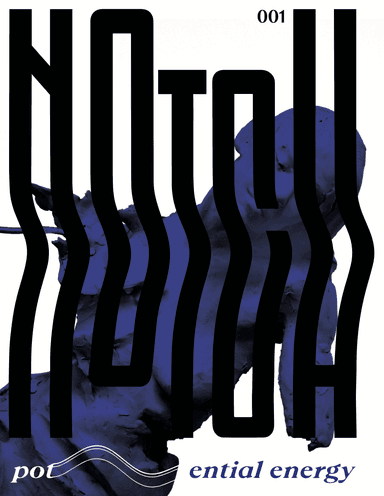
Notch Magazine latest issue 

Notch Magazine

We welcome meditations on conditionality and nested possibilities. Please send essays on the foundations of computational logic and stories that capture capillaries of reasoning. Share art that seizes visual polarity, cultivating contrast or queering light vs. dark. Track the evolution and architecture of decision trees—particularly when neat root systems spawn a Dantesque forest of disorientation. Consider temporal parallels, alternative paths that tug at the seams of the present. Capture the essence of elseness, being as/in/of otherness. Inhabit the space between If and Else; a clearing in which to grapple with potential.

We accept all mediums–from operatic scores to tattoos.

If submitting across multiple genres, please send separate emails with the genre in the subject line.

For writing: Pieces up to 1500 words are preferred. Longer work is considered on occasion. Works in translation are welcome.

For the visual & sonic: Please send a high resolution image, audio file, or link to your art. Artist statement optional.

Please note that, given the high volume of submissions, we can respond only to those selected for publication.

Submissions close January 7, 2026.

Contributors will be compensated.


To submit, email your work and a brief bio to:

submissions@notch.ink

Call for Submissions: Barnstorm Journal

Barnstorm publishes only previously unpublished nonfiction, fiction, poetry, and experimental work work. While we welcome submissions in multiple genres, please wait to hear from us before submitting twice in the same genre. We also accept visual art which accompanies each written piece published.

Submission Schedule

We only review submissions sent through Submittable. Submissions are accepted on a rolling basis and published from September through May. Work submitted during the summer will not be read until the fall.

We make every effort to respond in a timely manner. If your work is accepted and published elsewhere, please withdraw submissions in your submittable account.
Submission Guidelines

For all prose, please send one piece no longer than 5,000 words.

For poetry, send no more than three poems.

For art, we publish digital representations of visual work, including photography, graphic design, drawings, illustration, animation, and high quality pictures of sculpture, mixed media, paintings. Please visit our Submittable page for more information.

A note on our submission fee: This small financial resource will provide support for new possibilities: it can support the work of Barnstorm staff; it may fund future projects such as writing contests, prizes and awards, or a live reading event. Ultimately, it will help us achieve our mission: to publish the best personal and creative nonfiction essays, short stories, poetry and art that is playful, takes risks, and, as our motto says: harnesses energy.

We only review submissions sent through Submittable. Writing and art sent through our contact form, or email will not be reviewed.

Submit your work here

Call for Submissions: Lamp Lit

Lamp Lit publishes quarterly at the moment, though we would love to publish more frequently, and hope to do so as we pick up steam. We are looking for work we love, and that expands the capacity of our hearts. If you like, you can read our previous issues to see what we’ve chosen in the past, but we also eagerly look forward to reading work that looks nothing like what we’ve published before.

Submitting to Lamp Lit is free and we don’t have plans to change that. We accept submissions of poetry, flash fiction, personal essays, short stories of any genre and cover/other art for our issues.

We accept previously uncurated work, meaning that if you published it on your own website or social media in the past, that’s fine, but please do not submit work that has been accepted or published by another journal.

We also accept simultaneous submissions, but do tell us if your submission is being submitted elsewhere, so we can jump on your pieces if we love them. Please notify us immediately if your work is accepted elsewhere, and accept our hearty felicitations! If we do accept your work, please withdraw the piece from consideration by other publications.

We reserve first serial publishing rights, and the right to reprint or use quotes or excerpts for promotional use. All other rights revert back to you on publication.

We do not, at this time, pay contributors — this is a labor of love.

We will nominate for The Pushcart Prize and Best of the Net.

We do not accept submissions that denigrate other people of any description on the basis of race, gender, sexuality, religion or ability. Please do not send us anything gross. Submissions of this kind will be summarily deleted without response.

We do not accept work produced by AI. Please do not send any to us. Let’s not outsource our creativity to our tech bro overlords.

Submissions are accepted via email only at:

lampliteditors@gmail.com

Find us, or track your submissions on Chill Subs.

A cover letter is nice and we do hope you will say hello when you submit, but please don’t stress about it. What we really need is your short, third person bio and the titles of your pieces in the body of your email (separated by commas, please, not bullet points). Without a bio, your submission is incomplete. There’s no need to get fancy, just tell us who you are and where to find your work/socials so we can big it up when we publish.

You will receive a response from us within 3 months of your submission, and very likely much sooner.​ If you have not heard from us within three months, please feel free to request an update, and please keep it to the same email chain, that way everything is together, nice and tidy, and we won’t lose our minds searching the inbox.

More information here.

Call for Submissions: Smokelong Quarterly

Please note that we are currently in our quarterly free-submissions period (November 16th - December 31st). Our next paid-submissions window is January 1st to February 15th.

SmokeLong publishes flash narratives--fiction, nonfiction, and hybrid (somewhere between fiction and non-fiction)--up to 1000 words.

Include the word count and a print-ready, third-person bio with your cover letter. We prefer a simple cover letter.

Please remove all identifying information from your story’s document. Guest Editors and staff Submissions Editors read anonymously and have no access to bios. Also note that submissions editors have no access to Submittable messages. If you need to make changes to your submission, please withdraw and resubmit your work.

During unpaid submissions windows, you may send one previously unpublished piece at a time and wait until you hear our decision before sending another, or for a fee you may choose to send up to three submissions in one document through the Multiple Submissions form. The Multiple Submissions option comes with a discount code for The SmokeLong Shop and a promise to respond within three days. Paid multiple submissions are read by Christopher Allen, the publisher and editor-in-chief of SmokeLong, and passed to the senior editors for comments if Christopher decides they deserve further consideration. If we are considering your submission for publication, we'll let you know that we need a few more days to discuss your work.

For free submissions, please allow us up to four weeks to respond. We try to respond to paid submissions within one week.

Simultaneous submissions are considered. Please inform us immediately if your work has been accepted elsewhere for publication.

We pay $100/story or $150/story with audio, upon publication in the quarterly issue. Payment will be issued via PayPal or Zelle, and in rare cases the writer may be responsible for any associated fees if applicable.

If you are seeking feedback on your submission, please see the forms "SmokeLong General Submissions with Feedback" or "Senior Editor Critique." These services are subsidized by SmokeLong so that the editors giving feedback earn more than you're paying. This is one way SmokeLong is trying to keep feedback reasonably priced while also providing income for talented editors. If you are taking part in SmokeLong Fitness, please be sure to use the links for discounted links in the workshop.

If you choose to make a donation to SmokeLong using the tip jar feature, thank you so much! Your contribution will help the journal pay six senior editors (all freelance editors, so please look them up), artists, reviewers, interviewers, writers, and our webmaster, who has graciously stepped in to clean up our messes for more than 10 years. We sponsor up to four Emerging Writer Fellows each year, and we also support worthy causes, which you can find on our We Support page. While your donation will not influence our decision regarding your submission, it will influence our love for you. We also offer readers the possibility of donating to SmokeLong directly on the website.

We can't wait to read your words.

--The SmokeLong Team

Submit your work here

Friday, December 5, 2025

Artists' Residency: Monson Arts' Residency

Monson Arts’ residency program supports emerging and established artists and writers by providing them time and space to devote to their creative practices. During each of our 2-week and 4-week programs throughout the year, a cohort of 5 artists and 5 writers are invited to immerse themselves in small town life at the edge of Maine’s North Woods and focus intensely on their work within a creative and inspiring environment. They receive a private studio, private bedroom in shared housing, all meals, and $500 stipend ($250 for 2-week programs). The Abbott Watts Residency for Photography offers access to the photography studio and darkroom of Todd Watts in nearby Blanchard, adjacent to the former home of Berenice Abbott. Click here to read more about this unique opportunity specifically for photographers.

Applications for a residency at Monson Arts are open to anyone at any stage of their career, working in visual arts, writing, and related fields (i.e. audio, video, photography, woodworking, movement, screen and playwrights). Open calls for residency applications currently take place 3 times throughout the year with deadlines on January 15, May 15, and September 15. Each application period corresponds to specific residency offerings 3-6 months out.

Residents’ studios are located in newly renovated Main Street buildings that have been designed specifically for visual artists and writers. All of our studio spaces are outfitted to be as flexible as possible so that we can accommodate a variety of creative practices. Our visual arts studios are spacious and light-filled with large work tables and sinks. Shelving and portable storage carts are available as needed. Access is available to woodshop and metal shop facilities in nearby buildings for any fabrication needs. Our writing studios are comfortably furnished with work tables, office chairs, bookshelves, and reading chairs. For those working in time and sound based media: apply to the Writing category if quiet contemplation would be best for your project or the Visual Arts category if you need room and the opportunity to make and play sounds out loud.

Residents live in newly renovated historic homes throughout town, within walking distance to studios and everything that downtown Monson has to offer. These are mostly 3 bedroom structures that are fully furnished and comfortable all four seasons of the year. Houses all have shared kitchens, bathrooms, and common areas with laundry machines, telephone, and other amenities as well. Wifi is available in all of our buildings through high speed fiberoptic service.

Application Requirements include: 

  • Up to 5 images / 5 minutes of media OR 5 pages of writing examples
  • A letter of intent for your time at the residency
  • C.V. or Resume (limited to 6000 characters)
  • Two reference names
Spring

3/30 – 4/23 – Residency – (With Abbott Watts Resident)

4/27 – 5/21 – Residency

*5/26 – 6/5 – Residency – (With Abbott Watts Resident) 2 week residency (Tuesday start for memorial day)

Our next application period will be open December 1st – Jan 15th for residency sessions taking place in the Spring of 2026. 

More information and application portal here.

Call for Submissions: The Writing Disorder

The Writing Disorder Fall 2025 cover image 


The Writing Disorder 

CURRENT NEEDS:
Fiction, Poetry, Nonfiction, Art, Reviews, Interviews, Comic Art and Experimental work.
We would like to see more poetry, long fiction, nonfiction, artwork, reviews and interviews.

FICTION & NONFICTION:
“Welcome all. We are open to content and subject matter. Please send us your best work. We seek traditional as well as experimental submissions. Our staff enjoys reading all kinds of work. As always, there is no limit on word count.” — C.E. Lukather, Editor

POETRY:
“A new season, a new issue, a new crop of poetry. As your poetry editor it is my pleasure to offer this harvest. This harvest which is impossible without you. Impossible without your careful crafting, grafting, sowing of words. Without your words nestled like seeds on the paper, peas on a page. So send us your free verse, your experimental, your form. Send us the flowers, the fruit, and the hay.” — Juliana Woodhead, Poetry Editor

ARTWORK:
We showcase artists and photographers as well. Features typically include 10-15 images (minimum 1200 pixels wide, 100 ppi, RGB, jpeg files) Include artist statement, bio, links to work, list of shows, and titles of art. We can also include video or audio clips.

MANUSCRIPTS:
We are currently accepting manuscripts of nonfiction work for publication: biographies, autobiographies and unusual life stories. For more information, please contact us at: 

info@thewritingdisorder.com 

FORMAT:
The Writing Disorder accepts Microsoft Word document (storytitle.doc or .docx) submissions by email. However, we can’t promise that it’s going to look exactly the way you had it (we are Mac users). Please attach it to your email.

NOTE: Please include your last name in the title of your Word document.
Send your fiction, nonfiction and artwork to:

submit@thewritingdisorder.com 

Send your poetry to:

poetry@thewritingdisorder.com 

Our Submission Policy
The Writing Disorder is published four times a year: new issues are posted at the beginning of Spring, Summer, Fall and Winter.

Needs:
We seek work of the highest quality, but do not have specific guidelines for style or subject matter. Check our website before submitting for any announcements. Although we look for short stories and poetry, we also publish personal essays and memoirs. Novel excerpts are acceptable, if self-contained. Reviews, nonfiction pieces, humor, comic art, and criticism are also welcome. And we love experimental work. For poetry, please submit THREE to EIGHT poems. Also, let us know what type of work you are submitting. Sometimes it’s difficult to tell whether a piece is fiction or nonfiction.

Format:
Submit one prose piece or three to eight poems. A notation of publications and awards, if any, is helpful. Poems should be individually typed either single- or double-spaced on one side of the page. Prose should be typed double-spaced on one side and can be as many pages as you need.

Deadline:
Our reading period is all year long. Submit your work at any time during this period; if a manuscript is not timely for one issue, it may be considered for another.

Submitting Your Work:
Send only one manuscript at a time online. Do not send duplicate or multiple submissions. There is a limit of four total submissions per writer per reading period (season), regardless of genre, whether it is by mail or online. Do not send a second submission until you’ve heard about the first. We cross-reference our database periodically, and if we find more than one active submission, or a fifth submission (or more) during the reading period, all submissions will be immediately rejected unread. Simultaneous submissions to other journals are amenable as long as they are indicated as such and we are notified immediately upon acceptance elsewhere.

NOTE: We accept previously published work—as long as it is not currently available online.

Submissions by Email:

Email one file to:

submit@thewritingdisorder.com

— containing one prose piece or three to eight poems. If you have a legitimate association with a staff editor you may address that editor by name in your email. You should also include a brief citation of publications and awards (less than 50 words), if any. A longer citation of credits or a cover letter may be included as the first page of your submission document. Submissions must be sent as a Word (.doc or .docx) file. Any files that don’t adhere to our guidelines will be withdrawn from consideration. In general, you will receive a faster response by email versus by regular mail.

Call for Submissions: Prism Review

Recent cover image or website screenshot for Prism Review 

We are open--send great work!

Generally, all accepted authors are paid, and all non-contest submissions are considered for our $200 Staff Choice Award: an accepted submission chosen by our staff as best embodying two things we love and respect about writing: stylistic ambition and social engagement. One author each issue will receive this award, announced with the issue's release (usually in May).

As always: we hope to read your very best, we're excited to read it, and we want more, we hope for more, we quietly plead for/demand more. Simply: we love great literature, especially literature that is urgent and/or strange, and we love all voices, be they new, emerging, or established - certainly those from underrepresented groups. We always put samples from past issues on our homepage if you'd like to get a sense of our sensibilities.

Note: Submissions are being read for our spring 2026 issue. They must be previously unpublished, and simultaneous submissions are totally fine (but please withdraw accepted pieces immediately; the lack of this practice has increased far too much for us lately). Only one submission (in any genre) at a time.

Note 2.0: We generally charge a two dollar fee so that we can do something we hope all agree is a good thing: pay all our authors, at least $40 per writer; usually we have free submission windows in early Dec and May ... and during most of June and July, we're happy to provide free submissions to any authors who self-identify as being from underrepresented or minoritized communities or simply can't afford the $2 fee. Just email our editor at:

sbernard (at) laverne (dot) edu (Change (at) to @ and (dot) to . )

for more information.

-->Excepting the student contest, current students and employees of the University of La Verne are not eligible to submit. Sorry!

Note 3.0: We are not Prism International, a fantastic journal in Canada.

Submit your work here

Call for Submissions: Ninth Letter

Ninth Letter accepts submissions to our print issues between Sept. 1 – Feb. 28.

Genre Guidelines:

For poetry, please submit 3-5 poems (max. 8 pages) at a time.

For fiction and creative nonfiction, submit one story or essay up to 8,000 words at a time. For flash, you may submit up to 3 pieces with a total word count totaling no more than 4,000 words.

If you classify your work as “hybrid,” please submit to the genre category you feel your submission most closely applies. You are welcome to leave a note in the cover letter field with any details you think our reading team would find helpful. We will make sure your submission gets to the right team and receives the attention and consideration it deserves.

Submission Fee:

We charge a $3 reading fee. Fees are waived from December 1-31 or until we hit our cap of 300 submissions per genre.

Fee Waivers:

A limited number of fee waivers are available for writers for whom the submission fee would present undue financial hardship. Please send a short email to:

ninthletter9@gmail.com 

to request a fee waiver. No proof of income or other sensitive information is required.

Publication Terms & Payment:

Ninth Letter pays $25 per poem and $100 for prose upon publication and two complimentary copies of the issue in which the work appears. Contributors also receive an exclusive subscription discount offer at the time of acceptance. Ninth Letter acquires First North American Serial Rights (FNASR). We ask that you acknowledge Ninth Letter upon reprint of your work.

Response Time:

We strive to respond to your submission within six months. Please wait until that time has elapsed before querying about the status of your submission.

Submit your work here.

Call for Submissions: The Lemonwood Quarterly

The Lemonwood Quarterly latest issue 

What to Submit

The Lemonwood Quarterly seeks the best English language short stories and plays we can find. We do not publish poetry, flash fiction, nonfiction prose, book reviews, or interviews. We are looking for superbly written stories and play pieces between 2,000 and 10,000 words. Please submit a double-spaced Word document.

We especially seek out stories with female protagonists who are well into adulthood. There’s no minimum age requirement, but if your protagonist is not at least over thirty years old or so, it could be difficult for them to carry forward the type of stories we aim to publish. We definitely are not looking for coming-of-age stories. We are excited to showcase stories with protagonists who have already passed through those earlier milestones or hurdles and are at a different point in their life.

Who Should Submit

We welcome and encourage submissions from writers of every gender, age, race, ethnicity, sexuality, and nationality —including writers without fancy degrees or previously published work, and whose perspectives might be underrepresented in the literary world. Please do not send us work that includes machine-generated or AI text.

How to Submit

We accept only online submissions through the link below. Please do not send us emails or hard copies of your manuscripts. An online submission fee of $4 to help cover administrative costs is required to complete your submission.

Submissions are read anonymously, so please do not include your name anywhere on the word document itself. You will provide your identifying information in the submission form.

When to Submit

Our magazine is quarterly, so we are frequently considering new submissions. Our submission period may close if we reach our submissions capacity, so submit early. Please submit only one story or play at a time and wait to hear back from us before submitting again. We aim to respond within one to six months. If your story is selected for publication, please wait until the issue with your piece has been published before submitting another story. If your story is rejected, please send us new work; do not resubmit previously rejected stories.

Simultaneous Submissions to other Publications are fine, but please indicate in your submissions form that the work has been submitted to another journal. If work that you have submitted to us is accepted elsewhere, please notify us immediately via our contact form to withdraw your submission.

All work should be previously unpublished in any form, including online, in blogs, or in print.

Translations are accepted. Translators should acquire translation rights from the copyright holder before submitting. In the submission form, in addition to your translation and your own information, you will be asked for a copy of the original work, the author’s name, the work’s original title, a note stating the original language in which it was written, as well as a short bio about the author.

Revisions

Please send us your work in its final fully edited form. We do not have the staff available to consider individual revisions. If you feel you must revise, please contact us via the contact form to withdraw your submission, and resubmit the newly edited piece. It may take several days for your withdraw request to be processed.

Refunds of the submission fee cannot be made after the piece has been submitted, even if you need to withdraw the work. If you withdraw a submission and you want to submit a different piece, you cannot swap them out; you must make a new submission.

Compensation to Authors for their Work 

  • The Lemonwood Quarterly pays all of our contributors a flat rate. The current rate is $200 for every story or play published in our magazine.  
  • We will nominate as many pieces as we can to annual literary prizes such as The Pushcart Prize, The O. Henry Award and The Best American Short Stories.  
  • Contributing authors will be featured on our website and will have the opportunity to submit an updated bio, a photo, and any links to their social media.  
  • Authors will receive a contract upon acceptance and payment upon publication. The Lemonwood Quarterly’s publishing agreement includes the following rights: First worldwide electronic publication rights; non-exclusive online rights on our website, and other limited rights. Copyright is retained by the author. Authors are free to resell the work, although we do ask for a 90-day exclusive from our first publication of the work. We ask that whenever an author reprints a piece that first appeared in our magazine, The Lemonwood Quarterly is given acknowledgement as the work’s original publisher. 

Submit your work here

Call for Submissions on Theme of "The Great Unknown": Wild Greens

Wild Greens is looking to publish art, commentary, essays, poetry, short fiction, handmade items, and music for our January issue.

The theme is "The Great Unknown."

Grab your hat and your scarf and embark on a journey toward the inviting horizon. Does a better tomorrow await? Take the plunge into the endless possibilities of what could be.

Submissions open through December 15. 

Submit your work here

Writing Competition: The Richard Mathews Prize for Poetry

The Richard Mathews Prize for Poetry

Book Publication • $2,000 Award
Selected Poems published in Tampa Review


1. Manuscripts must be previously unpublished. Some or all of the poems in the collection may have appeared in periodicals, chapbooks, or anthologies, but these must be identified.

2. Manuscripts must be at least 48 typed pages; we prefer a length of 60-100 pages but will also consider submissions falling outside this range. Manuscript pages should be consecutively numbered.

3. Entries should include a separate title page with author’s name, address, phone number, and e-mail address (if available).

4. Entries must include a table of contents and a separate acknowledgments page (or pages) identifying prior publication credits.

5. Submissions are due December 31. Simultaneous submissions are permitted, but the University of Tampa Press must be notified immediately if the manuscript is accepted elsewhere.

6. A nonrefundable handling fee of $25 is required for each manuscript submitted. Submissions are not complete until this fee has been sent using any major credit card via our secure online service. (There is an additional small electronic payment processing fee.)

7. The winning entry will be announced in the subsequent fall. Online submissions will be acknowledged by email.

8. All entries receive one free issue of Tampa Review. (Mailed to any U.S. address; international subscribers will receive a digital issue.)

9. Judging is conducted in accord with the Council of Literary Magazines and Presses Contest Code of Ethics by the editors of Tampa Review. Submissions are not accepted from current faculty or students at the University of Tampa. Editors will recuse themselves from judging entries from close friends and associates to avoid conflicts of interest.

Submit your entry here

Writing Competition: The C. Michael Curtis Short Story Book Prize

The C. Michael Curtis Short Story Book Prize is open to emerging writers in thirteen Southern states. Submitters must currently reside in Alabama, Arkansas, Florida, Georgia, Kentucky, Louisiana, Mississippi, North Carolina, South Carolina, Tennessee, Texas, Virginia or West Virginia, and must have no more than one previously published book.

The C. Michael Curtis Short Story Book Prize includes $5,000 and book publication for a debut book of short fiction. C. Michael Curtis served as an editor of The Atlantic since 1963 and as fiction editor since 1982 and discovered or edited some of the finest short story writers of the modern era, including Tobias Wolff, Joyce Carol Oates, John Updike, and Anne Beattie. He edited several acclaimed anthologies, including Contemporary New England Stories, God: Stories, and Faith: Stories. Curtis moved to Spartanburg, S.C. in 2006 and taught at both Wofford and Converse Colleges, in addition to serving on the editorial board of Hub City Press. This prize is made possible by a generous contribution from Michel and Eliot Stone of Spartanburg.

A $25 submission fee will accompany each submission. Manuscripts will be taken through online submission only. All manuscripts will be read anonymously by paid screeners. This contest is guided by the CLMP Code of Ethics.

Deadline: Dec. 31, 2025

Submit your entry here.