Saturday, July 25, 2026

Writing Competition: 2026 Boudin Novelette Chapbook Contest


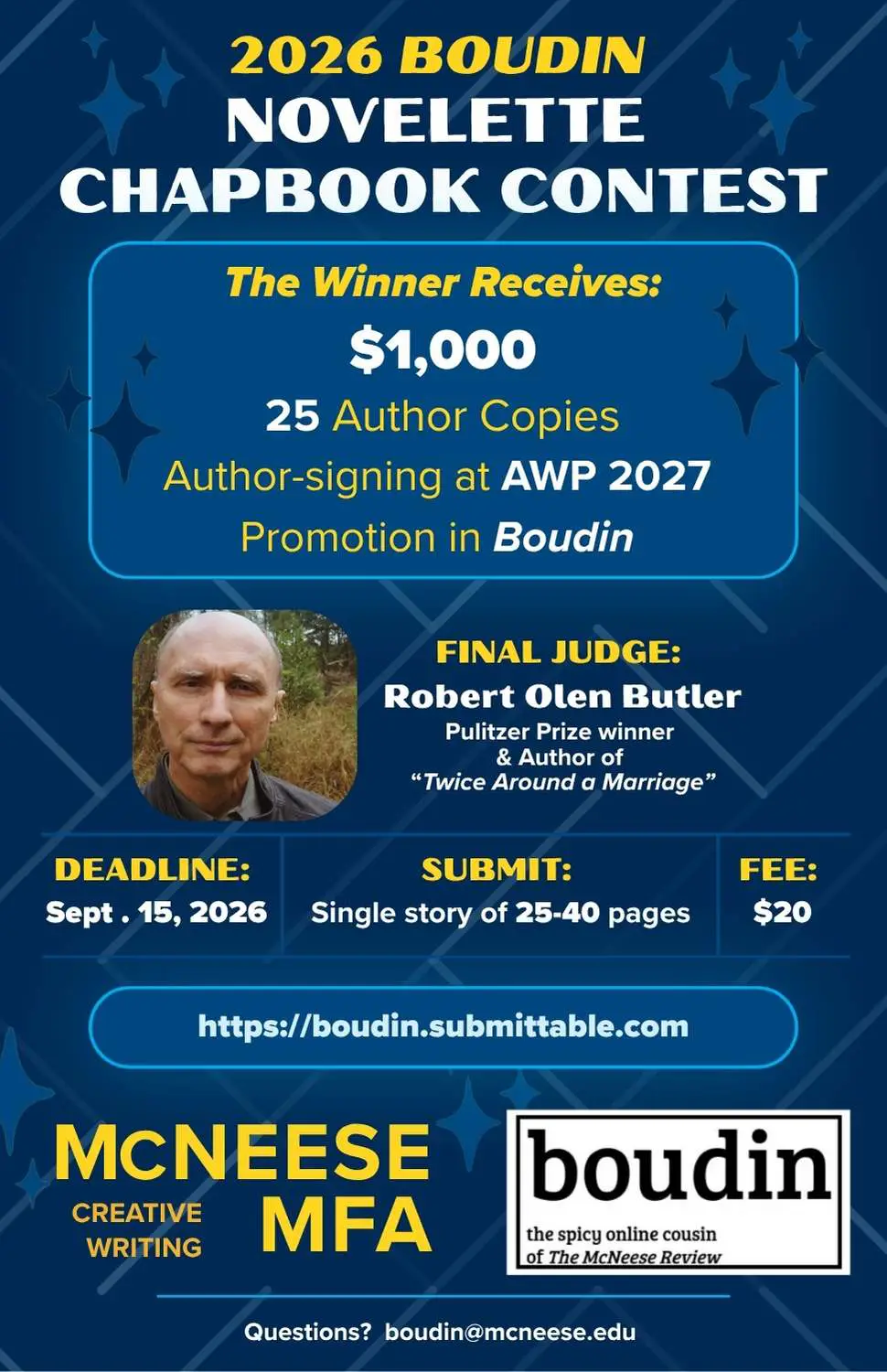
Full flyer for the 2026 Boudin Novelette Chapbook Contest showing a $1,000 prize, final judge Robert Olen Butler, September 15, 2026 deadline, 25–40 page submission requirement, and $20 entry fee.

2026 Boudin Novelette Chapbook Contest

Final judge: Robert Olen Butler

Deadline: September 15th, 2026

Prizes: The winner will receive $1,000, 25 author copies, an author-signing at AWP 2027, promotion in Boudin (“the spicy online cousin of The McNeese Review”), and a three-year subscription to The McNeese Review. The winning manuscript will be published as a special issue of The McNeese Review and distributed by TRP: The University Press of SHSU.

Two runners-up will be offered publication of individual pieces in Boudin.

Fee: $20


Manuscript details: 25-40 manuscript pages of a single story in a readable font like 12-point Times New Roman. Unpublished and original work only. Include only a title page.

Your name and contact info should NOT appear anywhere on the manuscript. Please include a cover letter and third-person bio on the Submittable submission form.

Judging: The first rounds will be read anonymously by McNeese State University’s MFA faculty and students. The final round will be read anonymously by Robert Olen Butler, who will determine the winner and two runners-up.

Robert Olen Butler's short-story collection A Good Scent from a Strange Mountain was awarded the Pulitzer Prize for fiction in 1993. His most recent novel is Twice Around a Marriage.

Other: Co-authored manuscripts are fine. Submitting multiple manuscripts is fine with entry fees for each. Simultaneous submissions are fine; please withdraw immediately through Submittable if your work is accepted elsewhere. Please note that the AWP author signing will take place at the Boudin/McNeese Review booth, and does not include travel expenses. Current McNeese State University students and employees are not eligible to submit. McNeese alumni are welcome to submit if it has been at least three years since they graduated.

We, unfortunately, cannot award the prize money to international submissions, though can still offer publication and subscription prizes.

--

Boudin fine print

Please only submit original work. If your work borrows from or quotes another writer, please make explicit mention of this with your submission, giving full attribution to any material you’re using from another source. We do not accept any work that was written with the assistance of AI.

Please only submit new, previously-unpublished work.

Please limit your submissions to four issues per calendar year.

In all genres, we are particularly interested in seeing work from women, people of color, LGBTQ writers, non-binary writers, people with disabilities, and other underrepresented groups.

No material published in Boudin may be reprinted or reproduced, in whole or in part, without the permission of the authors. Writers retain all rights to their work. We ask for ourselves only that Boudin be credited with first publication. Unfortunately, we are not a paying market; contributors to Boudin will receive our thanks and the promise that we’ll promote your work.

We encourage you to simultaneously submit your work while it’s under consideration at Boudin. If your submission is accepted by another publication, please withdraw immediately through Submittable.

We look forward to seeing your work! Surprise us. Spice it up!

Submit your entry here

Call for Submissions: Wildscape Literary Journal

Wildscape Literary Journal

Subs are OPEN.

Issue #8 subs for all genres are open until August 15, 2026

poetry guidelines

-Up to 5 poems

-Each poem must be two pages or shorter

-Please put all poems in one document, and start each poem on a new page

-12pt, times new roman font

-upload ONLY as a .doc/.docx (NOT a PDF, unless a PDF is needed to preserve the formatting. If this is the case, please let us know in your cover letter)

-Please leave all identifying information off of the document itself, as well as the document title. We prefer to read blind (i.e. not knowing who the author is)

-Keep your bio under 75 words, please. A cover letter is not mandatory and will not affect our decision, but we do enjoy getting to know the person behind the words/art, so feel free to let us know a little about yourself or the background info on your work, if you’d like.

-Prose poetry, as well as hybrid forms such as blackout/erasure poetry, are more than welcome

–We tend to lean away from rhyming poetry, and we tend to prefer experimental, contemporary, and free verse work.

flash fiction & creative flash nonfiction guidelines

-Up to 2 pieces

-max 1,500 words per piece

-Double spaced, 12pt, times new roman font

-upload each flash piece separately, and upload ONLY as a .doc/.docx (NOT a PDF, unless your work has unique formatting – if this is the case, let us know in your cover letter)

-Keep your bio under 75 words, please. A cover letter is not mandatory and will not affect our decision, but we do enjoy getting to know the person behind the words/art, so feel free to let us know a little about yourself or the background info on your work, if you’d like.

-Please leave all identifying information off of the document itself, as well as the document title. We prefer to read blind.

art guidelines

Please send up to 10 works of art. We prefer the whimsical and the beautiful, the ethereal and the wild. We tend to lean towards nature and florals, abstracts, watercolors, pastels, and whimsical work. But even if your art doesn’t fit any of these themes, send it anyway! We’re always looking for something new.
We’re open to any and all mediums, though. Submit as the file type(s) that best preserves your work. Genre does not matter, but we tend to lean away from horror.

-Please include a short, third-person bio. Keep your bio under 75 words, please. A cover letter is not mandatory and will not affect our decision, but we do enjoy getting to know the person behind the words/art, so feel free to let us know a little about yourself or the background info on your work, if you’d like.general info/FAQs

-We welcome and encourage work from all historically marginalized creators

-We do NOT accept AI-generated work, and we ask that you do not submit any work, written or visual art, that has been created using AI in any way

–Languages We Accept: We can only accept work written in predominantly English, though works with words/phrases in other languages are absolutely welcome

–Previous Contributors: We generally ask that contributors of the most recent regular issue skip one submission period before submitting work again. This does NOT apply to themed issues. This also does NOT apply to artists (i.e. artists can submit to any issue with no previous contributor restrictions). Anyone can submit work to a themed issue, regardless of when you were last published with us.

–Multiple Submissions: We allow up to THREE submissions per issue. We also allow more than one submission at a time. We do ask, however, that your submissions be separated based on the genre-specific guidelines (i.e. please do not send multiple genres within one submission, and do not send more than one submission’s worth of work within one submission).

–Simultaneous Submissions: Simultaneous submissions are more than welcome. In fact, we encourage them! Please notify us immediately of acceptance for publication elsewhere by withdrawing your piece from Duosuma, leaving a note/message in Duosuma, or by emailing us (wildscapelit@gmail.com)

–Previously Published Work: So long as you have the rights to your previously published work, and can prove that you do (i.e. contract with previous publisher, screenshot from communications with them confirming that you do, etc.), then you are welcome to submit it! We will not need proof of such until/unless your work is accepted, but please do mention that it’s previously published in your cover letter.

–Response Time: It can take us 1-6 weeks to make a decision on a submission. Sometimes, if things are slow, we might respond in around one week. Other times, if we’re swamped, it could take as long as six weeks. If you don’t hear from us within 45 days, please feel free to reach out via email, at:

wildscapelit@gmail.com.

Compensation: Unfortunately, since we are a small team, a newer magazine, and don’t charge for submissions, we are unable to pay our contributors at this time (but we hope to in the future). We do, however, nominate for the Pushcart Prize, Best of the Net, O. Henry Prize, and Best Small Fiction. We also promote our contributors on social media as best we can.

–Author/Artist Rights: All rights revert back to the author/artist immediately upon publication. We ask that if work originally published with us gets published elsewhere in the future, that wildscape. receives credit for first/prior publication.

–WE DO NOT ACCEPT: Hateful words of any kind (if you need clarification on this, then we might not be for you). We believe that black lives matter, that the people of Palestine & Sudan & the Congo & Haiti & all other oppressed populations/nations deserve to be free, & that trans rights are human rights. If you send work that enables or condones the oppression of any marginalized people. We reserve the right to rescind acceptance/publication of your work if it is found that you are expressing hate towards any oppressed/marginalized groups. We also do not accept work that has been created using AI in any capacity.

Submit your work here.

Call for Submissions: Punctuated Equilibrium

Punk Eek latest issue 

Punctuated Equilibrium is interested in your most polished work that engages with the natural environment. 

As a theory, Punk Eek (punctuated equilibrium) is an evolutionary model wherein a sudden burst of change occurs after an extended period of stasis. Born from urgency, we are an online magazine dedicated to interrupting the current moment. Fast-paced, bold, and responsive. Punk Eek follows the flow of nature: sometimes steady, sometimes unexpected.  

As editors, we take a broad view of what constitutes the natural world, and welcome writing that explores various interpretations and intersections. We value experimentation and innovation, opinions and research, audacity and compassion. We are dedicated to uplifting the writers behind the work we publish, acknowledging that writing is born from our different identities, experiences, and beliefs.  

The core of Punk Eek is the natural world—its beauty and power, the threats it faces, and the many species and places within it. Words are the spark that ignite change. 

We only accept original and unpublished work. 

Please make sure...

You email your submission to:

 punkeekmag@gmail.com

  • In the subject line of the email, you put [Genre/Category – First and Last Name]
  • If you’re submitting a fiction feature, your subject line should look like this: Fiction – Jane Doe
  • If you’re submitting a nonfiction feature, your subject line should look like this: Nonfiction – John Appleseed
  • If you’re submitting a poetry feature, your subject line should look like this: Poetry – Jane Doe
  • If you’re submitting a hybrid feature, your subject line should look like this: Hybrid – Jane Doe
  • If you’re submitting a Microburst, your subject line should look like this: Microburst – John Appleseed
  • If you’re submitting to Heat Index, your subject line should look like this: Heat Index – Jane Doe
  • If you’re submitting to Into the Fire, your subject line should look like this: Into the Fire – John Appleseed

In the body of the email, you include the title of your piece(s), word count (prose), a brief bio (100 words max), and any other info you’d like to share

You attach your work as a PDF (poetry) or Word (prose) document

You use a typeface like Arial or Times New Roman that is easy to read

There is no identifying information within the document

We accept simultaneous submissions, but please inform us if it is a simultaneous submission in the body of your email. We also ask that you let us know as soon as possible if your work is accepted elsewhere. Email us on the same email chain you used to submit your work to let us know. 

Payment: $50.00

Any other questions, please send us an email with “question” in the subject line.

More information here

Call for Submissions: Little Engines

Recent cover image or website screenshot for Little Engines 

Little Engines started in 2001, publishing four perfect-bound print issues. Each included a carefree mix of fiction, comics, interviews, photos, essays, and more. The Stranger called Little Engines “remarkably satisfying” and Philadelphia Weekly said the magazine was “such a wonderful creation.”

People liked the magazine, and I loved putting it together, but while digging into what should have been Issue Five, my day job in music became all consuming. I set the magazine aside, temporarily. Seventeen years later, a few months into Covid with live music shut down, I started working on a re-launch.

SUBMISSIONS

Open July 13 - August 9.

Stories, essays, interviews, reviews: send one, any word count will do

Poems, comics: include one to five

Books: include one chapter of your novel, memoir, or collection, along with a short description

We are a paying market.

Send work to:

avery@littleengines.pub

Call for Submissions: Headland: Literary Frontiers & Emerging Voices


Headland: Literary Frontiers & Emerging Voices 

Guidelines

Submissions are open until 5pm Monday 24 August 2026

Please read these guidelines thoroughly to ensure that you do not spend your energy preparing a submission that we will be unable to accept.

We accept short fiction and creative nonfiction only (up to 5,000 words). At this time we do not publish poetry, novel excerpts, scholarly essays, reviews or art. We do not include any illustrations in the pieces we publish.

We will publish what we love. Our process is as subjective as that, so please do not be discouraged if we do not select your writing for Headland.

We pay $75 (NZ) per accepted piece. We ask for first publication rights, after which all rights revert to the author. We kindly ask that you acknowledge Headland in any reprints.

We invite submitting authors to include (in your email) up to 300 words on what Headland journal means to you. We're looking to understand what readers and writers get out of Headland so that we can ensure we reflect your needs going forward. This is optional. What you write will not have any influence on our consideration of your work, but it may be published (with your permission) as part of a special blog.

When submitting work, your email address will be added to Headland's newsletter mailing list. If you would like to opt out of receiving our newsletter, please state this clearly in your email. Once on our mailing list, newsletter recipients will be able to opt out at any time.
Formatting and other FAQs

Please submit one piece only. Submissions can be made via email to:

headland.journal@gmail.com 

We do not accept submissions by post.

We do not accept material generated by AI.

Please format both your document name and the subject header of your email with the genre and the title of your piece, e.g. ‘Nonfiction_The House at Pukawa’. Include in your email a very brief writer’s bio.

For fiction and nonfiction, we ask for pieces up to 5,000 words in length. We are happy for you to submit your piece elsewhere, provided that you advise us immediately if your work becomes unavailable. All work should be previously unpublished; this includes self-publication.

We want to judge your work on its own merits, so please do not include your name anywhere in the body or file name of your document. Please include in the header of your document:

Title
Word count
Your nationality and country of residence
And, if relevant, ‘Unpublished Author’

If we are umm-ing and aah-ing over whether to select your piece, it may just tip the balance in its favour if we know that we have the opportunity to introduce a new voice and, hopefully, make someone’s day.

Any referencing should be in MLA style; see the Purdue OWL for MLA guidelines.

Please submit your work as a .doc or .docx file.

We may not be able to accept or decline all submissions until three months after each submission deadline, so please wait at least this long before contacting us.

Call for Submissions: The Manifest Station

What we publish

Personal essays and creative nonfiction about the messy parts of being alive: grief, family, the body, desire, rage, love that didn’t hold, love that held too tightly…

We’re not looking for tidy endings. We want writing that trusts the reader.

Read us before you submit.

What we don’t publish

Fiction and poetry. We love both, but they’re not what we do here.

A few specifics

  • 2,500 words maximum.
  • One submission at a time. Wait to hear from us before sending another.
  • Simultaneous submissions are fine. Just withdraw from us if you’re accepted elsewhere.
  • Previously published work is considered case by case. Tell us where it ran and why you want us to have it.
  • All rights revert to you. If you republish, credit TMS.
  • A photo of yourself or something that fits is welcome but not required.
  • We respond to everything. Give us 90 days before following up.

On AI

The work we publish comes from specific human lives. By submitting, you’re confirming that the writing and structure came from you, not a generative AI tool. Basic spelling and grammar tools are fine. Anything beyond that should be disclosed in your cover letter. Undisclosed AI use is grounds for rejection or retraction.

Why we’re here

The Manifest Station has been publishing since 2011 because we believe words matter. Especially now.

We’re looking for pieces that refuse to look away. For writers who talk themselves out of submitting.

If that’s you, send us something.

— Angela & Amy

Submit your work here.

Call for Submissions: Epistle Literary Magazine

Epistle Literary Magazine 

Submit Your Work

We accept any form of writing, so long as it responds to the theme: "How has an educator or mentor shaped you?" Consider poetry, short fiction, creative nonfiction, and letters to honor your educators.

  • Up to 3 poems (max 5 pages total)
  • Short stories up to 3,000 words
  • Essays, memoirs, or letters up to 2,000 words

We accept and encourage simultaneous submissions, but please let us know if your work is accepted elsewhere so that we can congratulate you and withdraw the submission on our end! We do not consider previously published submissions.

Along with your submission, please include a brief, third-person bio.

By submitting your work, you certify that it is your original creation, in no way plagiarized, and that you have obtained any necessary permissions from individuals named or identifiable in your piece. We reserve the right to remove your work from our site if we are made aware of plagiarism or unauthorized use of personal details.

Additionally, by submitting, you grant us the right to publish your submission in both digital and print formats if it is accepted, including on our website and social media platforms, and in any promotional materials related to the issue. Authors retain full rights to their work and may republish it elsewhere after it appears in Epistle, with credit to the magazine as the original place of publication.

Please send your submission to:

submissions@epistleliterary.org 

as a PDF. Submissions not attached as PDFs will not be opened for consideration.

Thanks to the help of generous friends and family on our end, every accepted author with a mailing address in the United States will receive a printed copy of the issue once it is released. You will have the opportunity to choose to mail this copy to the educator by whom your piece is inspired as a way to show your appreciation. Additional print and digital copies will be available for purchase by authors and readers.

Submissions close September 15, 2026.

Decisions regarding the status of your submission will be shared after the submission period ends. All submissions are read and curated by Rory Baskin, Editor-in-Chief.

Writing Competition: Willow Springs Poetry Surrealist Prize

What We Are Looking For

We are looking for poems in the surrealist tradition and its many iterations. One of the basic tenants of surrealism is a revolt of the imagination against reason, rationalism, and empiricism. The first surrealist movement is marked by the publication of Andre Breton’s Surrealist Manifesto. It is, as Robert Bly describes in discussion of Spanish surrealist poets, the poetry of “wild association” and “leaping.”

Melissa Kwasny writes the following useful definition of surrealism from her book Earth Recitals: Essasy on Image and Vision:

“Surrealism, with its emphasis on images drawn from dreams, the wildness of chance, and unconscious desire, extended our definition of the real by opening the conscious mind to realms of perceptions hitherto unknown or agreed upon . . . Breton states in his Second Manifesto [that surrealism is] “a total recovery of our psychic force.” . . . The images that washed up on the shores of the surrealist poem were recognizably different, strange and incoherent . . . Offshoots of French surrealism include the Latin American surrealism of Pablo Neruda a precursor of magic realism; the post-colonial surrealism of the Caribbean poets like Aime Cesaire; Lorca’s dark Andalusian rendition of the Deep Song; the American Deep image poets, influenced by Neruda, as well by Robert Bly’s translations of Transtromer and Rilke . . . and later, poets of the Beat era, collage poets, poets exploring the arrangement of images in non-narrative, disjunctive and, to borrow a word from the surrealists, convulsive ways all influenced by the freedom to go beyond the boundaries of the concrete for images. The image, as fragment, or rather, as discontinuous accumulation of fragments, bound by chance encounters in dreams and waking life, gave us a glimpse into an entirely different way of envisioning our world.”

We seek any contemporary poem born of these traditions in an attempt to identify and keep alive the many changing faces of the movement.

Prize

$1000 for a single poem to be published in the Spring issue of the Willow Springs magazine. 

Opens: March 1, 2026

Closes: September 15, 2026

Judge: Michael Hettich

Guidelines

  • Fee: $15
  • Submit a packet of up to three poems in one file.
  • Please do not include identifying information in your submission document. We will use your Submittable information to contact you, so please make sure your contact information is accurate and up to date.
  • Multiple submissions are welcome, as are simultaneous submissions. Please notify us immediately if your submission is accepted elsewhere.
  • We accept only previously unpublished work for publication.
  • We may consider any submission for general publication, unless the author states otherwise.
  • Runners up may receive acknowledgment in the print issue, and online publication (if desired).
  • We are not accepting submissions that are generated or produced with the assistance of Artificial Intelligence or Large Language Models. In short, no AI.

Eligibility

Students, faculty, staff, and administrators currently affiliated with Eastern Washington University or graduated from our creative writing program within the last four years are ineligible for consideration or publication. Previous winners should wait three years after their winning entry is published before entering again. Willow Springs adheres to the CLMP Contest Code of Ethics.
Submissions

Send your poem(s) to our Submittable page.

Sunday, July 19, 2026

Call for Submissions on Theme of "Water": The Fourth River

Recent cover image or website screenshot for The Fourth River 

The Fourth River 

General Guidelines

The Fourth River publishes print and online issues. Submissions are accepted July 15-September 15 and November 15-January 15. We will occasionally run special calls for theme issues as well.

Submissions for the web series, Tributaries, is rolling, though we will sometimes close for a short time to catch up on reading.

There is a $3 submission fee for our issues, however we will announce FREE submission days occasionally over social media, so be sure to follow us!

Submissions to Tributaries are always free.

We wish it were otherwise, but The Fourth River is not a paying market at this time. Contributors to our print issues will be offered one copy of the issue in which their work appears. Digital contributors will be offered either one back issue or a copy of the upcoming print issue.

We welcome submissions of previously unpublished poetry, fiction, creative nonfiction and visual art, that explore the relationship between humans and their environments, both natural and built, urban, rural or wild. We are looking for writing that is richly situated at the confluence of place, space and identity—or that reflects upon or makes use of landscape and place in new ways.

Submit your work here.

Call for Submissions on Theme of "Fire": Crescendo Magazine

Recent cover image or website screenshot for Crescendo Magazine
 Crescendo Magazine

Call for Submissions - Writing on Fire

Our triennial magazine will be publishing its third print issue. This issue will explore the theme of Fire.

As our ancestors have long known, fire both sustains life by providing heat to keep us warm and cook our food, and extinguishes life, through fires that become conflagrations. We fear fire yet are attracted to it. Perhaps it is the risk that fire brings, the possible danger that draws us to it, “like moths to a flame.” Fire takes on symbolic meaning in religion and spirituality, being used to “light the way” in houses of worship while also being a means for purifying or destroying evil. In times past and present, people light candles or a fireplace to evoke a certain mood. We light campfires to gather around and share stories.

Your writing might explore:

• Who or what burns (literally or figuratively)?

• What does fire destroy? What does it create?

• What does it mean to be on fire (literally or figuratively)?

• What is the relationship between humans and fire?

• Consider idioms where fire is present, i.e., “playing with fire,”
“burning bridges,” “going down in flames,” “you’re fired,” “ready, aim,
fire!,” “where there’s smoke there’s fire,” etc.

Send Us Your Work!

Email submissions of poetry, fiction, creative nonfiction, and inter-genre work to:

CrescMag@gmail.com 

by August 30, 2026. Writing should be original to the author and not created using generative AI. Submissions should be no more than 2500 words for prose and up to four poems.

We do allow simultaneous submissions. In your 1-page cover letter, please indicate where else you are sending this work. And if this work is accepted elsewhere after you send it to us, please let us know. There is no fee to apply.

Guidelines for Submissions:

• Typed, double-spaced (poetry may be single-spaced) pages
• Numbered pages
• Fiction, nonfiction, and other prose: Less than 2500 words. Excerpts of longer works are welcome if self-contained
• Poetry: Submit up to 4 pages with each short poem being on a new page (long poems no more than 4 pages)
• Translations are welcome if permission has been granted

Call for Submissions: LitMag Online


Recent cover image or website screenshot for LitMag Online

LITMAG ONLINE

Fiction, Nonfiction, and Poetry
Up to 4,000 words.

What to Send
One story or essay at a time, up to three poems.
Please wait until you have heard back from us before submitting again.

Previously Unpublished
We do not consider work that has previously been published either in print or online including personal blogs etc.

(If a piece was published in a known journal that has since closed and the piece is currently unavailable, we will consider a reprint, though acceptance would be rare, and only after a full disclosure of previous publication circumstances.)

LitMag Online: Upon acceptance, we pay $100.

LitMag Online will be open July 15 to August 15.


How to Submit
Online. We use Submittable. (Saves trees, prevents paper cuts.) We cannot consider emails with attachments or snail mail.

Multiple Submissions
Please submit only once in each category and wait until you receive our response before submitting again. (A contest is its own category.)

Simultaneous Submissions
Yes, of course. But please withdraw your submission immediately via Submittable if another publication beats us to your work.

Call for Submissions: Consequence

Recent cover image or website screenshot for Consequence 

Submissions are welcome during the spring (January 15 – April 15) and fall (July 15 – October 15) reading periods*, and will be considered for our print publication (Consequence journal), our website (Consequence online), or our blog (Consequence substack). Please note that all subs need to address in some manner the consequences of war or geopolitical violence.

*Translations is open year-round

Curious about the work we typically publish? Check out our substack.

If you have questions, please check out our FAQ page. If you still have questions after reading that, please send us an email via the form at the bottom of this page. Thank you.

Please note that we have a zero-tolerance policy when it comes to AI-generated work. If your sub is deemed to have been created by AI, even partially, you will be banned from submitting to us.

Pay Rates and Submission Info--

Poetry

  • Print: $20 per piece
  • Online Feature: $50
  • Substack: $30
  • We love any and all forms of poetry so no restrictions here.
  • Up to three poems per sub

Nonfiction

  • Print: 1-4 pp—$30
  • 5-10 pp—$40 | 11+ pp—$50
  • Online Feature: $50
  • Substack: $30
  • Interviews, Critical & Personal Essays, Narrative Nonfiction, and everything in-between
  • < four thousand words
Translations 
  • The same pay scale and guidelines as listed for the corresponding genre (e.g., a translated poem follows the Poetry guidelines)
  • Please note: Translations have additional sub requirements, which are listed on our submission platform.

Fiction

  • Print: 1-4 pp—$30
  • 5-10 pp—$40 | 11+ pp—$50
  • Online Feature: $50
  • Substack: $30
  • Shorts: < five thousand words
  • Flash: < a thousand words
  • Excerpts: < five thousand words

Reviews

  • We pay for reviews, though primarily publish ones we solicit. We’re open to pitches, though, so if you have a review idea for a book, movie, play, etc., that’s related to craft and/or our themes—please reach out to our Reviews Editor here:

reviews@consequenceforum.org

  • Fifteen hundreed to three thousand words

Art

  • Print: $150 for eight-page spread
  • Online Feature: $50
  • Substack: $30
  • We’re interested in all forms and mediums, though graphic narratives tend to work better online
Submission portal here.

Call for Submissions: Cygnus Magazine

Issue 2 Submissions

- Cygnus is open year-round.

- Our submission period is open from 11th June to 1st August.

- A gratuity of $33 to $50 and free digital copies of our Issue will be given to the selected poets and writers. Moreover, the shortlisted poets will only receive the free digital copies of our Issue.

- Please do not submit AI-generated, religious, or political work.

- Follow the submission guidelines, or your work will be rejected.

- Currently, we are operating as a small team, so please be patient with the results and our upcoming Issues.

Submission Guidelines

These are the submission guidelines below: -

1. We do accept previously published work, and simultaneous submissions are allowed; if your work is accepted elsewhere, you do not need to withdraw your submission. We will be glad to include it in our Issue.

2. Please send your work in a single Word file.

3. Give a heading to your work. Do not include your name or anything that involves your personal data in your Word file.

4. Send a maximum of 5 poems not exceeding 12 pages.

5. We accept poetry, short fiction, and flash fiction.

6. Submit only one short story not exceeding 5000 words and one flash fiction not exceeding 2500 words.

7. We accept poems of all forms and styles.

8. Please send your work in English only.

Call for Submissions: Yarnz

Yarnz Magazine latest issue

We’re grateful you’re considering submitting your work to our publication. We’re looking for pieces that challenge well-established ideas. We love writing that makes us pause after each paragraph, and we’re big fans of literature that helps us see old patterns through a new lens. We’re especially interested in ideas that are fresh and surprising. We welcome pitches from all voices, including those who may not consider themselves writers but have something meaningful to say. Please read our editorial tone guide here.

Creative Nonfiction & Essays

  • Cultural, social, and political essays. Well-structured cultural and social commentary, and analysis (afrobeats, literature, movies, etc.). Reported features are also welcome. There’s no word count!
  • We’re generally interested in essays that offer new and interesting ideas
  • We like works that offer an historical angle to a current problem or phenomenon
  • We’re a fan of essays that explore topics that aren’t popular
  • We welcome personal essays that do not veer into obsessive self-awareness
  • We value essays that explore African metaphors, music, memory, movement, imagination, and meaning-making.
  • Pitch us at:

 pitches@yarnzmag.com

Fiction

  • Short stories, literary or experimental fiction with strong voice and rooted settings.
  • We're interested in fiction that explore how people live and move in West African Countries; what does Black joy means and new definitions of this; positive representations of West African heritage; West Africans in the diaspora; meta-fictional address of societal issues and ailings in the region; engagement with consumerism and western institutions; works that send a message and shows depth of research; historical timelines represented in fiction; fluid and confident mixed use of English and pidgin and other WA languages

Send submissions to:

fiction@yarnzmag.com

Poetry

  • One to three poems per submission
  • We’re interested in explorations of cultural identity; works steeped in the essence of West African languages; what it means to exist and live in these areas; poems on seeing from a West African lens; poems that pay homage to tradition, forgotten cultural practices and West African gods; renaming the divine in this part of the world; works that explore what it means to write in other West African languages; West African poetry translations.
  • Send submissions to:

 poetry@yarnzmag.com

Visual Essays, Art & Photo Stories

  • High-resolution images (4-10), accompanied by a short artist statement or narrative (150–500 words)
  • We love pieces that are cohesive: your collection should tell a story
  • Your work doesn’t have to be political, but it should fit within a broader societal context
  • Satirical works are welcome. Art for art’s sake isn’t welcome

Send submissions to:

art@yarnzmag.com

Submission Format

  • Attach work as a Word document (.doc or .docx) or PDF
  • Use standard fonts and double spacing (except for poetry)
  • Include a short bio (max 80 words) and your social media handle. We ask that you follow us on social media as well. This makes it easy to find you when posting about your work.
  • Your email subject line should follow this format: ‘lastname_firstname_category’

Simultaneous submissions are allowed, but notify us if your work is accepted elsewhere. We accept original, unpublished work only. Upon publication in Yarnz, rights of all works revert to its contributor. Any subsequent publications must acknowledge us, i.e. “First published in Yarnz Magazine.” We will notify you after receiving each submission. We try to reach out with decisions 3 – 4 weeks after the submission deadline, but we’re a small, so delays might occur. If you have questions, please reach out to us via email:

info@yarnzmag.com

Pay

Yarnz is a new and entirely bootstrapped magazine. While we’re working hard to properly pay contributors, we can only offer a $10 honorarium for accepted submissions at this time. 

Writing Residency: The Jan Michalski Foundation Residency

The Jan Michalski Foundation’s residency for writers is designed to provide an environment for literary creation and to support those involved in the written word.

The Foundation features a group of seven distinctive residential modules that are available for writers and translators invited for residencies of varying lengths of time. Hanging from the openwork “canopy” that runs above the Foundation, these units are called “cabins” and offer ideal conditions to anyone who is looking to start, continue working on, or put the finishing touches to a writing project.

Although open to all kinds of writing and all languages, the residency program does give priority to literary writers and translators. The residencies can be for either individuals or pairs of participants in the case of projects involving more than one discipline. Each year some forty authors from around the world, from emerging writers to seasoned veterans, are able to count on a certain period of time dedicated to a literary project.

A percentage of the residencies are dedicated to nature writing, a form of fiction or creative non-fiction that raises awareness of nature, prepares for a sustainable future, and helps to better understand socio-environmental interconnections and the impact of human actions on nature.

Become a resident

General Terms and Conditions

Residences are available for all types of writers engaged in literary creation. While we give priority to writers and translators, we are also open to other disciplines as long as literature is at the heart of the project. Stays in the Jan Michalski Foundation are granted to individuals as well as pairs of writers working on a common project. The latter might include a writer and a translator, a writer and someone from another discipline, two writers, and so on.

Location

The Jan Michalski Foundation lies at the foot of the Swiss Jura Mountains in Montricher. The village is approximately 30 minutes from Lausanne and one hour from Geneva. It is possible to reach Montricher from Morges by train.

Six “cabins” overlook Lake Geneva and the Alps while a seventh is oriented towards the forested slopes of the Jura. One final cabin serves as a kitchen and common living area where resident writers can cook together, socialize and relax.

Length of stay

Residencies can vary in length, lasting from two weeks to one, two, or three months. The length of stay should match the scope of the project. The period applied for is a request only, and the Jan Michalski Foundation reserves the right to offer another period depending on availability.

Eligibility criteria

  • There are no age or nationality restrictions.
  • Beginners are accepted.
  • Candidates are only allowed to submit one application per year.
  • Former residents are not allowed to reapply.

Residence conditions

Residents are allocated one of the seven cabins for periods lasting from two weeks to three months. The cabin allows them to live independently. For projects in pairs, a separate cabin will be assigned to each of the selected candidates. We are not able to welcome families, children or pets at the Jan Michalski Foundation.

Please be advised that we are not able to divide residencies into multiple stays throughout the year.

There is one cabin available for people with reduced mobility. Please specify any reduced mobility needs in the Comments box in the Your Stay section of the application form.

Residents’ travel costs to and from their home address will be covered by the Foundation.

Residents are granted a weekly allowance of CHF 400.

The Foundation provides breakfast and lunch for residents and the village has a small grocery shop.

Electric bikes are available for residents.

The Montricher train station, with regular connections to Morges, is situated two kilometers from the Foundation.

Residents have free access to the library during the day.

Residents are free to participate in cultural activities organized by the Foundation.

Selection criteria and process

Applications will be assessed based on three criteria, the literary quality of the project, the candidate’s professional background, and whether or not the length of the stay matches the scope of the project. Beginners’ applications are assessed based on the quality of the project and the motivation they are able to convey in their application.

Please be aware that we are unable to modify applications or add documents to applications once they are submitted.

A panel of experts chaired by Mrs. Vera Michalski-Hoffmann will make a decision on all applications.

All candidates will be notified of the jury’s decision.

Reasons for non-selection will not be provided by the jury.

Schedule

The application forms for 2027 will be available online from 2 June 2026, and will remain open until 31 August 2026.

 Announcement of selected candidates: December 2026

Arrival of the first wave of selected residents: mid-January 2027

How to apply

  • Applications are to be registered and submitted online. Please make sure you follow each step and send all of the requested documents.
  • Incomplete applications will not be considered.
  • Applications can be submitted in English or French. But the excerpts from your current or your published work can be in any language.
Submit your application here

Writing Competition: Terrain.org

Terrain.org 17th Annual Contest

More than $5,000 in prizes! $1,000 grand prize in each genre and $200 to finalists.

Deadline: September 7, 2026

 Prizes

A prize of $1,000 plus publication for the first-place winner will be awarded in each genre. Finalists in each genre will also receive publication and a $200 prize. All submissions are considered for publication.

Selection Process

Terrain.org’s editors read all entries, passing the top entries (finalists) in each genre to the judges, who will choose the first-place winners. Decisions of the judges are final. Judges and editors do not know the identity of the contestants. Finalists are notified prior to sending their entries to the judges.

How to Submit

We do not accept submissions created by or with the assistance of artificial intelligence.

You are not eligible to enter this contest if you are a current student of the contest judges or if you have been a winner in the contest in the last five years. Finalists are welcome to submit again.

Simultaneous submissions are acceptable, but previously published material in any format, including blogs or social media, will not be considered. Submissions can be withdrawn through the submission system, though in that case contest entry fees will not be refunded. Individual components of submissions (i.e., a single poem in a poem set) may be withdrawn by sending a message through Submittable.

Cost

The cost to submit is $20 per story, essay or article, or set of 1-5 poems. 

What to Submit

You may submit up to three entries (at $20/entry) in any or all genres:

Poetry
Submit 1-5 poems per entry. Combine all poems into a single document. For poetry, we are seeking the single best poem or set of poems. The entire submission must not exceed 7 pages. Poems must contain only the poem title(s) and poem(s) without the author name or contact information (including in the document header/footer).

Fiction
Submit one story, up to 5,000 words total, or up to 2 flash fictions, up to 1,000 words each, per entry. Stories must contain only the story title and story itself without the author name or contact information (including in the document header/footer).

Nonfiction
Submit one essay or article, up to 5,000 words total, or up to 2 flash essays, up to 1,000 words each, per entry. Essays must contain only the essay title and essay itself without the author name or contact information (including in the document header/footer). We will consider all nonfiction, but are most interested in creative nonfiction, including personal essays, lyric essays, memoir, literary journalism, and other literary forms.

Submit your entry here.

Saturday, July 11, 2026

Call for Submissions on the Theme of "Love": The Avenue

The Avenue 

Theme

The theme for the next edition of The Avenue will be Love. What’s not to love about love? Love stinks, love makes the world go round, love is everywhere, love is the drug. We want to see what you have done with the topic and how you have interpreted it in your work.

Reading Period

Submissions will close on September 1st. We look forward to reading both prose and poetry, just keep in mind we print in Black and White.
 
Simultaneous vs. Multiple Submissions

Simultaneous submissions to other journals are fine as long as they are identified as such and we are notified immediately upon acceptance elsewhere. Multiple genres within one submission is okay, so long as the submission abides to the 5,000 word limit, described below. Please note: within multiple genre submissions, the editors reserve the right to publish one genre over another.
 
Manuscript Guidelines
  • Double-spaced (poetry may be single-spaced) pages in either Word or PDF.
  • Numbered pages.
  • Please use the following format for your submission: last name_title
  • Fiction and nonfiction: No more than 5,000 words. Excerpts of longer works are welcome if self-contained.
  • Poetry: Submit up to three poems in separate documents.
Carefully copy-edit and proof your work. We’re not against a typo or two, or even an occasion of their/they’re/there. However, do the courtesy of proofing your work. We’re a small staff and copy-editing should be done as much as possible prior to submission.
 
Please be thematically sound. We have a theme and we want you to relate to it in some way. We want it to be inventive and creative, but it can’t be tenuous.
 
Please strive to be inoffensive. We’re not against harsh language, sexuality, a depiction of the real world or offensive subject matter, but there has to be a context.
Unsolicited criticism is not considered.
 
Restrictions

We do not reprint previously published work.
 
Submitting

To submit follow this link: Submissions 
 
Notifications and Queries

Early submissions will be responded to faster than later ones. Feel free to query after one month has passed.
 
Fees

There is a $5 submission fee. If you would like a waiver please feel free to make a request.

Writing Competition: The Moth Nature Writing Prize

THE MOTH NATURE WRITING PRIZE 2026 IS NOW OPEN

The Moth Nature Writing Prize is an international prize. It aims to encourage and celebrate the art of nature writing and is awarded annually to unpublished pieces of prose or poetry which best combine exceptional literary merit with an exploration of the writers’ relationship with the natural world. 

The winners are chosen by a single judge each year, who reads the stories anonymously. Previous judges include Richard Mabey, Helen Macdonald, Max Porter, Kathleen Jamie and Cal Flyn.

THE PRIZES

1st prize €1,000 and a week at The Moth Retreat
2nd prize €500
3rd prize €250

The winning pieces are published in the Irish Times online.

HOW TO ENTER

The Moth Nature Writing Prize is open to anyone over 16, as long as the work is original and previously unpublished. An entry consists of a single poem of any length (not a collection of poems) or a single piece of prose (fiction or non-fiction) of up to 4,000 words. The entry fee is €16 per poem or prose piece.

You can enter online or send your entry along with a cheque or postal order made payable to ‘The Moth Magazine Ltd.’ with an entry form or cover letter with your name and contact details and the title of your poem or story attached to:

The Moth
Ardan Grange 
Milltown, Belturbet, Co. Cavan
Ireland H14 K768

Please remember to read the terms & conditions before you enter.

Closing date 30 September.

If you would like to be notified of the results, please sign up to our newsletter here.

Winners announced in December.

Eligibility

  • The Moth Nature Writing Prize is open to anyone over 16 at the time of entering.
  • An entry consists of a single poem of any length (not a collection of poems) or a single piece of prose (fiction or non-fiction) of up to 4,000 words.
  • Entries must be entirely the work of the entrant and must never have been published, self-published, published online or broadcast.
  • English translations of work originally written in another language are acceptable as long as translator has permission, and author and translator agree to share prize money. 
  • Simultaneous submissions accepted.
  • AI-generated work is prohibited.

Prizes

1st prize €1,000 plus a week at The Moth Retreat in rural Ireland, 2nd prize €500, 3rd prize €250.
The winning entries are published in the Irish Times online.

Fees

Entry fee €16 per poem or prose piece. 

Payment methods: online via PayPal; cheque (euro/sterling/dollar at current exchange rate) made payable to ‘The Moth Magazine Ltd’; credit/debit card via PayPal (to enquiries@themothmagazine.com); postal order (Ireland only) made payable to ‘The Moth Magazine Ltd’; cash (euro/sterling/dollar at current exchange rate).

Formatting

  • Stories must not exceed 4,000 words in length.
  • Poems can be any length (collections of poems not acceptable)
  • Entries can be on any subject but must reflect concerns about or appreciation for the natural world.
  • Entries must be written in English.
  • Postal entries must be typed and clearly legible (recommend 12pt font).

Receipt of entry

  • Enclose a stamped addressed postcard marked 'ACKNOWLEDGEMENT' if you require acknowledgement of receipt of postal entry (include international reply coupon if entering from overseas).
  • Online entries are confirmed by the email receipt of your payment to PayPal.
More information here

Call for Submissions: Blue Mesa Review

Recent cover image or website screenshot for Blue Mesa Review 

Blue Mesa Review accepts previously unpublished work in Fiction (up to 6,000 words), Nonfiction (up to 6,000 words), Poetry (up to 3 poems), and Visual Art. We have a rotating editorial board, so each issue is fresh and unique. In general, we are seeking strong voices and lively, compelling narratives with a fine eye for craft. We look forward to reading your best work!

*We only consider unpublished work. Please do not submit anything that has been published on your blog, through your Facebook page, in other magazines including those online, or in an anthology or chapbook.

*We only accept submissions online through Submittable. We do not accept submissions via email or postal mail. Any submissions received by means other than Submittable will be returned to the submitter unread or recycled if a stamped, self-addressed envelope was not provided.

*We gladly accept simultaneous submissions. Please notify us immediately if your work is accepted elsewhere and withdraw your submission through the Submittable system. If a poem in a group of up to 3 poems is accepted, simply add a message identifying the piece that is no longer available.

*Individuals currently affiliated with the University of New Mexico (students, staff, and/or faculty), should not submit to Blue Mesa Review until they have been unaffiliated for at least five years.

*Due to the high volume of submissions we receive, response time can be longer than our standard six months. Please be patient. If you have not heard from us in six months, you can email us at:

 bmreditr@unm.edu 

“Submission Query” should be the subject line.

*Submissions should be saved in Microsoft Word (.doc or .docx). Prose submissions should be double-spaced. Poetry can be single-spaced. Please use a standard typeface and font size (12 pt). Pages should be numbered and a brief cover letter should be provided.

*Authors who have been published with Blue Mesa Review must wait two years before submitting again.

Please submit only once per reading period.

Reading Period

We accept art, poetry, nonfiction, and fiction submissions between July 1 – October 31 for publication in our Fall issue and between December 1 – February 28 for publication in our Spring contest issue.

Genres

• Poetry: No more than three poems per packet.
• Fiction: No more than 6000 words.
• Nonfiction: No more than 6000 words.

We are always looking for visual art for publication in the magazine. Due to the layout of our site, we have a strong preference for landscape-oriented or square pieces, but we will accept the occasional portrait piece that captures our imaginations.

Magazine Payment & Copyright

We pay $25 per poem, essay, short story or artwork published in the magazine during our general reading period.

Rights: We ask for first North American serial rights and non-exclusive electronic rights for our website. Blue Mesa Review does not consider work that has been previously published in print or online. Rights revert to the author upon publication. Each piece is published in our online issue

Call for Submissions: San Pedro River Review

San Pedro River Review

We are only open for submissions during two periods: for the Spring issue, we are open Jan 1 to 31. The Fall issue window is July 1 to 31. Unsolicited submissions sent outside these periods will be deleted without reply.

GENERAL GUIDELINES

We're a small staff and review submissions daily, so you will hear back from us within one and ten days. If you do not hear back from us within ten days, please contact us.

The submission window closes at midnight, EST, on the last day of the submission window.

* ONLY ONE SUBMISSION PER SUBMISSION PERIOD. The exception would be when poems are submitted in one email, and art or photography submitted in a separate email. We do not consider writings paired with art or photography, if accepting the writing must include the art it is paired with. Poetry or flash fiction submitted in the same document with unsolicited art or photography will not be answered.

* Simultaneous submissions are fine.

* Please keep cover letters simple.

* Inscribe a third-person bio in the body of your email. Address is optional, but it will be incumbent on you to provide it if we accept your work. Payment is one contributor copy. NOTE: Under certain circumstances, contributors outside the US may need to purchase their own copies due to customs fees, taxation, etc.

* No previously published work. But we're okay with prior publication on blogs or social media, or your mom's refrigerator.

* We rarely, if ever, comment on work we decline.

* Email your submission to:

sprreview [ at symbol ] gmail.com (Change [at symbol] to @ )

GENERAL GUIDELINES

We're a small staff and review submissions daily, so you will hear back from us within one and ten days. If you do not hear back from us within ten days, please contact us.

The submission window closes at midnight, EST, on the last day of the submission window.

* ONLY ONE SUBMISSION PER SUBMISSION PERIOD. The exception would be when poems are submitted in one email, and art or photography submitted in a separate email. We do not consider writings paired with art or photography, if accepting the writing must include the art it is paired with. Poetry or flash fiction submitted in the same document with unsolicited art or photography will not be answered.

* Simultaneous submissions are fine.

* Please keep cover letters simple.

* Inscribe a third-person bio in the body of your email. Address is optional, but it will be incumbent on you to provide it if we accept your work. Payment is one contributor copy. NOTE: Under certain circumstances, contributors outside the US may need to purchase their own copies due to customs fees, taxation, etc.

* No previously published work. But we're okay with prior publication on blogs or social media, or your mom's refrigerator.

* We rarely, if ever, comment on work we decline.

* Email your submission to:

sprreview [ at symbol ] gmail.com (Change [ at symbol ] to @ )

POETRY AND PROSE

* We seek writing that employs a sense of concision — an economy of language that produces keen images. We like a touch of Kant's "crooked timber of humanity", and Lorca's duende that wrestles with mortality, emotion, and earthy forces — even the irrational, mysterious, and life’s inescapable wounds. We reject most poetry out of sheer gabbiness, which is not the same as a long poem, but a tumult of prosy verbosity.

* Submit up to 3 poems in a single Word document. ​Do not inscribe poems in the body of your email. No pdf. files unless your poem has special format or spacing needs. No .dat files or links to Google docs.* Submit only 1 piece of flash fiction, up to 1,200 words.

* We consider prose poems as well as the usual poem formats. Prose poems need rhythmical continuity, and like other poems, an economy of language, not simply be aborted fiction.

* No AI generated poems. Those we determine created AI work will not be considered in the future. You may be able to fool us, but please: have some integrity. 

All work must be in English, excluding, of course, the case where a non-English word or term is intrinsic to the poem. Non-English poems may be submitted if accompanied by their English translations.

ART & PHOTOGRAPHY

* Submit up to 8 pieces of art/photography, color or b&w, hi-res if possible (~ 250 to 400 DPI).

* We are generally not interested in outdoorsy, scenic art or photography. We find similitude in what Larry Levis said in The Gazer Within about landscapes and poetry, how they're intensively visual: as with the poet, the photographer of the solitary, silenced, abandoned, wayworn and defeated finds a connection with “human fertility within time.” The flaw is the art, the beautifully marginal. In sum, in we seek in art and photography what Robert Benton said of Saul Leiter’s photography of his models: “the frail and beautiful and deeply human.”

* We generally do not consider art or photography created solely by AI. That said, post-processed art/photography is fine, if post-processing removes blemishes, clarifies, or corrects lighting or distortions in the original work. Moreover, while we appreciate many forms of digital art, our editorial interests generally lean away from purely decorative, kaleidoscopic, fractal, highly symmetrical, or geometric pattern-based abstractions. We favor artwork that conveys a distinct artistic vision, emotional resonance, narrative presence, atmosphere, or a strong sense of personal expression and human experience.

* Submit as separate jpegs in a single email, unless the files are so large they require separate emails. Art may include photography, collage, drawings, and hybrid forms thereof.

NOTE: Nude art or photography is welcome but it must adhere to strict artistic and legal standards. Consider Saul Leiter's "In My Room," and the work of Francesca Woodman and Brittany Markert. If these specific rules are unclear or too general for you, we will send you the separate guidelines.

* Please do not give your art trite, cliched, cute, or overly descriptive titles. Don't lead the witness. Let the viewer's imagination compose the piece's narrative. Even single words for titles would be fine. That said, we also like longer titles if they are imaginative, especially those employing figurative language.

​By submitting to us you grant us permission, if we select your work, to publish it. No separate author's consent form or proof will be sent out.

All work must be that of the submitter. Plagiarism will be reported.

San Pedro River Review acquires first serial rights to accepted pieces. Copyright reverts to the author after publication.

Contributors may purchase additional copies at reduced rates. Discounts are only available through us, not the regular Amazon site. Otherwise, copies for non-contributors are available on Amazon at the regular retail price.
Writing Competition: The Grayson Books Poetry Contest

The deadline for the Poetry Contest (full-length collection) is August 15. This is for 50-90 pages of poetry.

Guidelines for Grayson Books Poetry Contest: Full-Length Manuscripts

Use the submission manager to submit your 50-90 page manuscript electronically: Submittable.com

*If the contest you are submitting to does not appear, it is not currently open for submissions.

The winner will be awarded a $1,000 prize, publication, and 10 copies. The runner-up may also be offered publication.  

There is a reading fee of $26.

Submissions accepted starting May 1st. Deadline is August 15th.


Please do not put contact information on the manuscript. Entries are judged anonymously. Simultaneous submissions are acceptable if we are notified immediately about an acceptance elsewhere. Acknowledgments of previously published poems may be included with your submission, but are not required. When a manuscript is chosen for publication we will request acknowledgments.

Call for Submissions: Fusion Fragment

Fusion Fragment 

Submission Status: Open through July 31st.

What We Want:

  • Science fiction or SF-tinged literary fiction stories and novelettes ranging anywhere from 2,000 to 15,000 words. Although any science fiction subgenre is fair game, our tastes lean towards slipstream, cyberpunk, post-apocalypse, and anything with a little taste of the bizarre. FF prefers character-driven stories, and often skews towards quiet, reflective pieces. If the primary tone of your story is one of high adventure or humour, it’s probably not the right fit for FF. That said, quality always outstrips genre preference in terms of importance, so feel free to send us anything that even vaguely resembles science fiction.
  • We don’t accept reprints.
  • Work written by humans. We have no interest in AI-written stories.
  • We’re always interested in publishing work by marginalized voices. If that’s you, and you feel comfortable doing so, please call this out in your cover letter.
  • We used the results of our submitter’s survey to post some details on the types of stories that usually work best for us. You can find the info on our Patreon here.

What We Pay

  • We pay 4 cents (CAD) per word, up to a maximum of $400 (CAD) per story.
  • Our preferred method of payment is PayPal. If you live in a region where PayPal is not available, we’ll do our best to work with you to find an alternate method of payment.
How To Submit
  • Send your stories in RTF, DOC, DOCX or ODT file formats. Standard manuscript formatting is nice but not necessary. No one’s going to get accepted or rejected based on manuscript formatting, so don’t stress about it.
  • If you’d like to include a cover letter, feel free to do so. If you’d rather leave it blank, that’s fine, too. (Note that the submission system requires you to enter something in the cover letter field–if you don’t want to include one, just write “Blank” or something like that.)
  • Simultaneous submissions are fine, but please be sure to withdraw your submission from us if accepted elsewhere.
  • You may submit one original story at a time. If a story is rejected, you can feel free to send another story right away.
  • You will receive an automated email confirming receipt of your submission that will include a link where you can check your position in the queue. If you do not receive this email, you should query via our contact form to make sure that your story has been received. (In some cases, you may need to whitelist moksha.io in your email settings.)
  • Send your stories to us through the Moksha submission system, which you can access by clicking here.

Call for Submissions: Strange Pilgrims

Strange Pilgrims 

We believe in narrative as pilgrimage — a journey through wild and wounded places into strangeness and transformation. We read to arrive somewhere we haven’t been before, to glimpse life through another’s eyes in an attempt to understand. The work we’re drawn to is surreal, philosophical, sincere, and unforgettable — stories and essays that get under your skin and reach the heart of the human condition.

We see writers as essential voices in the fabric of society, articulating our delights and sufferings. Each piece we publish is accompanied by a brief interview with the author, offering readers a deeper sense of their world. Together, we hope they form a map of the strange pilgrimages we take through language and life.

We publish one piece each week, alternating between flash and long-form writing:

🜂 Short Stories (1001 to 10,000 words)

🜁 Essays / Narrative Nonfiction (1001 to 10,000 words)

☉ Flash Fiction (under 1000 words)

☾ Flash CNF (under 1000 words)

We’re not married to any genre, structure, or subject. We love surreal, speculative, and fabulist stories; unhinged, lyric, and fragmented essays; voice-driven experimental narratives and slow-burn realism; cultural and literary criticism; hyper-intellectual riffs and children’s stories — so long as they move. If your work is honest, well-crafted, and offers something emotionally and intellectually vivid, we want to read it.

PAY ˗ˋˏ$ˎˊ˗

We pay all our contributors:

$200 per short story/essay

$50 per flash piece

Deadline: July 20, 2026 

Payments are made via PayPal within one week of publication.

We welcome submissions from anywhere in the world.

We publish one piece each week, which means we’re highly selective and read with care.

Multiple submissions are not allowed. Please only make one submission (whether that’s a story, essay, OR flash piece) at a time. After you've heard back from us, you may submit again right away if you wish to.

Simultaneous submissions are fine — just let us know immediately if your work is accepted elsewhere.

We do not currently accept previously published works. Self-published pieces (on your blog, Substack, etc.), however, are welcome.

All submissions are handled through our custom submission portal.

Submissions are always free for general categories. If you’d like to support the magazine, you can become a paid subscriber, leave a tip, or request paid editorial feedback. These options help us sustain the magazine and pay our writers.

Currently, our general response time is ~4 months. We offer a $10 Fast Response option, wherein we’ll respond within 4 weeks.

We nominate for the Pushcart Prize, Best American Short Stories, Best American Essays, Best Small Fictions, and Best of the Net.

More information here.

Call for Submissions: The Rumpus

The Rumpus publishes original fiction, poetry, literary humor writing, comics, essays, book reviews, and interviews with authors and artists of all kinds. Founded in 2009 and independent from the start, The Rumpus is a home for excellent, incisive writing that stands the test of time. We welcome work from both emerging and established writers. (We are closed to interviews until September.) All work must be previously unpublished. This includes personal blogs and social media.

  • I wish this didn't have to be said, but it has to be said. We don't accept or even consider work that was written with assistance from or by AI.
  • We are an all volunteer publication and hope to respond to your submission within three (3) months. Please do not query before three months have elapsed.
  • Please only send one submission to a given section at a time; when we've responded with a decision, you are welcome to submit to that section again.
  • We accept simultaneous submissions. Please promptly withdraw your submission if your work is accepted at another publication
  • Please note if you are an annual Rumpus member you should've received a link to a "magic" portal via a Member welcome email that ensures a 6 week initial response time. Please use that link to submit to any of the open calls below OR to submit to specific genres (poetry, fiction, essays) outside of our usual open reading periods.
  • We accept submissions of fiction, poetry, essays, comics, criticism, and interviews. Accepted work will be published on The Rumpus website and/or in The Rumpus newsletter. More specific guidelines for a given genre can be found at the relevant submission link.

We pay $500 for prose submissions and comics, and $200 for poetry. 

Submit your work here. 

Sunday, July 5, 2026

Call for Submissions: SAND Journal

 Recent cover image or website screenshot for SAND

Submissions for SAND 30 will open from 1-20 July, 2026 (or until we hit our submissions caps — more info below).

Founded in 2009, SAND looks for submissions that push the boundaries of form, message, and voice in fresh and unpredictable ways. Take risks, experiment, and subvert expectations. Send us the sensitive and the rough, the enigmatic and the joyful, the unruly and the disorienting.

SAND’s international team in Berlin has long sought out and amplified fresh and underrepresented voices. We encourage submissions from a range of perspectives, especially from writers and artists who are: LGBTQIA+, women, nonbinary, Black, Indigenous, and/or people of Color, Muslim, Jewish, disabled, neurodivergent, working class, migrants and those who have been forced to migrate, undocumented or stateless, and/or otherwise marginalized in mainstream European publishing.

We welcome submissions from both emerging and established creatives, and we’ve worked hard to make SAND a paying market for the writers and artists we publish. We currently pay semi-professional rates, which vary based on our funding situation (typically 20 to 40 EUR per piece).

We have a free submission option available for those who need it, and revenue from our €3 poetry/prose submission fee goes directly to paying the writers and artists we publish. Our all-volunteer staff work long hours out of passion for our project, and SAND is currently funded solely through these small fees, donations, and issue sales.

The best way to get to know if your work is a fit for us is to read issues of SAND, read select pieces from the archives at SAND ONLINE, and explore other resources on our Instagram, YouTube, Facebook, Twitter.

GENERAL GUIDELINES FOR ALL GENRES 

  • We accept previously unpublished poems, fiction, flash fiction, creative nonfiction, translations, and visual art.
  • Submit fiction, flash, creative nonfiction and poetry as early as possible. There is a submissions cap on these genres to manage our all-volunteer editorial team’s time, so these genres may close early.
  • We only accept work that is the creative effort of humans. SAND has long been dedicated to publishing work by diverse, international creatives whose voices need to be heard. The lived experience of being human is critical to that mission. Therefore, we are not open to work that has been fully or mostly written or generated by AI (artificial intelligence). We are open to prose and poetry that has experimented with and incorporated technology in creative ways, and we are open to digital and conceptual art that uses AI, as long as the role of AI is clearly explained in the artist statement or the text itself, as applicable. All submitters will be required to fully disclose the role that AI and other non-standard technologies have played in the creation of their submitted work. Stand-alone excerpts are acceptable (e.g. work forthcoming in a book, etc.) as long as the excerpt appears in SAND before the book’s publication date. We ask for worldwide First Serial Rights. (Rights revert to you after publication.)
  • Simultaneous submissions are welcome, but please inform us as soon as possible if the work has been accepted elsewhere.
  • You may only submit once per genre, though you may submit in multiple genres.
  • Please allow six months for a response before sending an inquiry.
  • We pay contributors semi-professional rates which vary depending on our current funding.
  • We ask past contributors to wait at least two issues before submitting again in order to ensure enough space for new voices.

Genre-specific guidelines can be found on Submittable during our submission periods. 

Call for Submissions: Mulberry Literary

Recent cover image or website screenshot for Mulberry Literary 

Mulberry Literary

We are accepting submissions for online and print publication in ISSUE 13 (Fall 2026) and ISSUE 14 (Spring 2027).

Early Bird FREE Submissions open July 1st and close midnight on July 14th.

Last Minute PAY-WHAT-YOU-CAN Submissions open July 15th and close midnight July 30th.

What We Happily Accept

We want to read your best work, regardless of theme or genre. Send us your fiction, your nonfiction, your poetry, your experimental work, your genre work, your plays, your screenplays, your films, your ballet, your artwork—we want to see your passion and personal style! Mulberry Literary considers work from all writers and artists who wish to submit. We particularly encourage work from LGBTQIA+, women, international, and BIPOC writers.

What We DO NOT Accept

  • Copyright-infringing material, including fanart.
  • AI-generated, AI-prompted, or AI-assisted writing and art.
  • Previously published material, including work posted to public social media and blog platforms.
  • Manuscripts, novels, or chapbooks.

General Submission Guidelines

Choose one category to submit to through the online form. We no longer review submissions sent to our email; submissions sent to our email without a form or prior approval will be automatically rejected.

Early Bird Submissions require NO donation, so we can keep the barrier of publishing with us accessible for creators of all walks of life. If you would like to receive an expedited THREE-WEEK response, please consider making a donation in any amount to our PayPal. We greatly appreciate your support!

Last Minute Submissions DO require a donation, so Mulberry can remain self-sustaining and free to access! To read more about how your pay-what-you-can donation is used, check out our donation page.

Simultaneous submissions will be considered, but please inform us immediately if your piece has been accepted elsewhere.

Response time varies on the volume of submissions we review and can last up to three months. If you do not hear back from us within 90 days, please reach out to confirm we received your submission.

After a piece has been accepted (or rejected), do not send us another entry during the same submission period.

Editors cannot provide personal responses to any applicants. Due to the high volume of submissions we receive, critique and feedback will not be provided with rejections. Please understand that we cherish the chance to read and view your work, but rely on volunteer efforts to read hundreds of submissions each year.

Mulberry Literary’s Fresh Voices Award—all applicants are considered for this award. Check out our award page for more info!

If Your Work is Accepted. . .

You’re published!

Publication dates for Issue 13 (Fall 2026) and Issue 14 (Spring 2027) are TBA.

You’re paid!

Contributors featured in our issues will receive a flat rate of $25 USD for each piece accepted. At this time, payments to our contributors can and will only be distributed through PayPal. 

You receive a copy of the issue you’re featured in.

Physical copies will be available to creators in North America at no charge. Once the tariff situation is figured out in the USA, we hope to ship physical copies internationally as well.

Digital eBooks will be available to all other creators at no charge.

 Physical and eBook copies of Mulberry Literary will be available for purchase in our online shop.

Mulberry Literary receives first North American serial publication rights (FNASR). After the issue is published, feel free to re-publish your piece elsewhere afterward so along as you state Mulberry Literary as its first appearance.

Writing accepted by Mulberry Literary is subject to edits. Proofs will be sent to all contributors before the release of an issue. We encourage you to read them. If there are any changes you do not agree with or changes you would like to make in addition, do not hesitate to let us know.

Got a question we didn’t cover? Email us at:

mulberryliterary@gmail.com 

and one of our editors will get back to you as soon as possible. We look forward to reading and sharing your stories!

Call for Submissions: Litmosphere

Recent cover image or website screenshot for Litmosphere 

For the Fall 2026 issue, submissions will be accepted from anyone currently residing in the United States regardless of citizenship, and U.S. citizens residing anywhere. Eighteen years or older, please. If your work was published in the most recent issue, please sit the next one out before submitting again.

How, When, What to Submit

All work must be submitted through Charlotte Lit’s Submittable page during the month of January (for our Spring issue) or July (for our Fall issue). Note that we close at 300 submissions, and usually reach that well before the end of the month.

Poetry
Submit up to three poems, ideally topically, thematically, or stylistically related, as we prefer to showcase multiple pieces as a set from each selected contributor. Each poem should start on a new page inside a single .doc, .docx, or .rtf file (up to ten pages total), using Times New Roman or another readable font. Important: Do not include your name/contact information in the document so we can read without bias. Payment: $25 per accepted poem.

Flash: Fiction and Nonfiction
Submit up to three pieces (up to 500 words each), preferably stories or essays that speak to each other in some way as we prefer to showcase multiple pieces as a set from each selected contributor. Start each piece on a new page inside a single .doc, .docx, or .rtf file, using Times New Roman or another readable font. Important: Do not include your name/contact information in the document so we can read without bias. Payment: $25 per accepted piece. 

Short Fiction and Literary Nonfiction
Submit a single piece (1500-5000 words) as a .doc, .docx, or .rtf file, using Times New Roman or another readable font. Important: Do not include your name/contact information in the document so we can read without bias. Payment: $50 per accepted story.

Art

We are not accepting submissions of visual art for this issue. Please try us again in the next submission period.

Submission Guidelines

Poetry, Flash, Short Fiction & Nonfiction:

We welcome unpublished original poetry, flash, short fiction and literary nonfiction in English from established and emerging writers 18 years and older. For the Fall 2025 issue submissions will be accepted from anyone currently residing in the United States regardless of citizenship, and U.S. citizens residing anywhere. Reading periods are January 1-31 for the Spring issue and July 1-31 for the Fall issue, or until we have reached 300 submissions in a period.

For All Submissions: 

  • Start each piece on a new page inside a single .doc, .docx, or .rtf file, using Times New Roman or another readable font.

Category-specific Guidelines: 

Poetry:

  • Submit up to three poems, ideally topically, thematically, or stylistically related, as we prefer to showcase multiple pieces as a set from each selected contributor.

Flash (Fiction and Nonfiction):

  • Submit up to three pieces (up to 500 words each), preferably stories or essays that speak to each other in some way as we prefer to showcase multiple pieces as a set from each selected contributor.

Fiction and Literary Nonfiction:

  • Submit a single piece (1500-5000 words).
  • Do not include name or other contact information in your uploaded file so we can read without bias. Your name and contact information will be obtained through Submittable.
  • Submissions must be previously unpublished, including in blogs or social media, and must be entrant’s original work. AI-generated/assisted work is prohibited.
  • One submission per writer per period across all categories.
  • Simultaneous submissions acceptable. If any of your pieces are accepted elsewhere please contact us immediately through Submittable’s “Message” (not “Notes”) function to withdraw or partially withdraw your submission.
  • We’ll let you know as soon as humanly possible, but no longer than 30 days, if we’d like to publish your work.

Submission fee is $3. We pay $25 for each accepted poem or flash piece and $50 for each accepted short fiction and nonfiction piece for first electronic rights and non-exclusive archival rights. Copyright remains with the author. 

Submit your work here. 

Call for Submissions: The Bokeh Review

The Bokeh Review 

WE ARE CURRENTLY OPEN FOR SUBMISSIONS TO ISSUE 2.

We aim to respond to all submissions within 72 hours. You may query your submission after 5 days.

Each issue, one piece will be selected to receive a $20 monetary award, regardless of genre.

Simultaneous submissions and previously published pieces are welcome. If your piece was previously published, please let us know where so we can credit the original publication.

Submit only once per category per quarterly submissions cycle. You may submit in more than one category.

Submissions will close on September 15.

❋ Poetry (including prose poems)—

Up to 3 poems on a single document, with titles in bold. The document should be no more than 6 pages long.

Preferably submitted as a Google Document, but a PDF is allowed if necessary to preserve the form of a piece.

12-pt Times New Roman 1.5 spacing is our standard, preferred font, but we understand that variations may be used to best reflect the author’s intent.

❋ Prose—

Up to 2 prose pieces (short story, micro fiction, creative nonfiction, plays, essay, excerpt, etc) on a single Google Document. 12-pt Times New Roman 1.5 or 2.0 spacing is required.

There is a word-count limit of 3,000 words per piece, but we do prefer shorter, punchier pieces!

❋ Visual Art—

Up to 5 pictures, attached separately. Submit a PNG, PDF, or JPEG.

Paintings, drawings, digital art, collages, photography, and other static, uploadable images.

❋Animation—

One short animated film under two minutes.

Upload the video to Google Drive and submit the link to us through the Google Form. Please ensure sharing permissions are set to “anyone with the link can view.”

❋ Performance—

One video under three minutes of spoken word, storytelling, choreographed dance, comedy, theater, monologue, or any other type of performing arts.

Upload the video to Google Drive and submit the link through the Google Form provided. Please ensure sharing permissions are set to “anyone with the link can view.”

(If the piece is hybrid, any option may be chosen depending on which best reflects the author’s intent.) 

Submission form and more information here