Many thanks to Cathy Ulrich for publishing my flash fiction, "What We Bring to the Shelter," in Milk Candy Review. You can read it here.

Many thanks to Cathy Ulrich for publishing my flash fiction, "What We Bring to the Shelter," in Milk Candy Review. You can read it here.

February 1 to March 31, 2026
Theme: Collaborations
Guest Editors:
Poetry: Octavio Quintanilla & Todd Fredson
Fiction: Jeff Friedman
Creative Nonfiction: Sherre Vernon
This reading period we are looking for collaborations, broadly interpreted. Send us your co-authored poems, stories, essays, or graphic texts. We consider a “collaboration” to be any way an individual poet, writer, artist interacts with another’s work: translations, versions, trans-e-lations, ekphrastic writing, erasure, centos, etc. We also want your work about collaborators of all kinds—informers, spies, business partners, community theater companies. We welcome a statement about your collaboration, along with your submission.
Submission Guidelines:
AI policy: Inefficiency is part of the artistic process, and we have not seen any instance in which AI-produced or assisted work is worth wasting our planet over. Therefore, we publish human-generated work only (without the assistance of AI or LLM tools).
Categories:
Poetry: Submit 3-5 poems, not to exceed 8 pages. Please submit all work + bio in a single Word file, with each poem beginning on a separate page.
Fiction: One story up to 3,000 words long or 1-3 works of flash/microfiction, up to 500 words each.
Creative Nonfiction: One essay up to 4,000 words long or 1-3 works of flash/micro-CNF, up to 500 words each.
Art, Photography, Comics: Please submit a single document or up to 6 image files (all files must be included in a single submission). Stand-alone images submitted to this category will be considered for inclusion within the journal’s pages and as cover art.
Translations: We welcome unpublished translations into English from any language, provided the translator has obtained permission from the author. See above for word limits for each genre. Please include a copy of the original work with your submission.
Submit your work here.

The Aftermath
Stories often focus on the climactic events in one’s life, but after these points of intensity, the world goes on. What happens when the adventure is over? How do you live your daily life after being abducted by aliens? What do you fill your days with after receiving the Nobel Peace Prize? What happens in the sequel to a story that doesn’t need one? This spring, Barrelhouse is calling for short stories, poetry, creative nonfiction, and art that measure moments in and after abnormal times. The ways we can feel elated, apathetic, tortured, or fixated on the events that shape us. What does it look like once the afterglow has faded?
The Details
Fiction and Creative Nonfiction: up to 5,000 words
Poetry: 3-5 poems
Art: Make sure files are in a format and resolution appropriate for web posting
Simultaneous Submissions: Are welcomed! Just make sure to withdraw a piece immediately if it's accepted elsewhere.
Multiple Submissions: Please only submit once for this call
Payment: $50
Deadline: Submissions will stay open until March 16, or when we reach our submission cap for this call (500), whichever happens first. Likely we'll hit that cap, so don't wait too long to submit.
Submission link here.

New Delta Review publishes a wide range of fiction, poetry, creative nonfiction, book reviews, interviews, and artwork. Please read the editor statements below for a sense of our aesthetics, our mission statement, and, of course, check out our back issues, available online. All submissions must be sent using Submittable.
Fiction
We publish fiction of wildly different styles and modes. While we tend to gravitate toward the weirder side of things, our aesthetic is always in flux and this dynamism is exciting to us. We enjoy stories with or without plots, but, either way, we’re looking for complete fictions, ones with an arc, an atmosphere, a heart, preferably with blood. Novel excerpts are fine as long as they’re self-contained: if it needs a summary to make sense, it’s not for us. Please check out what we’ve published in the past; current and back issues are available for free, right here, on the internet.
While we do occasionally publish longer pieces, we prefer our stories to come in at around 3,000 words. We also have a special interest in flash fiction, and brief series of flash pieces.
Poetry
We would like you to challenge traditional notions of lyricism, or avoid the lyric altogether. Stricter forms are fine, but we tend to prefer them corrupted. Embrace the the bizarre, the political, the radical, but do so with purpose. Five poems maximum, please and thank you.
Nonfiction
We welcome essays with compelling emotional resonance and distinctive, effective command of voice. Experiments in form and structure that feel urgent, necessary and inextricable to the content make our brains tingle, and we get excited over excellently executed traditional narrative. Bring us your lyricism, your breaks in form, your reclaiming histories, your deepest inquiries — all topics fair game.
Write from personal experience or not, but please note we do not accept essays that amount to voyeurism of/parachuting into marginalized cultures by authors from Western backgrounds, or essays rooted in the dehumanization of marginalized peoples. We do accept essays that engage with current events, so long as they are relatively evergreen, given that our publication process lasts roughly three months.
For longform submissions, we prefer essays around 3,000 words or less, though we may occasionally publish a longer piece. For flash submissions, send up to three essays of no more than 1,000 words each.
Hybrid
NDR’s hybrid category is intended for works that use language, in its broadest terms, to push the boundaries of writing and genre. Possible forms could include: collages, interactive writing, micro-fiction and nonfiction, sound-texts, video-texts, visual and/or concrete poems, or anything else that challenges the boundaries of medium and genre or might not otherwise be able to be published in a print magazine.
Art
We consider artwork in all media—from traditional (painting, drawing, photography, installation/sculpture) to new media (video, animation, and hypertext). Please consider our online format, and the possibilities of art on the web, when submitting your work. We want art that works with or around the limits that our online platform offers. Please see our past photography contest winners and the cover art featured in our back issues for a sense of our evolving aesthetic. We strive to push against traditional concepts and forms; send us your wildest and most challenging pieces.
Interviews & Reviews
NDR seeks the most creative interviews and reviews—we want to hear about books and authors that range from the mainstream or the very-well-known to the not-so-well-known and deeply underground. We want to know what’s hot to you. Please see our back issues to get a sense of our length requirements and standard practices—but don’t be afraid to surprise us with something that’s entirely different.
While we do occasionally publish longer pieces, we prefer our stories to come in at around 3,000 words. We also have a special interest in flash fiction, and brief series of flash pieces.
Submit your work here.
Deadline: April 30, 2026
One published piece a year in each category receives $250.
Cahava (meaning “proverb” in Urdu/Hindi) is an international literary journal dedicated to championing remarkable voices in the literary world. We strive to introduce up-and-coming writers to a wider audience.
Cahava publishes pieces that explore the human condition - short stories that make you laugh to poems that may make you cry. Most importantly, we look for work that offers a new perspective on the world around us; or perhaps just help understand ourselves a little better.
Cahava is an international online literary journal, published quarterly. Each issue features a thoughtfully curated selection of poetry and fiction.
We welcome submissions of short stories, flash fiction, poetry, and prose poetry. All work must be original, unpublished, and written in English. Translations are also welcome, provided that appropriate permissions have been secured.
We accept submissions year-round and do not charge a submission fee.
Submission - Spring 2026
Deadline: Apr 15, 2026
Prose
Submissions up to 3,000 words, including:
Short stories
Novel excerpts
Creative nonfiction
Personal essays (literary or general interest)
Play scripts
Postcard stories
Compensation: $0.05 per word
Poetry
Submit up to original poems of any style. Individual poems must not exceed three pages in length.
Compensation: Higher of $10 or $0.05 per word
Additional Notes
Simultaneous submissions are accepted; however, notify us immediately if your piece is accepted elsewhere.
Previously published work (in print, online, or digital) will not be considered.
Response time: up to 6 weeks.
All rights revert to the author after publication.
Submit your work here.
The Ground Beneath Us: Place, Power, and Resistance
“We stand on ancestral land. We walk through stolen cities. We return to sacred places. We resist with our bodies, with our breath, with our stories.”
In this current political moment marked by state repression, attacks on bodily autonomy, climate collapse, and rising authoritarianism, we are reminded that place is never neutral. It is shaped by power, haunted by memory, and pulsing with resistance.
This remarkable issue invites work that explores place as a site of struggle and survival. We seek writing and art that engage with land, home, borders, environment, and community, not as static backdrops, but as living terrains that hold grief, memory, and the seeds of transformation.
We welcome poetry, essays, fiction, hybrid work, visual art, and multimedia submissions from those rooted in activism, spirit, and justice. Emerging and established artists are encouraged to submit. In addition, we especially encourage submissions from BIPOC, Pasifika, LGBTQIA2S+, disabled, immigrant, and frontline communities whose connections to place are marked by struggle, resilience, and reclamation.
Here are some questions we want to delve deeper into that we invite you to meditate on. How do we resist displacement, erasure, or environmental destruction through our connection to place? What are the geographies of protest, healing, and communal care in your work? How do we carry the memory of land we no longer live on or are barred from returning to? What does it mean to reimagine maps, neighborhoods, and sacred ground in this political climate? How do we fight for place while honoring those who fought before us?
Possible themes include:
The Lascaux Prize in Poetry
Poems may be previously published or unpublished, and simultaneous submissions are accepted. Winner receives $1,000, a bronze medallion, and publication in The Lascaux Review. All entries are considered for publication.
Entry fee is $15.
Poets may enter more than once, and as many as five poems may be submitted per entry (all pasted into one document). There are no length restrictions. All genres and styles are welcome. Judges are the journal’s editors. Poets retain all rights to their work at all times. Because editors are dispersed geographically the review is unable to accept submissions via postal mail.
Please submit your work by 31 March 2026.
Submit your entry here.
2026 CRAFT Award for Excellence
February 9, 2026 – April 12, 2026
$5,000 Awarded
CRAFT’s mission since day one has been to explore how writing works and to celebrate the art of prose. With that goal in mind, we are introducing the CRAFT Award for Excellence, honoring the very best in each of our creative prose genres: Fiction, Creative Nonfiction, Flash Fiction, and Flash Creative Nonfiction.
Each genre will award one winner the CRAFT Award for Excellence, selected by CRAFT’s editors; these winners will receive a $1,000 prize, online publication, reMarkable Paper Pro tablet & set up, and a CRAFT plaque commemorating your win. Two editors’ choice selections from any genre will receive $500 and online publication.
Show off your setting skills, dazzle us with snappy dialogue, render us spellbound with your lyricism. Whatever your craft, our only requirement is excellence.
GUIDELINES:
We are always happy to answer any questions. Email us:
contact@craftliterary.com
AWARDS:
Waiting Room Publishing offers a collection of magazines in health & wellness, senior lifestyles, and grief & loss.
We accept submissions year-round for nonfiction, fiction, poetry, art, and photography. Whether you're a seasoned professional or sharing your work for the first time, we believe good work is good work, and we want to hear from you.
Curious about our style? Take a look at our magazines for inspiration. They include:
Candlelight Magazine
Comfort in Times of Loss--Connection for those navigating grief and honoring the memory of loved ones.
Clarity Magazine
Mental Health, Minus the Fluff--A stigma-free space for wellness, emotional resilience, and self-discovery.
The Grand Life
Living Fully After 65--Joyful inspiration for older adults living fully with curiosity, style, and purpose.
Vital Years
Science-Backed Wellness for Seniors--Sharp, engaging health content for those who want to age well—on their own terms.
Gigi
Redefining Aging with Style and Power--A lifestyle magazine for women over 60 who are evolving and redefining what it means to thrive.
If you're unsure whether your work is a fit, email us anyway—we love talking shop.
To submit, email:
info@waitingroompublishing.com
with “submission” in the subject line.
Payment: $25.00
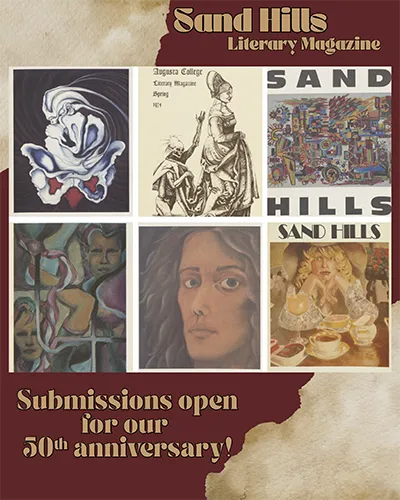
Sand Hills, Augusta University's premiere literary magazine, is committed to publishing the highest quality of creative writing and visual art in print every Spring. Housed in the heart of the American south, Sand Hills has been keeping the written word and independent voices alive since 1973.
Sand Hills brings together new and established voices from diverse backgrounds. We are looking for works that celebrate different perspectives, we want writers to submit their truths, their fictions — to share their humanity.
We seek to publish the best drama, poetry, prose (creative nonfiction and fiction), and visual art created by individuals currently residing in the U.S. All general submissions are read blind by the Sand Hills staff.
While we do accept simultaneous submissions, we do not accept previously published work (including self-published material in print or online at personal blogs, social media, or websites). Visual art may be accepted even if they are posted on personal social media or websites. If your work is accepted elsewhere, please withdraw your work from Sand Hills as soon as possible. Failure to adhere to the guidelines may result in disqualification. For questions about the magazine, email:
sandhillslitmagau@gmail.com
Submit your work here.
Deadline: March 8, 2026
Submission Fee for Those Outside the University: $3.00
Submission Dates: The submission window will open January 1 and close March 5.
Issue theme: Change
Editors of Speckled Trout Review welcome submissions of unpublished poetry (nothing previously published in an electronic publication of any kind or print) for its winter issue (Winter 2026). Poets can paste up to 4 poems, followed by a 50-75 word writer’s biography at the end, in the body of an e-mail to:
speckledtroutreview@hotmail.com
Simultaneous submissions are fine, but please share the good news when a poem finds a home elsewhere. For any questions about submissions or Speckled Trout Review, reach out to us at the above e-mail address.
For contributors whose work appears in either a summer or a winter issue, we ask poets to acknowledge Speckled Trout Review as the original publisher of the poem(s) in any subsequent publication thereafter.
THE MEDUSA ISSUE (SPRING 2026)
DEADLINE: March 09, 2026
SUBMISSION GUIDELINES
Your work should be formatted as follows:
Writing: Single document with work and author biography attached. Please no PDFs!
Photography: Upload your images with a title and short description of your photography narrative.
Poetry submissions are limited to a maximum of five per quarter.
Fiction and non-fiction stories should range from a minimum of 500 words to a maximum of 2500 words. Each submitter may send no more than two stories per quarter.
Photography narratives may include a maximum of 10 photos per quarter.
Work that has been previously published will not be accepted. However, this exclusion does not apply to your own personal social media pages.
We welcome submissions across multiple categories, acknowledging and honoring your enthusiasm for exploring diverse mediums.
Submissions may be submitted year-round, though publication will occur quarterly.
The cost of a submission is $5. This small price goes toward production costs, as well as the growth of the magazine.
We currently operate on a contributing basis.
We do accept simultaneous submissions. We simply ask you let us know if your work is selected by another publication.
You will retain the rights to your work. We simply request that should you decide to republish a piece in the future, you include a sentence indicating its prior publication in Persephone Literary Magazine. For example: "Originally featured in the ___ edition of Persephone Literary Magazine."
If you have any questions or issues with the submission form, please feel free to email:
Thank you!
Submit your work here.

Strength in Stories Contest
FLARE is happy to announce our first contest in 2026!
Submissions OPEN Now-March 1st, 2026!
How Will This Work?
Theme: Disability as a Strength
We want pieces that show finding your voice when it comes to managing mental health, disabilities, and chronic illnesses. So often, a disability, a chronic illness, and/or a mental health condition is seen as a stigma or a weakness. But we didn’t have a choice–we were dealt a bad hand. So, this is your chance to find your voice and showcase how being disabled has made you (or a character, if fiction) stronger. What are your badges of honor, your battle scars? What does your “fight” look like?
Pieces must use this theme for the contest. This is only a writing contest, so no art for this contest. This contest is open WORLDWIDE.
*Please note that the FLARE team consists of ONE person.
The Nitty Gritty Details
This contest is COMPLETELY FREE to enter, but please only ONE piece (this includes poetry) per person. Winners get paid via PayPal or Venmo.
1st Place Winner: $140 + online publication (Update 2/7/26: we increased the prize money $15 due to donations received – original was $125.)
2nd Place Winner: $80 + online publication (Update 2/7/26: we increased the prize money $5 due to donations received – original was $75)
3rd Place Winner: $55 + online publication (Update 2/7/26: we increased the prize money $5 due to donations received – original was $50)
3 Runners Up: $15 each + online publication (Update 2/5/26: we received some donations, so we can pay runners up a little now! This number might increase if we get more donations!)
Update 2/5/26: There will be a longlist! These writers won’t receive publication or prize money, but they can list the accomplishment on socials, websites, writing bios, and for street cred! Think of this as an honorable mention!
Please number the pages and REMOVE ANY IDENTIFYING INFORMATION IN THE DOCUMENT INCLUDING THE TITLE OF THE DOCUMENT. ANY INCLUDED WILL RESULT IN DISQUALIFICATION. We plan to read these blindly to ensure fairness.
Response Time for Contests
Since we are open for longer periods of time, we will likely not be responding to entries within 24 hours like for regular issue subs, but it is possible to hear back within 24 hours for a rejection (it depends on where we are in submission reading). We try to manage the workload as subs come in because this is one-person show (one editor, no readers or other editors).
The winners will be announced shortly after the contest ends. We’ll give an update as we receive entries and/or after the contest closes.
Extra Important Info!
In 2025, we raised about $250 between our GoFundMe and Redbubble store, which is amazing! If anyone cares to donate to our GoFundMe from last year and/or buy something through our Redbubble store during the open call, we’ll increase the monetary prize for winners! But of course, this is only OPTIONAL and as already said, this contest is absolutely free to enter. The 2025 GoFundMe can be found here!
To continue having contests, we’re opening a GoFundMe page for 2026, and any donations will be for future contests in 2026 or 2027 and beyond! To donate to the 2026 GoFundMe, you can donate here!
Since this is a contest, there will be no feedback option for this, like regular submissions have the option.
Please only submit unpublished pieces for contests.
Accepted Genres for This Contest
ONLY Microsoft Word and/or PDFs are allowed.
Please double-space prose submissions!
Please use content warnings ahead of your submission.
Simultaneous submissions are okay, but like with general subs, please let us know immediately when it’s accepted and promptly withdraw your submission.
When submitting, please put the title of your sub and its genre (poetry, short story, etc.) in the subject line of the email. Also, please write CONTEST in the subject line as well, so we can differentiate between contest subs and general submissions when we open in February!
In the body of the email, please include a short 3rd-person bio with pronouns, any website links, and any social media links/handles (including which social media platform each handle belongs to). You’ll also include your name in here too, but just not in the piece itself.
Send your submission to:
flaremagazinesubmissions@gmail.com

Co-founded in 2007, Mascara is a journal which focuses on the work of First Nations, CaLD, disabled and neurodivergent writers, as well as human rights and experimentation. We specialise in publishing platforms for minorities, focusing on cultural cohesion and participation. We foster a space for critical research to bridge the gaps left by institutions; a space for writers, readers and researchers that is progressive and vibrant. We are interested in shaping the way that discourse structures social realities and positions individuals hierarchically.
Submit
Submissions will open from 5 February 2026 to 2 March 2026 in all categories.
Submission Guidelines
We only consider previously unpublished work, ie first serial rights, electronic and print. Simultaneous submissions are acceptable as long as we are notified immediately if your work is accepted elsewhere.
Email your submission to:
submissions@mascarareview.com
***Note: Please only submit once until you have heard back from us. (See response times below.)
Response Times
We are a very small team whose editors work on a voluntary basis. Our response time is 3-6 months. Please do not query the status of your submission before 3 months. We thank you for your patience and understanding.
Payment
Poems $100
Fiction and essays $200
Reviews $200
First Nations & CaLD critics $500
Tasmanian critics $400
Please note: We are not currently funded to pay international contributors.
Intern Opportunity
Thanks to a grant from the Copyright Agency, we are currently offering two opportunities for emerging or established First Nations and CaLD editors to write and acquit a grant and be paid $5000. Applications close 27th February 2026.
Head over to our Support page for details.
We publish fiction and poetry.
We pay $25 per accepted piece.
We have no affiliation with this magazine that existed until 2000, but it looks rad and was founded the year I (Ryan) was born.
Hanna Shea edits poetry. “I want to read poems that make space for incompatibility, disunion, chaos. Also poems about the rocks and clouds near your home.”
Ryan Shea edits fiction. “I want to publish work that gives a shit, that is not afraid to move, that is paying attention, but to something else. I’m excited about experimental, transgressive horror, speculative fiction that is not twee, and literary stories that run for the cliff’s edge.”
Submissions
Submissions are open
Email submissions to:
coverlitmag@gmail.com
Include the title(s) and your name in the subject line.
Add the work as an attachment (doc, pdf, whatever makes sense).
We’ll ask for a short bio on acceptance.
Please submit with the knowledge that we will likely have edits.
We accept the following types of submissions: Fiction: short stories from anywhere in the world. See the Fiction category for some examples.
Stories from the City: non-fiction pieces that are set in and around the Greater Toronto Area. See the Stories from the City category for some examples.
Who do we publish?
We are firm believers in the idea that the writing should speak for itself. It’s irrelevant to us whether you’re a new writer or an established writer. All submissions to Toronto Journal are anonymous.
Compensation
We pay $50 per piece. All published writers will also receive a printed copy of the issue in which they appear.
Submission Guidelines
We are currently accepting submissions for our Summer 2026 issue. Deadline: 1 March 2026 at 11:59 PM EST.
Submit your work here.
The Tom Grass Spirit of Adventure Literary Prize celebrates the spirit of our friend Tom Grass - a multi-talented writer, avid reader, and fearless traveller.
Open to emerging writers aged 25+, the prize welcomes short pieces of stand-alone prose in either Fiction or Non-Fiction (1,500 - 3,000 words). It can be adapted from a longer work but must be satisfying to read by itself.
The prize invites writers from all walks of life, whether writing a short story, essay, memoir, piece of reportage, historical investigation, or other hybrid form, as long as the writer reflects the sensibility of the prize.
The prize is not aimed at the action-adventure genre nor limited to the idea of physical adventure. We invite writers to grapple with the spirit of adventure in any way they interpret. Pieces will be read and judged on their literary merit and their engagement with the general reader.
The Prize is a not-for-profit foundation, created and run by friends and family of Tom Grass.
Open to emerging writers over the age of 25, the Prize celebrates creative storytelling with a focus on the spirit of adventure. Through readings and an annual award ceremony in London, we will come together to celebrate life’s bold journeys and the stories they inspire.
The Tom Grass Prize is open to all writers from all over the world who are over the age of 25 and writing in the English language.
Entrants must not be represented by a Literary Agent and must not have any previous or new book under contract with a mainstream publisher for the duration of the prize.
The word count is between 1,500 and 3,000 words.
The entry can be either fiction or non-fiction and must be a stand-alone piece of prose.
Entrants are invited to reflect the spirit of adventure in subject matter and/or style in whichever way and in however broad a sense the writer interprets this.
Entry Fee: Free before Feb. 28; 15 pounds March 1-31, 2026
Prizes
1st prize: £1,000
Two runners-up prizes: £500 each
All three finalists will be offered a meeting with a Literary Agent.
Final entry closes: 31 March 2026
More information and submission link here.
Anyone may submit writing to the Willow Review for consideration.
We invite your submissions year-round. You may send a maximum of five poems or short fiction and creative non-fiction of up to 7,000 words. As part of our mission, we also publish reviews of books written by Midwestern writers or published by Midwestern presses.
Include a cover letter with your submission and indicate how many manuscripts you enclosed for consideration. Your work must be unpublished and accompanied by a self-addressed stamped envelope. Manuscripts will not be returned unless requested.
We aren’t accepting electronic submissions currently. Mail your submission to:
We will accept submissions to the Hayden’s Ferry Review Fiction & Poetry Contest between February 1-28, 2026.
There will be two prizes of $1000 each and publication in HFR (online in summer 2026 and in the fall/winter 2026 print issue) for a poem or a group of poems and a work of fiction. A runner-up in each category will receive $250 and publication. All entries are considered for publication.
This year’s fiction judge is Gina Chung, author of Sea Change and Green Frog. Our poetry judge is Sarah Ghazal Ali, author of Theophanies.
View a list of our past winners and judges here.
Submit 1-3 poems totaling up to 10 pages or a short story or novel excerpt of up to 20 pages with a contest entry fee.
You can choose between a $15 entry fee, which comes with a 1-year digital subscription or a $23 entry fee, which comes with a 1-year print subscription. For international addresses outside of the US, please select a digital subscription. Your 1-year subscription will begin with our spring/summer 2026 issue. Current subscribers will receive a 1-year renewal. Writers may submit multiple entries, but each entry must include its own entry fee.
*If you have an international shipping address and are interested in a 1-year print subscription, we are happy to accommodate this with an additional shipping fee. Please get in touch before submitting and no later than February 20th to discuss details at haydensferryreview (at) gmail (dot) com.
Judges will pick the winners and runner-ups from a list of finalists chosen by HFR editors. All entries are considered for publication in the fall/winter 2026 print issue. We do not read submissions anonymously.
How to submit
Between Feb 1-28, 2026 submit your work to the appropriate genre at https://hfr.submittable.com/
Submitted work must be original work by the writer and unpublished. If your work is accepted elsewhere for publication, please withdraw your submission. If only a part of your poetry submission has been accepted elsewhere, please leave a note in Submittable.
Eligibility
Close friends, family, or former and current students of the judges should refrain from submitting. We define a "former or current student" as someone who has done a semester-length course with the judge or who the judge has served as a thesis advisor. If you attended a one- or two-week-long workshop or similar with the judge, you are still eligible.
If you were published in one of HFR's print journals or web issues in the past two years, you CAN submit to this contest. (See our "general notes on submission" for specific guidelines for our print and web issues, which may differ from contest guidelines.)
Anyone affiliated with ASU (staff, faculty, and graduate/undergraduate students) is not eligible to submit to this contest and should refrain from submitting to HFR until they have been unaffiliated from ASU for three years.
We do not accept work that was produced wholly or in part by AI.
All individuals are able to submit without regard to sex, race, national origin, religion, disability or any other characteristic protected by law.
tarry is…
an annual literary magazine of original short fiction, poetry, art and other creative works inspired by the people, history, and geography of the Tarrytowns.
At the turn of the 19th century, this area inspired Washington Irving to write some of our nation’s most enduring stories, giving a voice to Americana and forever shaping our country’s folklore.
tarry builds on that legacy to entertain, delight, and inspire—and to tell some good stories.
Thank you for your interest in submitting to tarry! The best way to know what we’re looking for is by reading our inaugural issue, which you can find at Transom Bookshop in Tarrytown and other wonderful local bookstores.
Want something a little more succinct? Ok, sure—check out our frequently asked questions. Other than the guidance there, we’d say that we love pieces that:

Fiction Guidelines
We like stories that are subtle in their telling and stick with us long after we've finished, and we're more likely to buy stories that balance a sense of wonder with a bold plot and emotional depth. For our two issues focused on the climate crisis, we're particularly interested in publishing stories from people displaced by or threatened by the climate emergency. For our other four issues, we're open to a wide variety of stories across the SFF and weird spectra.
Poetry Guidelines
We like poems that use complex fixed verse forms (think sestina, awdl gywydd, masnavi, etc) as well as free verse. Most important to us is vivid imagery, clever lyricism, and a strong emotional core. For our two issues focused on the climate crisis, we're particularly interested in publishing poems from people displaced by or threatened by the climate emergency. For our other four issues, we're open to a wide variety of poems across the SFF and weird spectra.
February: General Submissions Window
A brief note on AI/LLMs: Haven Spec Magazine is only interested in stories, poems, and art created by humans (and maybe very smart whales). Please do not use AI or LLMs to generate your fiction, poetry, or art, in part or in whole. Any submissions which are determined by our editorial team to have used AI or LLMs will be rejected.
Acolyte Submission System

Ecotone, the literary magazine dedicated to reimagining place, welcomes work from a wide range of voices. We are particularly interested in place-based work by people and from perspectives historically underrepresented in literary publishing and in place-based contexts: writers and artists who are Black, Indigenous, people of color, people with disabilities, people who are gender-nonconforming and LGBTQIA+, women, people with low access to wealth, people from rural places, and others. We welcome the work of emerging writers of all ages and walks of life. Please review our complete guidelines before submitting. We strongly encourage writers to read work we’ve published before sending their own. A selection of writing and art from recent issues is featured on our website, where you can also order a copy of the magazine or subscribe.
Spring 2026
We will open to general submissions in poetry, fiction, and nonfiction this spring, and will be reading for upcoming unthemed issues and for the Delight Issue. Given the overwhelming response to our recent reading periods, for our fee-free window we will cap submissions at 250.
Opening Feb. 2: Fee-free submissions (closes after 250 submissions)
Feb. 2–4: General window ($3 fee via Submittable)
Feb. 2–March 2: Current subscribers may submit (no fee)
Valentine’s Day 2026
Happy Valentine’s! For our annual fee-free Valentine’s Day window, we invite submissions of work we love and would like to see more of. This year we’re looking only for poetry, fiction, and nonfiction that engage directly with the climate crisis, and for work that responds to our call for the Delight Issue. Please do send us work that directly addresses these things, and don’t send anything else—if you have other work to share, wait for our next reading period. Thanks, Valentines!
If you already submitted during one of our general windows, but have additional work that fits these criteria, feel free to send one additional submission on Valentine’s Day.
This reading period is one day only: February 13.
Prose
We appreciate a wide range of essays, and are especially interested in nonfiction that engages deeply, but not overly seriously, with the sciences—ecology, natural history, and other fields, in both Western and non-Western contexts.
We like to see fiction that is deeply rooted in place, and/or that engages similarly with ecology, natural history, climate crisis, et al.
A prose submission consists of one prose piece (fiction or nonfiction) of no more than thirty double-spaced pages (approx. 10,000 words).
Most work we run is shorter than this upper limit.
We are also interested in shorter prose works (minimum 2,000 words, please).
Poetry
We are especially interested in poetry that engages with the social and natural sciences and/or considers place, ecology, identity, and climate crisis, as well as poetry that uses form, meter, and/or other poetic constraints in innovative and expansive ways. Work in the French repeating forms (rondeaux, ballades, rondelets, and the like) as well as in newer forms (golden shovels, fibs, etc.) is especially encouraged, as is work that employs meters other than iambic.
A poetry submission consists of three (minimum) to five (maximum) poems.
Accepted Work
We are dedicated to supporting our contributors with a thoughtful editorial process.
We use Microsoft Word to send edits. If Word is not a good option for you, we can also work in OpenOffice or Pages.
Contributors receive an honorarium upon publication, with a $100 minimum; two copies of the issue in which their work appears; and a one-year subscription beginning with the subsequent issue.
Thanks for thinking of Ecotone! We look forward to reading your work.
More information and submission link here.

Submissions Open February 1st!
The first 100 submissions are free, after we have reached our limit there will be a $3 dollar fee to submit. This fee will be used to help us pay our authors.
Estrella House Publishing accepts work from new and established authors. Our interests are in poetry that questions and maintains a sense of beauty, narrative or not. We want fiction with an intriguing narrative or characters. Nonfiction should leave us seduced and thoughtful.
Whatever you write, bewitch us! Allow us to be absorbed in your world.
We do not, and will not, accept any works that promote any form of hatred, bigotry, or violence. Likewise, AI-generated works will not be considered nor accepted. Please do not send it in.
Format
Please only submit once per open call.
Genre
While we do not limit around genre, certain genres will have a lower chance of success. Those genres are:
Sci-Fi
Erotica
Mystery
Thriller
Technical Specifications
Please submit your manuscripts in any legible 12-point font with double-spaced paragraphs, page numbers in the footer, and 1-inch margins.
Please ensure that all written submissions are in one document.
On page 1 please include the author’s name, submission title, genre, and 75 character bio.
If you are writing in genre fiction, please make a note of that genre as well.
How to Submit
We consider submissions online via submission portal only. Snail or e-mail submissions will not be considered.
We do not consider unsolicited submissions via email.
Simultaneous Submissions
We are happy to consider manuscripts that have also been submitted elsewhere. Though, please notify us immediately if your work is accepted by another journal.
Rights
Estrella House Publishing reserves First North American Rights to any work that is published on our platform.
We do not accept any work that has been previously published in a literary or arts journal, forum/archival site, or an online blog.
Payments
We are excited to pay our authors. Estrella House utilizes a revenue share system where authors get a portion of ad revenue generated from views to their work and a portion of submission fees. Because we are a new publication, we cannot yet guarantee any flat rates.
Fees
We are submission fee free for the first 100 writers. After that, we will have a small $3.00 fee to help pay our writers.
We offer a fee waiver for people who identify as a historically marginalized group. To apply: email us with the subject line: Fee Waiver – Your Name.
Submit your work here.

Submissions are open January 18-February 17, 2026.
The fifth anthology of The Rebis will focus on The Moon (XVIII), and we are open for submissions from January 18-February 17 at 12pm PT.
As with previous issues, the work should be deeply intimate. We are looking for original writing, artwork, and any other form of creative expression that you dream up inspired by the 18th card of the Major Arcana. Send us work that is subversive, provocative, erotic, and deliciously alive.
We are interested in exploring:
The ideas shared here are simply thought-starters. We encourage you to take an imaginative, deconstructionist lens. We are looking for diversity and originality in both creative techniques, artistic formats, and concepts explored.
To submit, please fill out this form.
Writing: We are especially interested in publishing experimental and genre-bending work (creative non-fiction, short stories, flash fiction). Personal memoirs, researched articles, interviews, and poetry are all welcome, too. For full guidelines, please refer to the submissions form.
Artwork: Photography, illustrations, paintings, comics/graphic stories, digital art, and collage art are all welcome. Multimedia work that weaves print + digital into an immersive and/or interactive experience is always fun. Artwork needs to fit into our vertical magazine orientation. For full guidelines, please refer to the submissions form.
Collaborative work: We enjoy seeing work incorporating multiple collaborators—art and writing that pair together, dual bylines, an epistolary project, etc. If you are submitting as a collaborative project, please submit one time only, but include the names, bios, and links to examples of work for all people involved.
Only submit unpublished work: Please submit previously unpublished work. By "unpublished" we mean that it hasn’t appeared in any print or digital publications beyond your own social channels or website.
To submit: Please fill out this form by 12pm PT February 17, 2026. Contributor decisions will be made in February, and complete/final work will be due in mid-April.
Questions: If you have any questions about the submissions process, please email:
submissions@therebis.com
We love workshopping ideas and helping you bring your concepts to life.
AI policy: We do not accept AI-generated content or artwork.
Payment: The Rebis believes in compensating writers and artists for their work. Right now, we can afford to pay each contributor $200 for longer-form essays or short stories, and two pages of poetry or artwork. We pay $100 for pieces of flash fiction, single page poems, and one page of artwork.
Disclaimer: By submitting your work to The Rebis, you agree to grant our publication first serial rights as well as electronic archival rights. If your submission is accepted, you’ll grant The Rebis a license to use the submission on all its assets; however, you’ll retain ownership. By submitting your work, you confirm that your work is original and does not violate copyright laws. Full terms will be sent out in a Contributor Agreement.
pride microchapbook series
During the month of June 2026, fifth wheel press will publish 22 queer single-author or collaborative microchapbooks (one each weekday). These small collections will be available to download digitally for free.
First, credit where credit is due: the idea to run this series is heavily inspired by the Ghost City Press Summer Series (Kevin Bertolero), which published my first micro-collection in 2023. I also owe credit to Katherine Fallon from Whittle Micro-Press for showing me the true power a tiny collection can wield, as well as Kendall A. Bell from Maverick Duck Press and Aldrin Badiola from Artists from Maryland for implementing similar micro publishing practices.
Send us anything—any genre, any style, any subject. The only restriction is a hard page count cap of 10 pages of content (not including title page, acknowledgments, etc). Please do include acknowledgments if there is anything previously published in your collection; a ToC is not needed. Pieces in the collection may have been previously published, but please don't send us something that's been published before as a whole.
Additional specifics
Selected manuscripts will be published digitally by fifth wheel press for $0+ on Ko-fi. Any tips received will be paid to you, the author, on a biannual basis at the end of June and December.
If selected, your collection’s cover will be designed in house style for your approval. We are not able to accommodate outside cover artists at this time.
This does not come with our standard publishing contract—for simplicity’s sake, we’re treating it more like a big issue of a literary magazine than a book. Your agreement to participate in the series upon acceptance will grant us first global electronic publishing rights to all works contained in the collection (or second rights, if they’ve been published before).
No waiting period for previous fwp authors! We’d love to get some of y’all in the mix.
Shadowplay is currently OPEN to submissions.
Our reading window is from October 15th to March 15th.
How to submit your work.
We will only accept previously unpublished work—including digital/online content—submitted through email at:
Please put “Genre: FirstName LastName” as your email subject line (for example, Fiction: Elvis Presley). We aim to respond to submissions within six months.
Length and styling
There is no minimum word count, but please make sure fiction and nonfiction submissions are at 2,500 words or under. Poetry must be at or under five typed pages, with each new poem beginning on a separate page.
Keep submitted work in a single document, attached as a .doc or .docx. Do not copy and paste work into the body of the email and do not use .pdf unless the format requires it.
Bio

